Ad

From biodegradable glitter to ‘TicketSwap for wellness’: students pitch their innovative business ideas
Some teams came with climate change fixes, others with solutions for everyday life. At the Erasmus University Challenge, finalists proved that good ideas can bring real-world impact to urgent problems. The awards were for natural skincare products, biodegradable glitter and addressing nitrate pollution.
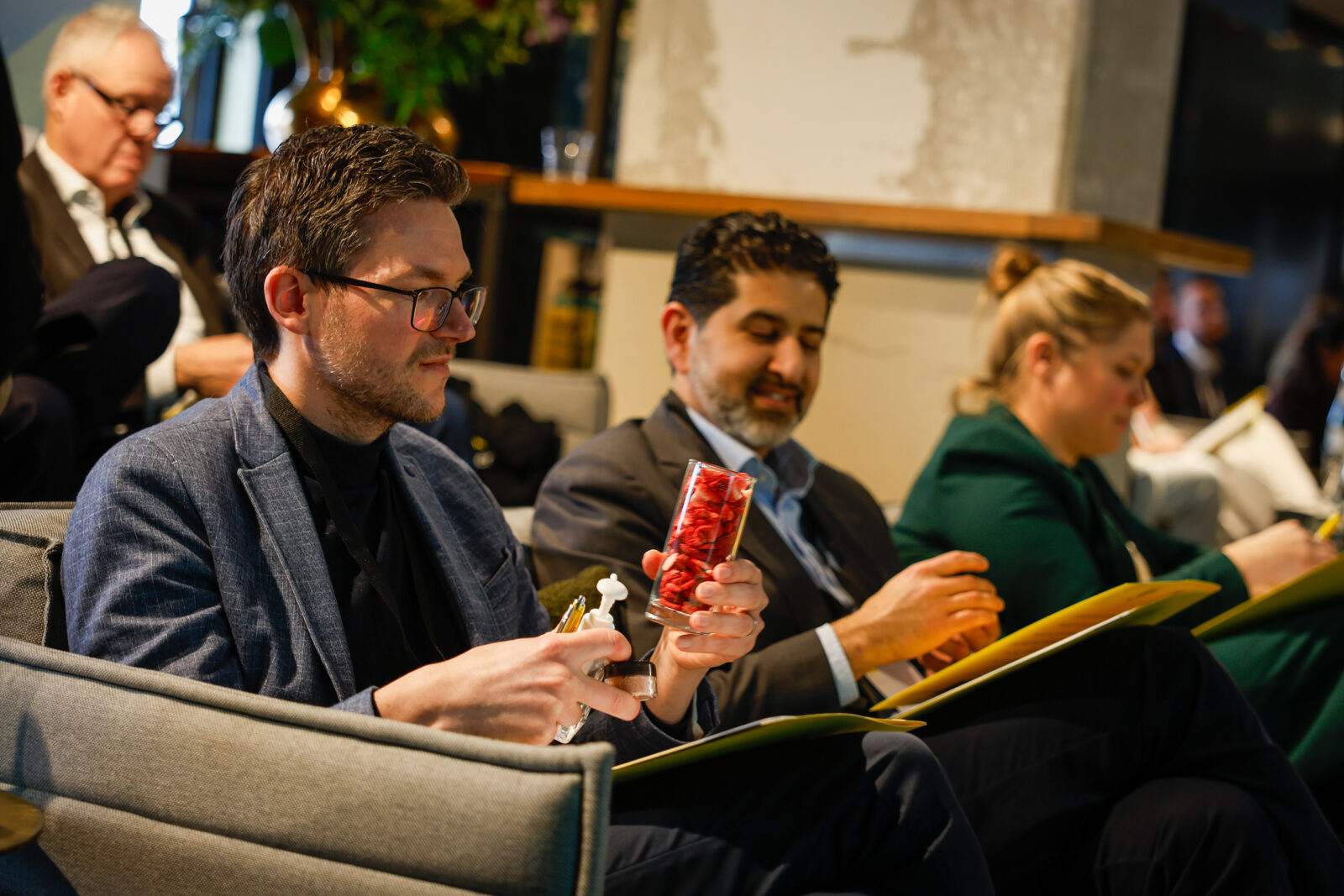
The jury assessing samples of freeze-dried strawberries.
Image by: Daan Stam
Colourful confetti cannons fired above the stage at Excelsior Stadium last Thursday, to mark the end of the grand finale of the Erasmus University Challenge. Over the course of the programme, 120 teams developed business plans, but only 11 were chosen to pitch their innovative ideas. Divided into ideation, prototype, and start-up categories, they had two minutes each to convince the jury that their project should win.
This year, environmental projects stood out the most, with teams presenting ideas on deforestation, water scarcity, and pollution. However, the grand finale also made room for no less important daily problems, from DIY skincare products to platforms that tackle last-minute cancellations.
The Erasmus University Challenge is a competition organized by Erasmus University and Erasmus Enterprise, in which students develop their ideas through workshops and mentorship before pitching them at the grand finale. The contest awards thirteen prizes, from financial support to consultancy sessions.
Personal interest in environmental issues
Almost all environmental solutions began with a personal moment. For Leaf.it, the team behind a device that keeps trees hydrated, it started with a phone call that they refer to as a ‘funny story’. “One of our co-founders was on the phone with a German founder one time”, said second-year International Business Administration student Albertine Mangan. She explained that despite him going to the field every day to water the trees, the founder still lost 90 per cent of his seedlings that year. The call pushed them to look deeper and to realise that when trees die, people start turning away from reforestation.
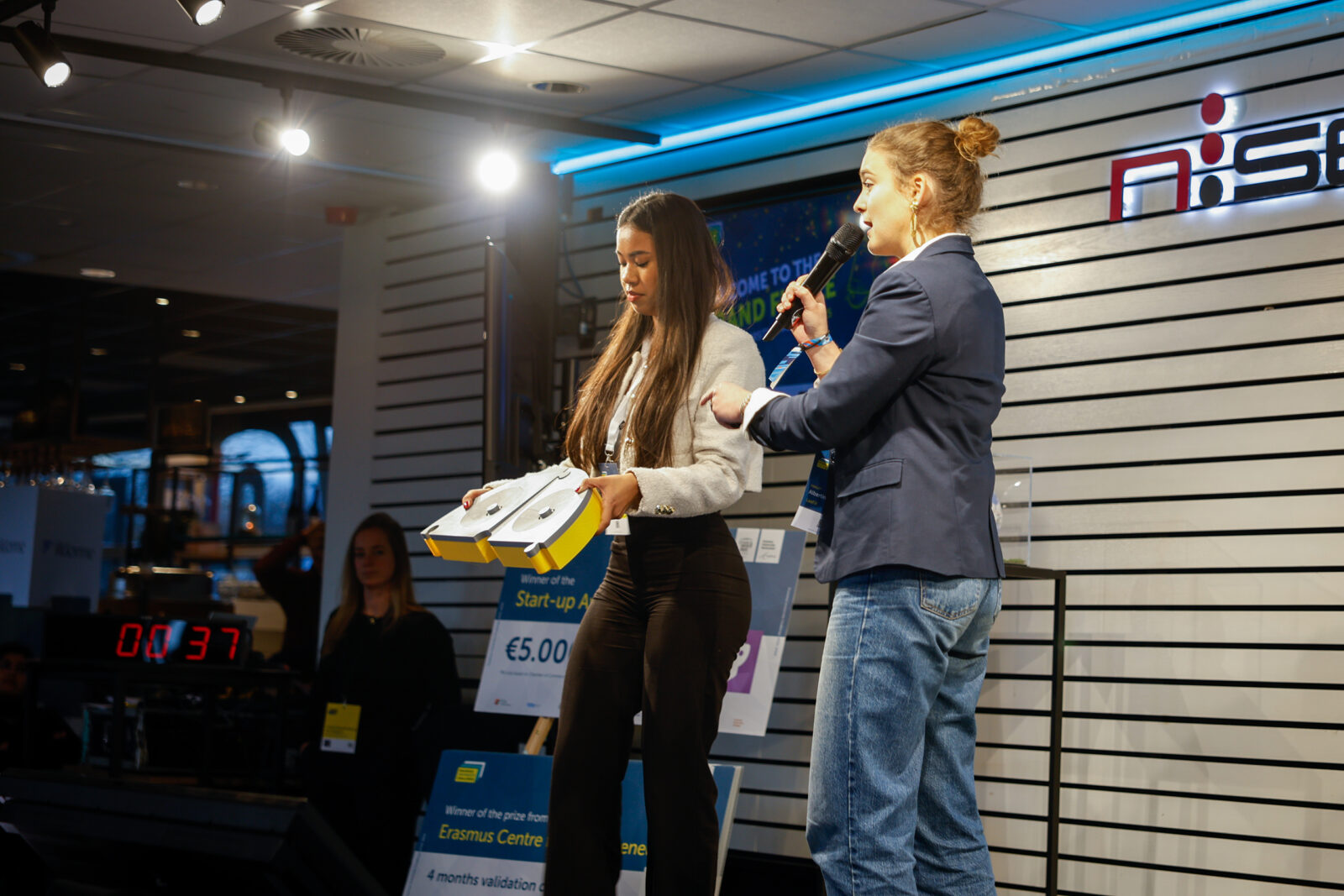
Leaf.it members Alysa de Haas and Albertine Mangan presenting their prototype.
Image by: Daan Stam
Their solution is a compact disc that wraps around the base of a tree. Holding their grey-and-yellow prototype, Albertine pointed to the two holes. One compartment releases water into the soil, while another one protects seedlings from wildlife damage. “There’s an odour”, Albertine added, “and that smell scares away the animals.” The prototype they brought to the finale was still a demonstration, with the wick system still in development and pilots running in Portugal. For now, Leaf.it is producing the discs in-house and speaking with suppliers. “And of course it’s a dream to sell more”, said team member Alysa de Haas.
Right next to the Leaf.it team in the room, Algaenuis approached the environmental issue from a water scarcity angle. Founder and Business Administration student Meinke van Oenen traced the idea back to high school biology. “I was 17 and very passionate about water. The problem is that we’re running out of it”, she said, and started looking for ‘a species or a plant that can desalinate’. Years later, the team of three has been testing how well algae in small beads can desalt seawater to make drinking water more sustainable and cheaper. They did not come up with the beads immediately. “We tried to work with an algae wheel. It was a very big rotor with algae on it that you push through water”, Meinke explained. However, they realised that it was not efficient enough.
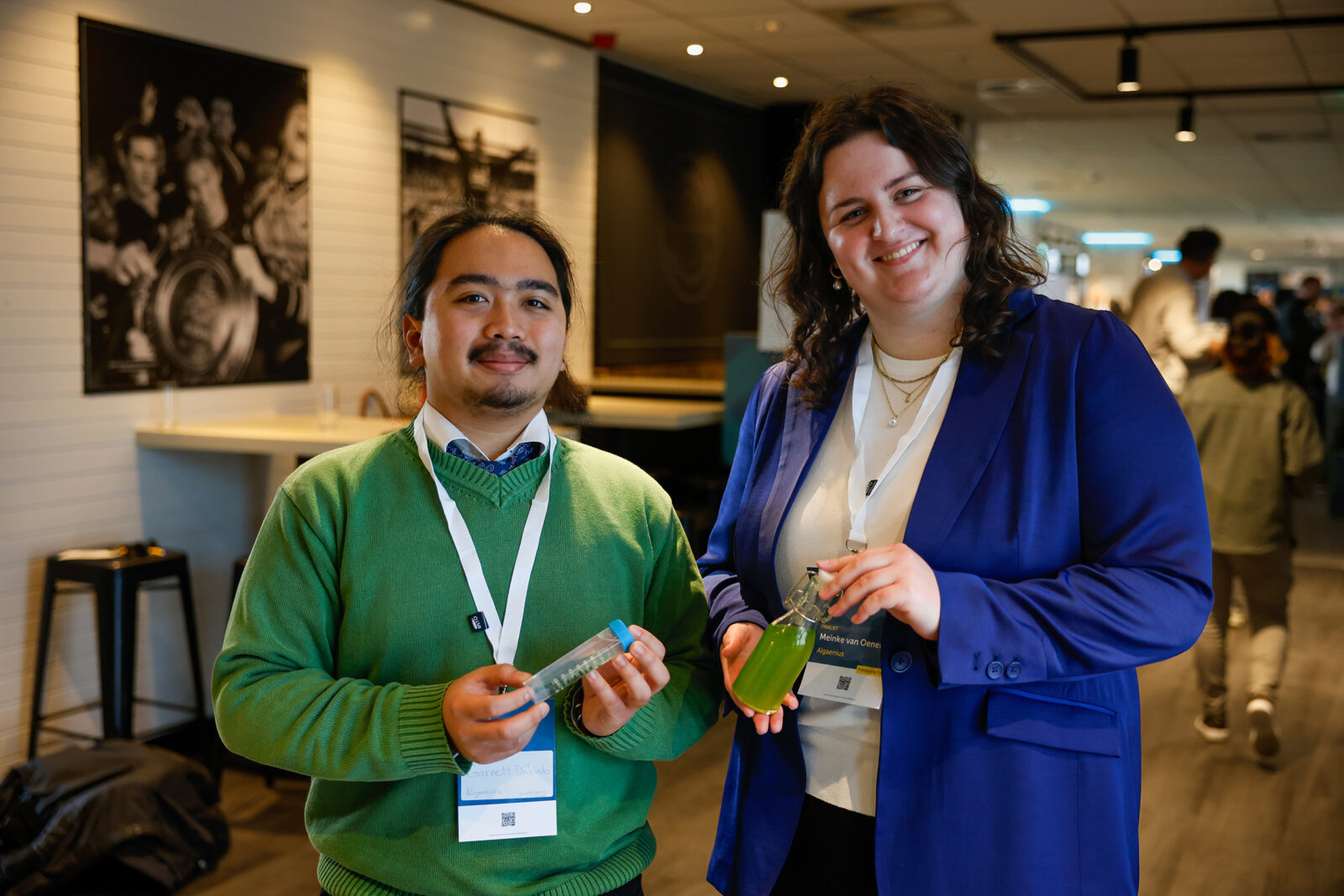
Algaenuis team members Garrett Dublado and Meinke van Oenen with their prototype.
Image by: Daan Stam
Two other teams focused on water pollution in different forms. SeaSpark pitched biodegradable glitter made from seaweed as a replacement for plastic-based glitter due to European Commission restrictions. SolPhyX, meanwhile, focused on nitrate-cleaning technology, removing nitrate from water and soil via powder and reusing it as a slow-release fertiliser. By the end of the event, those two projects left with prizes: SeaSpark won the 4000 euros prototyping award, with Algaenuis as runner-up. SolPhyX took the 5000 euros start-up award, ahead of FlexWheels, a student-friendly bike subscription, which later secured the 1000 euros audience award.
A new take on skincare cosmetics
Not every pitch was about ecosystems. Uosis made that clear by handing the jury samples of freeze-dried strawberries. Founded by first-year IBA students Gabrielė Kapačinskaitė, Nao Yoshimoto, and Fatima Nouman, pitched ‘100 per cent natural skincare’ made from freeze-dried fruits, herbs, and vegetables. Instead of selling liquid serums that often contain preservatives and other chemicals, the young entrepreneurs remove water and turn ingredients into powder.
The product is designed to be mixed at home. “For example, for a vitamin C serum, you could freeze-dry oranges and mix it with aloe vera, then put it on your skin, and it’s 100 per cent natural”, said Nao. According to her, aloe vera can last two years compared to homemade masks that can be used for ‘two or three days’.
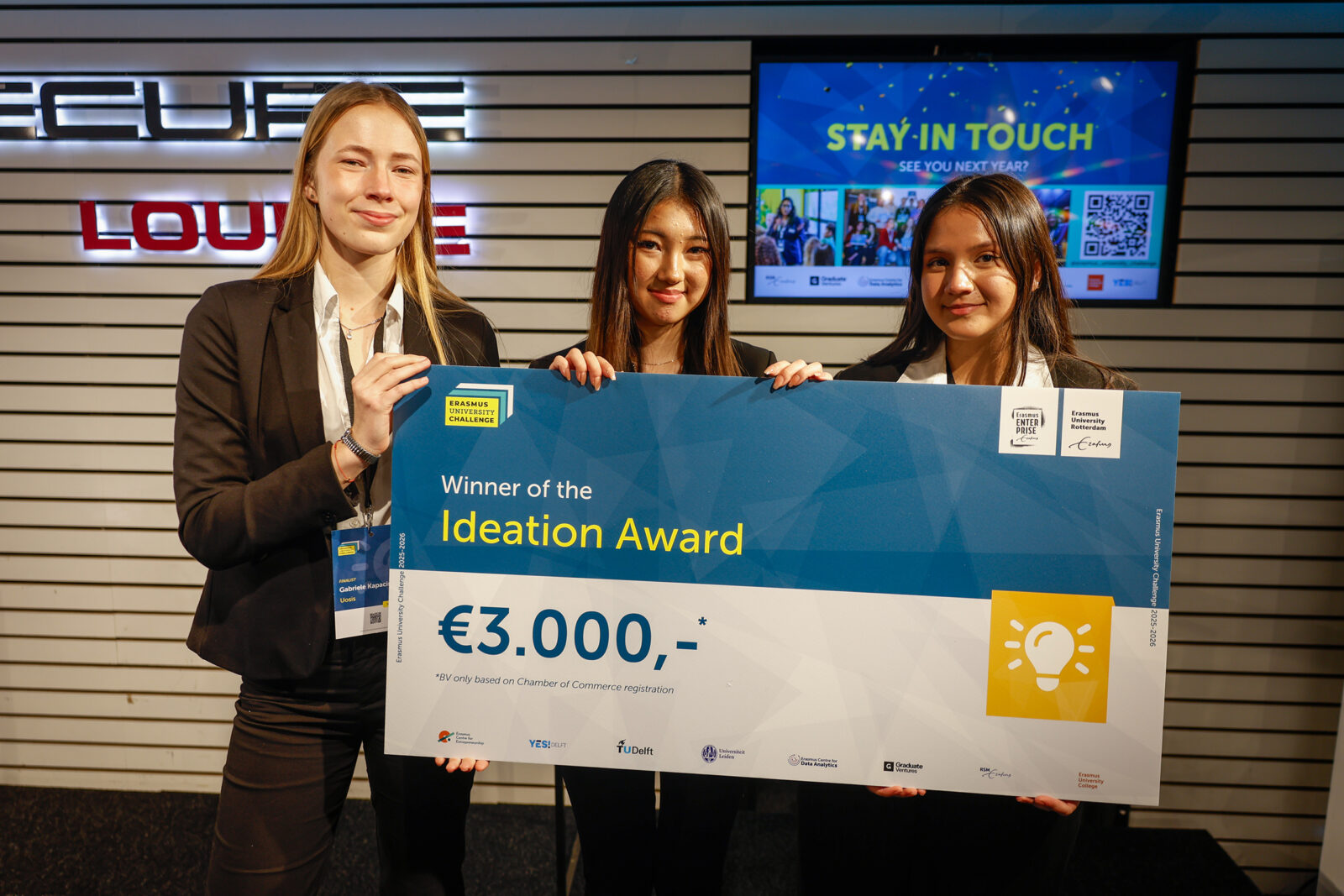
Gabrielė Kapačinskaitė, Nao Yoshimoto, and Fatima Nouman from the Uosis team after winning the award.
Image by: Daan Stam
Having won the ideation award worth of 3000 euros, the team’s next step is to become independent in production. Until now, they were buying freeze-dried powders on Amazon, which Nao said ‘increased ingredient costs’. With the prize money, they plan to buy a smaller freeze-drying machine to test prototypes faster.
Filling last-minute slot
For some teams, the problem was not global, but ordinary. Neeru Gogia, co-founder of SpotsBooking, said the concept ‘clicked’ after a salon appointment she tried to cancel 24 hours in advance. “The owner really shouted at me, and I was angry”, she recalled. Only later did she realise that a last-minute cancellation leads to lost revenue. SpotsBooking is her attempt to help businesses fill empty slots instead of losing them, ‘like TicketSwap, but for wellness’, Neeru explained.
Now, the team is looking for investment, planning to expand to the United Kingdom within two months, and exploring partnerships with freelancers.
Read more
-
Master’s student Mihai Tulbure bought a large van and now runs his own moving company
Gepubliceerd op:-
Student life
-
Comments
Comments are closed.
Ad
Read more in Entrepreneurship
-
Student start-up OASYS NOW wins big money in Berlin
Gepubliceerd op:-
Entrepreneurship
-
-
Ethical DNA database and CO2 calculation software among the prizewinners at Erasmus University Challenge
Gepubliceerd op:-
Entrepreneurship
-
-
Electric aircraft and haptic gloves at tech fair in Q-building
Gepubliceerd op:-
Entrepreneurship
-