Ad

Friso swaps Kralingen’s pavements and ‘student nuisance’ for national politics

Alumnus Friso van Gruijthuijsen is leaving the district council of Kralingen after four years. The former econometrics student is trading his local seat for the chair of the JOVD, the youth organisation of the national VVD party. On a crisp autumn morning he looks back on his time in the neighbourhood and talks about what comes next.
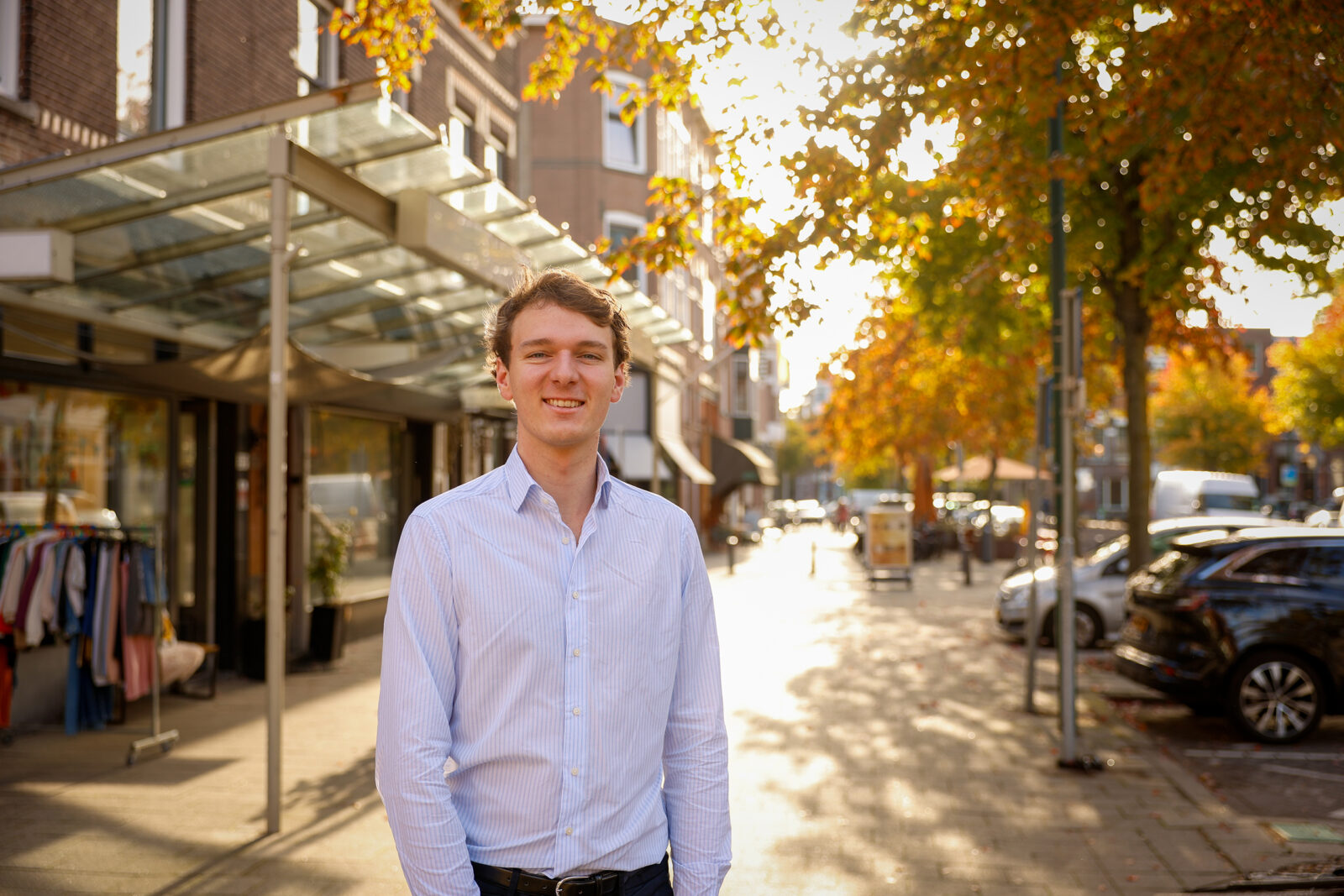
Friso van Gruijthuijsen has been a member of the Kralingen district council for four years.
Image by: Daan Stam
It is 9.30 when Friso arrives at the war memorial on the Oostzeedijk Beneden, at the junction with the Hoflaan, next to the Sint-Lambertuskerk in Kralingen. The monument is small, almost unremarkable: a white cross with the inscription ‘For those who fell’, with the Dutch lion on the base.
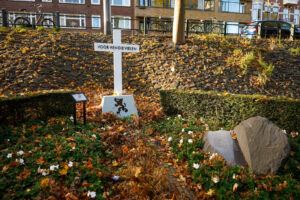
For years, Friso cycled past this monument without knowing what it really was.
Image by: Daan Stam
A few cyclists rush past. Friso remembers how for years he cycled past the memorial without knowing what it was. “Only when I became a district councillor did I find out that twenty people were executed here by the Germans”, he says. He points to the stone next to the cross on which the names of the twenty Rotterdammers are engraved.
Last May he stood here as host of the local 4 May commemorations. The ceremony was organised by residents and student association RSC/RVSV, and drew more than six hundred participants. Friso calls that one of the most beautiful moments in the neighbourhood. “Kralingen is quite a strange neighbourhood. Many people think only well-off residents live here, but you have all kinds of people: from social tenants to students. That they come together to organise and mark Remembrance Day is remarkable”, he says.
‘Students are certainly willing to contribute, as long as they are not labelled the cause’
Student nuisance vs residential nuisance
He walks towards the Lusthofstraat. The sun shines gently and the smell of fresh pastry from a bakery drifts on the breeze. The terraces are opening and local residents collect their shopping from the supermarket around the corner. The street looks convivial, Friso says, but the idea to stand for the neighbourhood council arose precisely because of the problems in this street.
In the side streets off the Lusthofstraat, there are many student houses and during the coronavirus pandemic, four years ago, there was enormous tension between students and residents. “Students were at home, the associations were closed. You really couldn’t go outside, so people held house parties. Literally on the other side of the wall there were residents who had had their children at home for months and had to keep everything running. That tension built up, month after month. At a certain point the pressure reached boiling point”, Friso says.
It was a big issue in the neighbourhood. “I thought: maybe as a student I can bring the student perspective. I knew exactly what they were going through, because I lived in a room like that myself”, he says.
Once elected, he set himself firmly to the problem. “One of the things I reacted strongly to was the term ‘student nuisance’”, he says. “If we want a solution, we must change the language. As long as you call it student nuisance it sounds as if students are the problem. Call it residential nuisance, and you change the mindset of everyone who wants to help find a solution. Students are certainly willing to contribute, as long as they are not labelled the cause.”
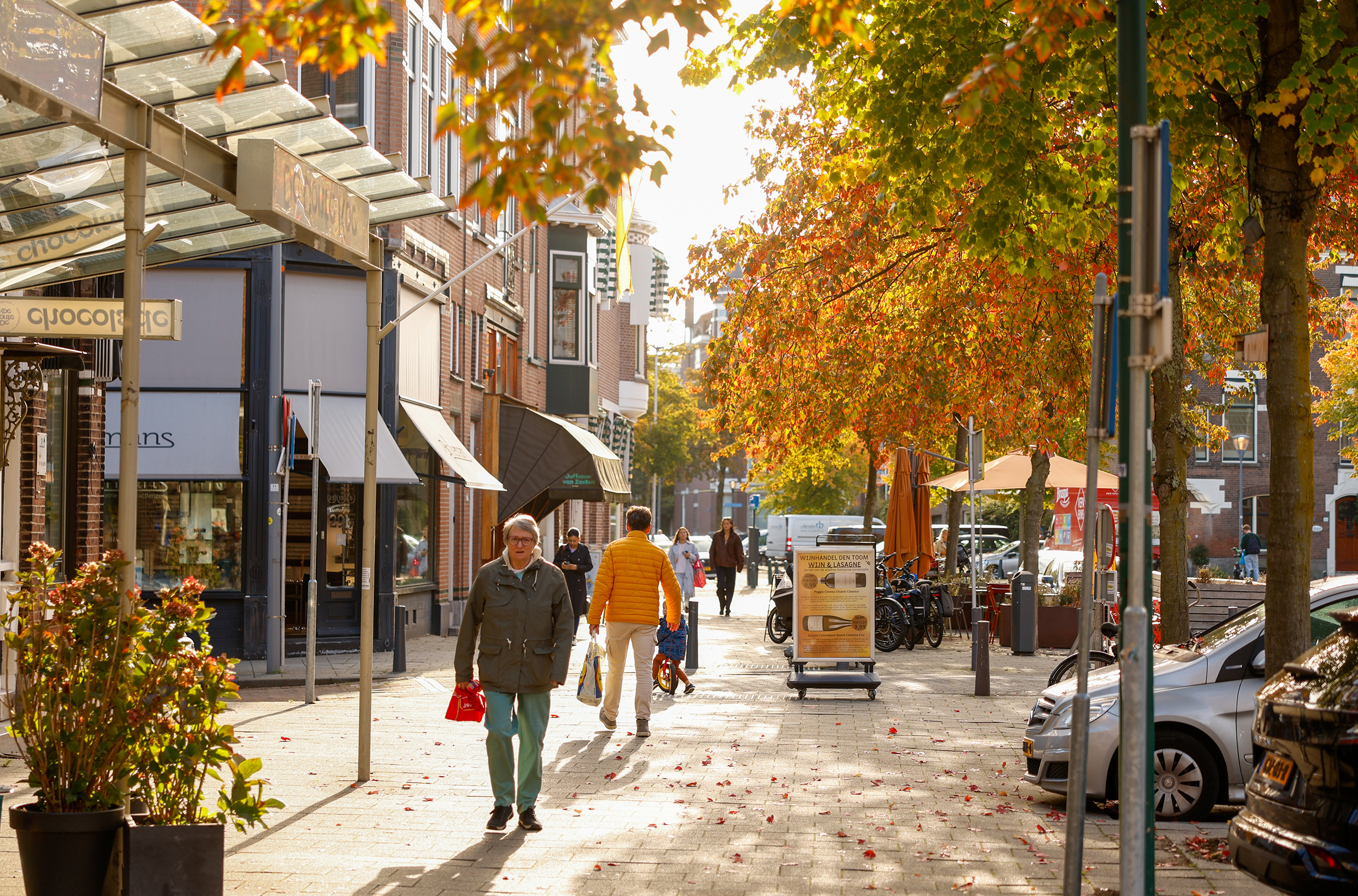
The Lusthofstraat, where the idea to stand for the neighbourhood council arose.
Image by: Daan Stam
Concreet
What he likes about the district council is that the work is concrete. “Sometimes it’s about pavements and planters, but it’s also about how your neighbourhood feels and looks. You facilitate the conversation between residents, students and the municipality. Whether it’s about exercise equipment in the Kralingse Bos or about residential nuisance: they are all issues where you can really make a difference.”
He held many discussions to tackle residential nuisance. “We have kept close contact with student associations Laurentius and RSC/RVSV”, he says. “Every now and then there is a large student roundtable where police, enforcement, residents and associations come together to discuss all kinds of things, from the logistics around the Eurekaweek to nuisance reports.”
How is the neighbourhood doing now? “There are still houses where clashes happen between residents and students”, he says. “But on the whole it’s really much better. You can see it in the figures: the number of nuisance reports has fallen.” In January 2022 there were 148 student houses causing nuisance, but this year the number had fallen to 43.
‘Freedom means you can develop and lead a free life, but also that you take responsibility for what you do and sometimes stand up for those who cannot do so themselves’
Reservist
The walk ends on the terrace of Il Capo, an Italian trattoria on the Lusthofstraat. The restaurant has just opened, the chairs are set out, and the espresso machine hisses inside. Friso drapes his coat over the chair and orders a cappuccino. He waves to an acquaintance inside: someone he knows from the district council.
Alongside his work as a district councillor and his studies in Econometrics, Friso is a reservist with Ministry of Defence. He has worked on various projects, from the procurement of field hospitals to Arctic exercises with marines. He is currently involved in a new programme in which civilians are trained to be reservists in ten weeks.
It is no surprise he has little free time with such a full agenda. “That is indeed a downside”, he laughs. “But if I have time off, I go travelling or I do analogue photography and reading. And I still like going out. In that respect I’m just as much of a student as the rest.”
National politics
After the district council Friso is now turning to national politics. Since September he has been chair of the JOVD, the youth organisation of the VVD. Why that party? “I am a true liberal. I believe the government cannot solve every problem. Freedom means you can develop and lead a free life, but also that you take responsibility for what you do and sometimes stand up for those who cannot do so themselves.”
Still, he is critical of his mother party. “Some measures were taken too quickly”, he says. “The slow-progress penalty was the clearest example. As the JOVD we put forward a motion at the party congress to abolish it. We lobbied hard, and a week and a half later the penalty was off the table within the party. That was a nice success.”
‘We must return to our liberal core: freedom, tolerance and responsibility’
In 25 years
Friso also has views on the populist tendencies within the VVD. “The party sometimes tries too hard to win right-wing voters instead of telling its own story”, he believes. “I think we should return to the question: why does the party exist? We must return to our liberal core: freedom, tolerance and responsibility.”
He has many plans for the organisation under his chairmanship, he says. “Our real role is to work on the Netherlands of 25 years from now. Everything we do – training, programmes, debates – is aimed at the long term. We want to train young people who will contribute throughout their lives to a free and resilient Netherlands.”
Does he see himself in 25 years in The Hague as Mark Rutte’s successor? Friso smiles. “I don’t know. I have a clearer picture of the Netherlands of the future than of myself in 25 years. I find too many things interesting. I’ll see about that later.”
Lees meer
-
Econometrics student Friso wants to make Kralingen better
Gepubliceerd op:-
Student life
-
De redactie
-
 Feba Sukmana
Editor
Latest news
-
TU Delft may not favour women in admissions to courses
Gepubliceerd op:-
Education
-
-

Hate campaigns and political pressure: KNAW wants legal protection for academic freedom
Gepubliceerd op:-
Science
-
-
Signing up for a Dutch course ‘feels like a race’, no more places available for now
Gepubliceerd op:-
Internationalisation
-

Comments
Comments are closed.
Ad
Read more in Student life
-
RSC/RVSV accused of poo stunt targeting student houses in Utrecht
Gepubliceerd op:-
Student life
-
-
Carolina could wake up ten minutes before her lectures
Gepubliceerd op:-
Housing
-
-

No joint introduction week for vocational, applied sciences and university students for now
Gepubliceerd op:-
Eurekaweek
-