Ad

You graduate more quickly if your parents are rich

In higher education your family background makes a difference. Students from poorer families have a harder time during their studies. And now they are also getting into financial difficulties more often.

It appears once again that some students are more successful than others in higher education, according to the annual Policy Measures Monitor, which Education Minister Robbert Dijkgraaf sent to the House of Representatives on Tuesday.
In the report, research agency ResearchNed outlines the many trends in higher education, to the extent that they are apparent from the figures. For example, what academic success do particular groups of students have?
Parents' income
The parents’ income plays a major role. Students still have less chance of graduating if their parents earn little money. That is certainly the case in higher professional education.
The authors of the monitor make a distinction between five different income groups. At universities of applied sciences, the distribution is considerable: there is a gap of more than 15 percentage points between the academic success of students from families with the lowest and highest incomes.
At research universities students from the poorest families tend to lag behind, but other differences are smaller than in higher professional education.
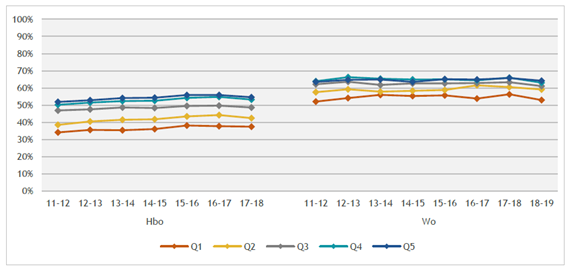
HBO students getting their bachelor's degree within 5 years and WO students getting their degree within 4 years relative to income parents.
Image by: CBS microdata
Students' Income
Additionally, students are experiencing financial problems more frequently. In the last academic year, the percentage rose from 17 to 22 percent. This particularly affects groups that were already in difficulty.
One in three students from low-income families now has financial problems. The same applies to students from families without a highly-educated parent. Those groups will of course overlap.
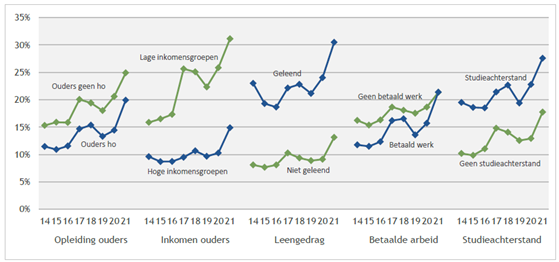
The relationship between perceived financial difficulties and five different circumstances in which students find themselves.
Image by: Student Monitor 2014-2021
The financial problems can have an effect on a student’s academic career. Students from poorer families tend to lag behind, even though the monitor says they spend more time on their studies. They drop out earlier and are also more likely to switch study programme.
Men and women
The difference between men and women also catches the eye, as always. In higher professional education around 40 percent of the men get their Bachelor’s degree within five years (i.e. with a delay of no more than one year) as opposed to 60 percent of the women.
In the three-year Bachelor’s programmes more than 80 percent of the women graduate within four years. The figure for their male counterparts remains just below 70 percent.
Dijkgraaf
Minister Dijkgraaf remains silent on the results of the monitor because a major review of the system is on its way, to which he will respond after the summer. He will then readdress the issues raised by this monitor.
The basic student grant makes its return in September. And in the next academic year students living away from home will get 164 euros extra in basic student grant because of the high inflation. There will also be a one-off energy allowance of 400 euros for students living away from home who have a supplementary grant.
De redactie
Latest news
-

After Covid, students are once again more likely to go abroad for part of their studies
Gepubliceerd op:-
Internationalisation
-
-

EM TV newsflash: Shorter waiting time for medical interns, lively trade in graduation tickets and purchasing power increase
Gepubliceerd op:Article type: Video-
EM TV
-
-

In memoriam Rob van der Wal
Gepubliceerd op:-
In memoriam
-


Comments
Comments are closed.
Ad
Read more in Money
-

Budget Day: Students’ purchasing power barely changes
Gepubliceerd op:-
Money
-
Politics
-
-

More than 1,500 euros extra in tuition fees for non-European students: U-council wants to limit increases
Gepubliceerd op:-
Internationalisation
-
Money
-