Ad

Minister believes temporary contracts impact academic freedom
The increase in temporary contracts in science is causing a deterioration of academic freedom, Minister Dijkgraaf said in a debate with the House of Representatives on Tuesday evening. Partly for this reason, he wants more permanent jobs.
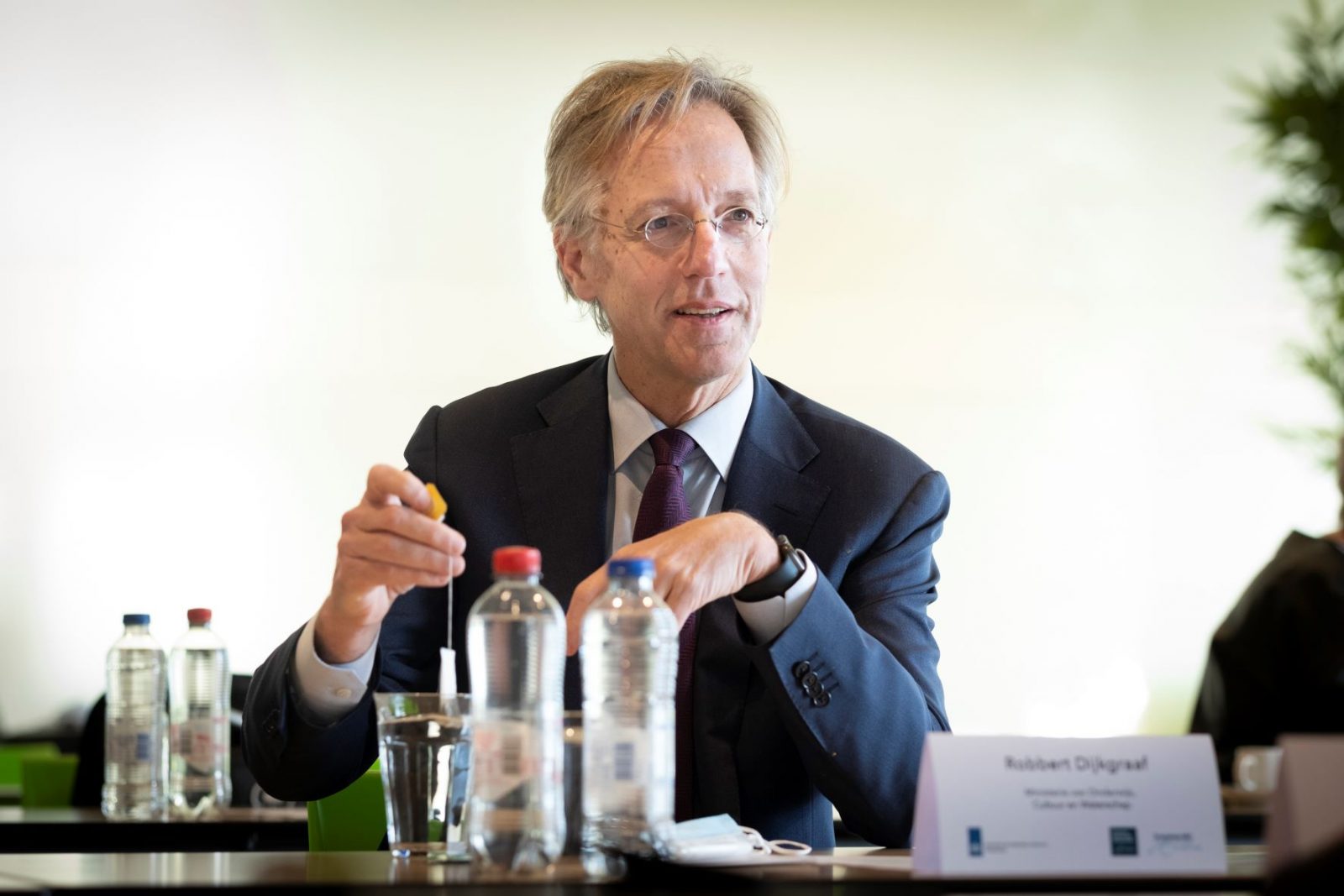
Minister of Education Robbert Dijkgraaf
Image by: Levien Willemse
In an hours-long debate on Tuesday evening, Lower House members and Minister Robbert Dijkgraaf discussed science policy, and in particular academic freedom and knowledge security.
Dijkgraaf did not want to make the problems bigger than they are. “I don’t feel it will come to that in the Netherlands, if I may put it like that”, he said. That might sound a bit facetious, but perhaps I see greater evils in the rest of the world.” Yet he did not want to sweep them under the carpet either.
Read more
Sponsorship
Various parties had previously broached the subject in different ways. Peter Kwint of the SP, for example, criticised the the business community’s ‘sponsorship’ of professorships and the dismissal of critical lecturers on account of an ‘impaired working relationship’.
Dijkgraaf could say little about that. The courts deal with impaired working relationships, not the minister. He did acknowledge a tension between labour law on the one hand and ‘the extent to which teachers can safely express themselves on the other’. He promised to include this in his approach to social safety in higher education.
And of course academic independence must remain guaranteed in the case of external funding; everyone agreed on that. So what about those Zuidas offices influencing the curriculum at four universities? “Reading that brought a deep frown to my face too”, the minister admitted. There will be an investigation, however, and he wants to wait for the results of that.
Read more
-
Many dozens of chairs receive funds from foundations and agencies
Gepubliceerd op:-
Science
-
Room for different opinions
Other parties, such as PVV and FvD, focused their criticism on the woke ideology at the academy, using the uproar around UvA lecturer Laurens Buijs, who opposes the idea of non-binarity, as an example. Should researchers still be allowed to share such ideas?
A study on self-censorship in science is ongoing, Dijkgraaf recalled. “This is a phenomenon that we see worldwide”, he said. “I feel we have to be alert to that. My own view is that: above all else, a university should be a place where as many different opinions can be heard as possible.” As long as the discussion is conducted according to academic rules, based on research.
As for the Buijs issue, he awaits the outcome of the University of Amsterdam’s investigation. Why, then, had he spoken out about the ‘non-binary’ label in written answers to parliamentary questions? He had done that as ‘Minister for Emancipation’, he said. “I think it is very good that discussions are held, but I must be alert to the exclusion of people. Which, incidentally, I did not say was the case in this particular case.”
Circumnavigation
He thus circumnavigated difficult issues: sometimes nuancing them, other times referring to upcoming research. Does academic freedom become an issue if you depend on external funding? Not necessarily, because at the end of the day everyone needs funding.
And all those temporary contracts, which make it difficult to speak out? Yes, Dijkgraaf would like to see more permanent contracts in academic research. “I am not saying it is the solution to all these problems, but the proliferation of all those temporary contracts has led to a deterioration of academic freedom.”
Read more
-

Minister wants more influence on internationalisation
Gepubliceerd op:-
Internationalisation
-
Racism
Similarly, the education minister sought nuance in a clash between GroenLinks and PVV over knowledge security. Lisa Westerveld of GroenLinks understood the measures, but also warned of the risk of racism. Students are considered suspicious if they come from an unsafe, non-democratic country: as if they were all sent here to share certain knowledge. How can the minister prevent whole groups from being discriminated against because a few people from that group have done something wrong?
This is not about racism, Harm Beertema of the PVV argued. “Racism is not the big danger. The biggest danger lies in the geopolitical considerations, which are very important.” He recalled the Pakistani scientist who had gathered knowledge in the Netherlands that enabled Pakistan to build an atomic bomb.
Dijkgraaf referred to the Iranian refugees and the Dutch with a Chinese background. We should indeed be careful about automatically labelling someone with a certain background as dangerous, he thought. You have to look at where the risk lies and minimise it. “With the proviso that if certain countries behave in certain ways, stricter procedures will apply.”
Motions
The House of Representatives could go some way to agreeing, but members still want to table motions to push the government’s course in the right direction. The debate will therefore continue.
De redactie
Latest news
-
Interest on student debt at highest level in 17 years
Gepubliceerd op:-
Money
-
-
Behind on repaying your student debt? DUO may soon pass the details on to your municipality
Gepubliceerd op:-
Politics
-
-
Extra funding for higher education does not keep pace with inflation
Gepubliceerd op:-
Education
-
Politics
-
Comments
Comments are closed.
Ad
Read more in Politics
-
Behind on repaying your student debt? DUO may soon pass the details on to your municipality
Gepubliceerd op:-
Politics
-
-
Extra funding for higher education does not keep pace with inflation
Gepubliceerd op:-
Education
-
Politics
-
-
Cuts to education after all? It could happen, according to secret coalition plan
Gepubliceerd op:-
Education
-
Politics
-