Ad

Dear EUR, act(ion demanded)!
Recently, our university has issued a statement to address its community following the recent worldwide uprisings against racial injustice, sparked by the brutal murder of George Floyd and many other black people. In it, the EUR claims its Erasmian values are clear: they ‘stand fundamentally behind the creation of knowledge across all barriers of race, language, culture, and background and [they] believe in shared opportunities and in challenging discrimination and exclusion wherever they may be’.
In its official statement, EUR makes a commitment to addressing societal challenges through its alliance with the wider community, referring directly to the website of the Erasmus School of Colour (ESoC). This referral was done without the input or approval of ESoC.
From the beginning, we have faced difficulties navigating within the university. We acknowledge that we were not the only association facing these barriers, but we are the ones that are named specifically in this statement.
We were surprised to notice that they now consider us part of their community, which raises expectations on our side. We expect for them to consider us a collocutor and to enable us in our further endeavours, instead of solely namedropping us in statements that we haven’t even been consulted about or have been able to approve of.
Watch Meral Dap in Erasmus TV
-
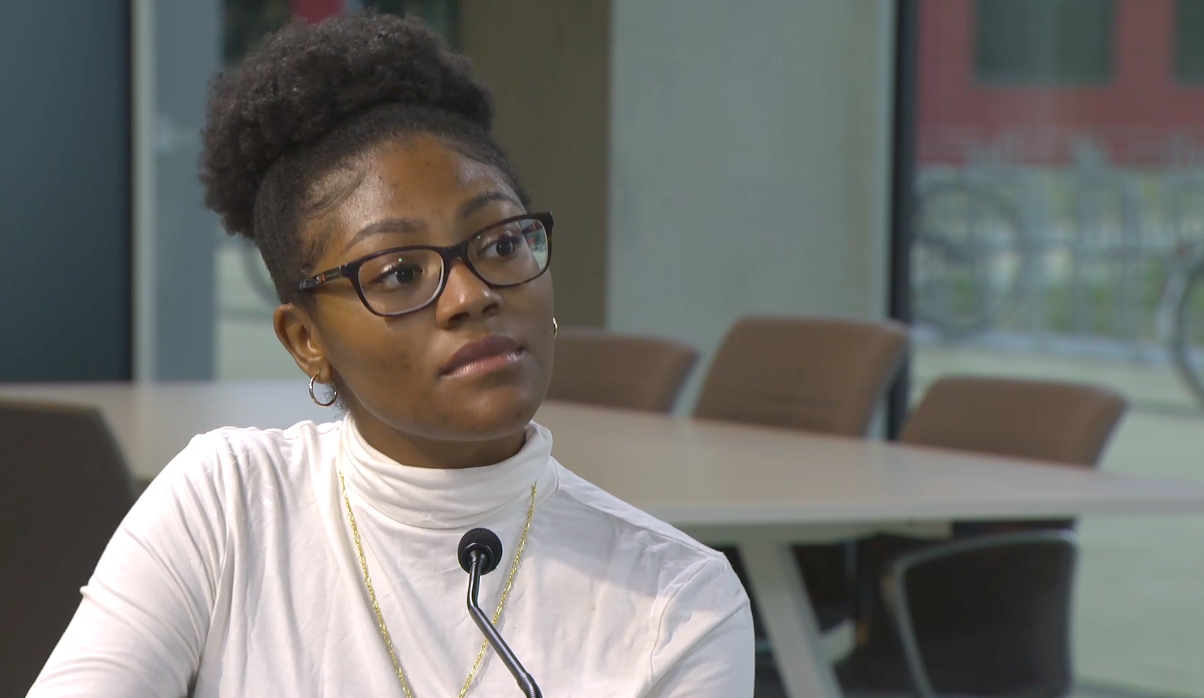
Erasmus TV: ‘University isn’t doing enough to promote inclusion and diversity’
Gepubliceerd op:-
Erasmus TV
-
In addition to that, we would like to remind the EUR that ‘wider community’ is not just us, it is the world beyond our campus, one of the most diverse cities in the Netherlands. Our board member Merel put this well on Erasmus TV: “I don’t see Rotterdam on this campus”, urging the university to work with the many grassroots organisations within the city.
It is furthermore a nice gesture to reach out to ‘the community’, and to let us know that the Erasmian values are ‘anti-racist’. However, this statement obscures two things: the fact that institutional racism also exists within the walls of the university and the non-existence of a call to action. We therefore fear that this is another situation of what renowned scholar Sara Ahmed, who recently gave a lecture at our university, calls creating evidence of doing something while in fact not a lot is being done. Because creating evidence of doing something is not the same thing as actually doing something.
‘Instead of merely being specific about being non-inclusive or saying that one values diversity, the university should take active steps in order to become diverse’
So, what could it mean for the university to take institutional racism seriously? One concrete example is found in Garfield’s and van Norden’s article: If Philosophy Won’t Diversify, Let’s Call It What It Really Is.
First, the university should make explicit their own specificity. Its Eurocentric outlook, which is often not even recognised as such (which is Eurocentric in itself), is present in all fields of academia. Garfield and van Norden advocate for renaming those philosophy departments that only focus on western philosophy and thought: if these departments are in fact not diverse, why not call them ’Department of European and American Philosophy’?. The authors hereby illustrate that being explicit about Eurocentrism decentres western thought by making visible that philosophy is more than western thought alone: that no hierarchy of ideas exists within philosophical knowledge.
Secondly, they stress that it is more important and preferable that philosophy departments make an effort to take non-western voices seriously. Extending this argument to the university would mean not merely providing this knowledge as extracurricular activities or courses, but by making these voices an integral part of curricula. Instead of merely being specific about being non-inclusive or saying that one values diversity, the university should take active steps in order to become diverse, especially in its role as educator. This also implies actively creating a safe and welcoming environment for those who want to engage with these issues.
‘If you justify these ‘no’s’ by referring to the so-called ‘pipeline’, then you are simply hiding behind privilege’
Institutional racism must be addressed in all areas of life. Many of us are taking action on a personal level, whether it is in the form of educating ourselves, amplifying black voices, donating to charities, and having uncomfortable but necessary conversations with family, friends, and others. However, as an institution, the university has a critical societal role in not merely addressing the issue, but acting on it too.
The university should ask itself: are we enabling and supporting students and employees of colour to thrive in our community? Are we continuously investing time and resources in providing a safe space and platform for marginalised groups and voices? Are we earnestly living up to our ‘Erasmian’ values of diversity and inclusivity?
If the answer to any of these questions is ‘no’, then take this as an opportunity to reflect on why that is and what can be done about it. And if, like many, you justify these ‘no’s’ by referring to the so-called ‘pipeline’, meaning that there is a lack of diversity in terms of recruitment and admissions which inhibit you from making more inclusive decisions to begin with, then you are simply hiding behind privilege. The privilege to not know any better, the privilege of not looking beyond your immediate environment, the privilege to tell yourself ‘you are doing the best you can’.
We refuse to believe that. Without concrete plans of action showing response-ability, as used in the work of Donna Haraway, statements of intent and support tend to peter out. This issue is too big and important to not involve everyone concerned: faculty, staff, students, associations, university leaders and the community outside of the EUR. We therefore challenge EUR to do better and ‘make it happen’.
Written collectively in the name of Erasmus School of Colour by Nina Wang, Nonie van der Waal, Alyssa Renfurm, Nia Nikoladze, Zouhair Hammana, & Melisa Ersoy (in no particular order).
Latest news
-

TU Delft may not favour women in admissions to courses
Gepubliceerd op:-
Education
-
-

Hate campaigns and political pressure: KNAW wants legal protection for academic freedom
Gepubliceerd op:-
Science
-
-

Signing up for a Dutch course ‘feels like a race’, no more places available for now
Gepubliceerd op:-
Internationalisation
-

Comments
Comments are closed.
Ad
Read more in Letter to the editor
-
‘ESL loses a programme that could have become a beacon for law students’
Gepubliceerd op:-
Letter to the editor
-
-
Upon the departure of the rector: ‘We would have loved to keep going with you as our figurehead’
Gepubliceerd op:-
Letter to the editor
-
-
Open letter PhDs concerning the corona crisis
Gepubliceerd op:-
Letter to the editor
-