Ad

From office to garden: staff grow vegetables at work for the edible campus garden
Staff from various departments at the university have spent the past month and a half not only working at their desks but also looking after plants. The seedlings, which were raised in offices, were given a permanent place in the campus garden last week.
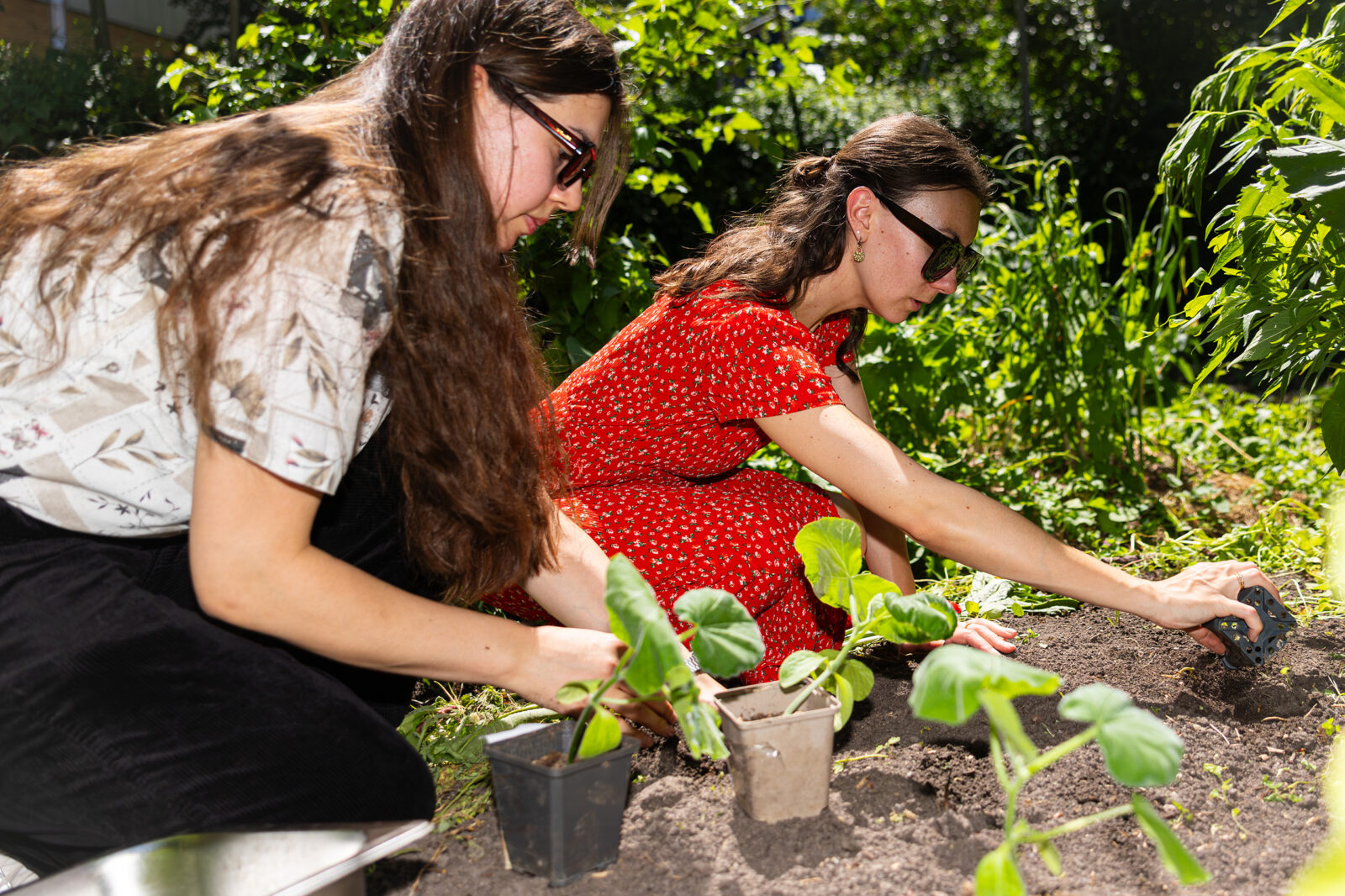
Mara (left) and Evelyn (right) lay the foundation for a future pumpkin harvest in the campus vegetable garden.
Image by: Pien Düthmann
On Thursday, five staff members gathered in the campus garden next to the exit towards Kralingse Zoom to plant out the seedlings. While the plants were being put into the ground, participants exchanged experiences of looking after them at the office. “Once the plants were in the office, we realised how many colleagues were interested”, one participant says.
Involving staff in sustainability
The project was set up by the Erasmus Sustainability Hub, which is among other things responsible for Edible EUR: the edible campus garden of Erasmus University. Vegetables, herbs and other crops are grown there. The edible campus garden has now been around for more than ten years. The initiative was originally launched by former student Bob ter Haar, who wanted to show students and staff where food comes from and how it grows. Ter Haar is still actively involved in the garden, even though he now lives in Wageningen.
For Natalia Ramos, engagement lead at the Sustainability Hub, this project is a way to involve staff in sustainability in a different way. “We want to bring more people to the campus garden, because the threshold for going out into nature is becoming higher and higher for many people. People do not want to get dirty, are afraid of insects or are too busy behind all their screens. At the same time, I notice that fewer and fewer people understand how natural processes work, even though nature ultimately forms the basis of everything we do”, Ramos says.
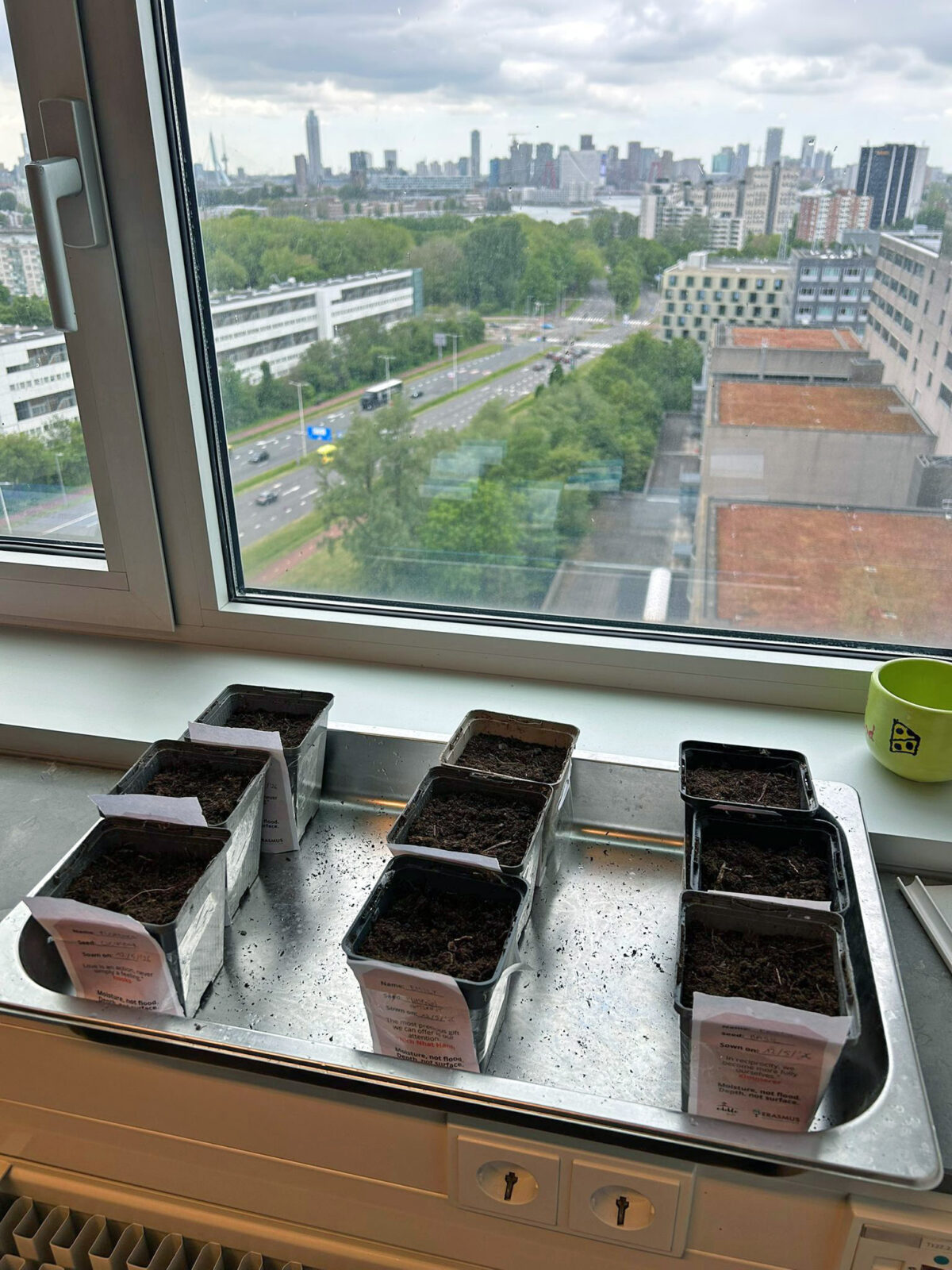
The seedlings moved into the participants’ offices, where they soon became part of everyday office life.
Image by: Sustainability Hub
Bringing the garden to the office
That is precisely why the Sustainability Hub decided to bring the garden to the people. Ramos sent out an invitation to staff within the university and in the end applications came in from six different faculties and services. Last Thursday, four of the six were present, namely: Erasmus School of Social and Behavioural Sciences (ESSB), Erasmus University College (EUC), Erasmus School of Philosophy (ESPhil), and Real Estate Facilities (REF). Participants were given various seedlings to take back to their offices and grow themselves. They could choose from, among others, tomato, basil, cucumber and pumpkin plants.
The seedlings then formed part of office life for weeks. They were well cared for, and gradually all the plants developed their own story. “Many plants even got their own names”, Ramos says, laughing.
Staff members Evelyn Vanhulle and Mara Plomp, both PhD candidates at ESSB, saw the invitation and decided to take part in the project together. This was the first time they had raised plants themselves, and today they are giving them a place in the vegetable garden.
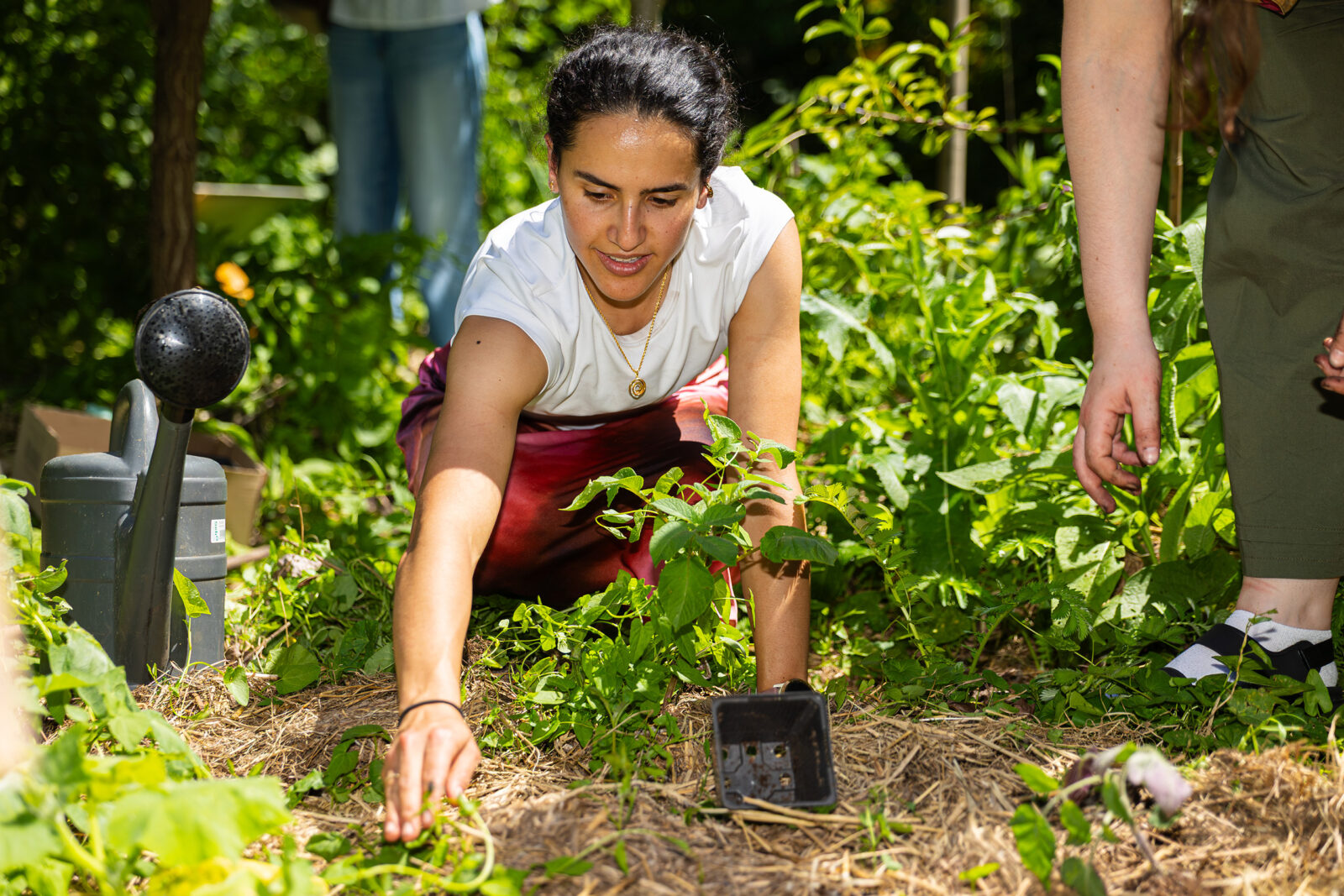
Initiator Natalia Ramos aims to lower the barrier for employees to spend time in nature.
Image by: Pien Düthmann
‘Office babies’
When Vanhulle and Plomp arrived at the office with pots of soil and seeds, they were met with surprised looks from their colleagues. “No one really knew what we were planning to do”, Vanhulle says, with a laugh. “But people immediately became curious.” According to Plomp, an unexpected level of engagement emerged. “Once the plants were in the office, we noticed how many colleagues were interested. People asked whether the plants had already been given enough water, and colleagues moved the plants out of the bright sun when necessary. Eventually the plants were even called the ‘office babies’.”
In the end, caring for them turned out to be simple, but it did lead to more contact between colleagues. Not only in person, but also online. Vanhulle and Plomp regularly updated colleagues on the plants by sending photos in the group chat. The plants were eventually named after colleagues and after Evelyn and Mara themselves.
After more than a month of care, it was time last Thursday to say goodbye to the ‘office babies’. In the campus garden, the cucumber and pumpkin plants were given a place among the other vegetables and herbs.
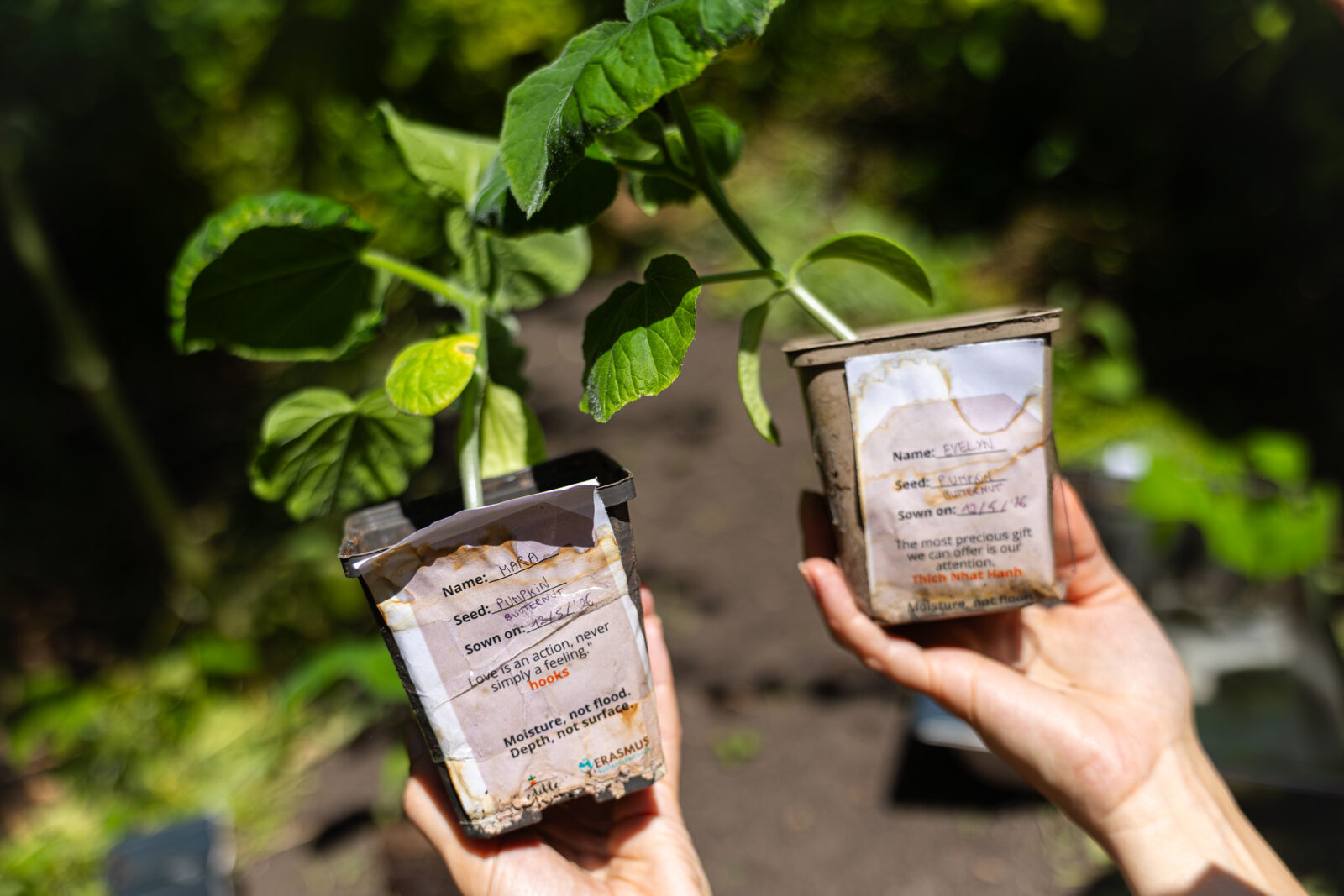
Mara and Evelyn’s pumpkin plants are now large enough to be planted in the vegetable garden.
Image by: Pien Düthmann
More than a vegetable plant
“I actually find it quite strange to see how big they have grown”, Vanhulle says as she looks at the plants. Plomp says the opposite: “In the office they seemed much bigger. Now that they are here in the garden, they suddenly seem very small again.”
The seedlings have also left their mark in the office. Now that the plants are gone, the workplace even feels a bit empty, according to the staff. “We have already talked about putting a few more plants in the office”, Plomp says. “They made the space feel cosier.”
For Ramos, that is precisely the strength of the project. She says it is not only about growing food, but above all about developing a different relationship with nature. By looking after a plant for weeks, this relationship takes shape.
Vanhulle and Plomp are keen to come back to the campus garden to see how their plants are doing and to pick the vegetables in the end. “We had not really thought about that before, but now that we are here it actually seems like a very nice idea.”
De redactie
-
Roos den Hartog
Intern
Comments
3 reacties
Comments are closed.
Ad
Read more in Nature
-
The Tinbergen building is one enormous bat enclosure
Gepubliceerd op:-
Nature
-
-
There’s more in the university library’s ‘sea of nourishment’ than you might think
Gepubliceerd op:-
Nature
-
-
The burrow might be abandoned, but the greenery behind the exam rooms is ideal for foxes
Gepubliceerd op:-
Nature
-
Carlo Cavicchia op 28 June 2026 om 23:25
I’d be interested in joining this project. Who should I contact? Thanks!
Wieneke Gunneweg op 30 June 2026 om 18:25
You can contact Natalia Ramos, from the Sustainability Hub
Natalia op 14 July 2026 om 18:51
Hi Carlo, this is Natalia! Happy to get in contact. We’ll definitely launch a second edition of this initiative.