Ad

Voting for the University Council at Erasmus MC: ‘I hope the new council can do something about study-related stress’

The University Council is organising various initiatives this week to attract extra attention to the elections. From 13 to 20 April, students can vote for candidates who wish to represent them in the coming academic year.
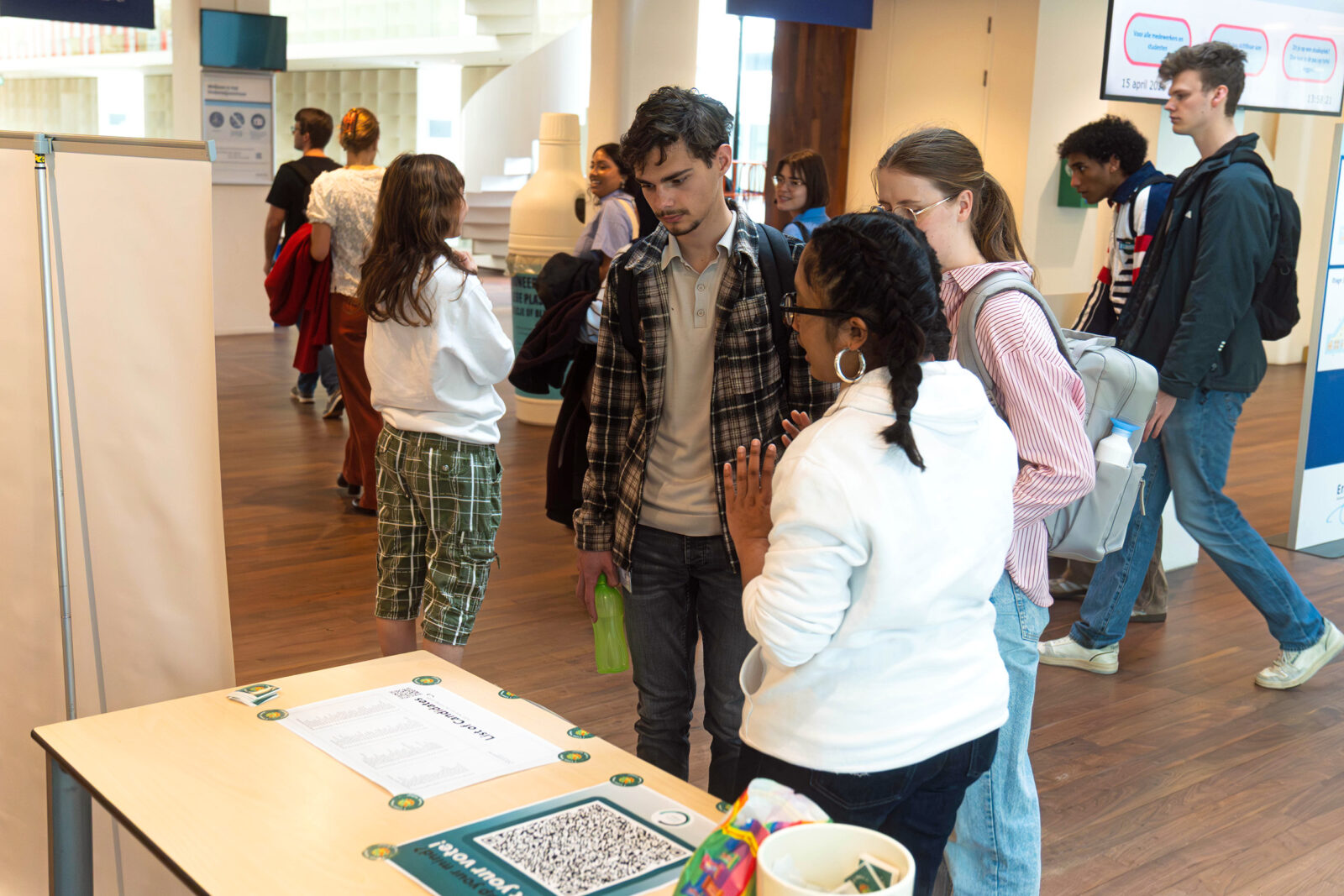
Students view the list of candidates for the University Council elections in a temporary voting booth.
Image by: Nhat Minh Bui
Outside the entrance to the Erasmus MC Education Centre, Kayla Dharma and Anne Vromant have set up a makeshift voting booth to remind students that the student representative elections are taking place this week. The two students are responsible for the University Council’s marketing as student assistants.
Some students are rushing to their lectures because they are running late, whilst others are listening attentively to what Dharma and Vromant have to say.
Voting guide
To encourage more people to vote, a voting guide has been introduced this year. Passing students can use a QR code to see the positions held by the student parties. This gives them a better insight into the ideas and plans, for example regarding the quality of education and student welfare.
Dharma hopes that these initiatives will raise the profile of the elections. “Not all students know that elections are taking place. We hope this will help draw more attention to them.”
Een lijst met artikelen
-

Significant increase in voter turn-out for University Council
Gepubliceerd op:-
University Council
-
The importance of the elections
This year, students can choose from 106 candidates, spread across five lists. Four of these have multiple candidates. The last is a single-candidate list. A sixth independent candidate withdrew at the last minute.
In 2025, 15.1 per cent of all EUR students cast a vote. That was a significant increase compared to the previous year, when 9.8 per cent voted.

Denis has not yet voted
Image by: Nhat Minh Bui
The University Council has the right of consent on many matters, such as strategic choices, the broad outlines of the budget and regulations. This means that the Executive Board must first obtain the Council’s approval for many decisions. In addition, the Council has the right to advise and the ability to put forward its own initiatives.
To vote or not to vote?
However, not all students have voted yet. Denis Torbin, a Neuroscience student, is aware of the elections but has not yet voted. He plans to do so. “I think this is a good way to involve students in important decisions.”
One student who has already voted is Salma Mohamed. She believes student participation is important. A key issue for her is academic pressure. “Many medical students experience study stress and a heavy workload. I hope the new council can do something about that.”

Salma hopes the new council will tackle academic stress.
Image by: Nhat Minh Bui
Nicolaas Reus, a medical student, voted for the first time this year. Although he hadn’t looked into the elections in detail, he decided to vote for a candidate after speaking to them.
Pleased with the initiative
After an hour, Dharma and Vromant dismantle the stand. They are satisfied with how the afternoon went. “Many students I spoke to this afternoon were already aware of the elections. Some had even already voted,” says Dharma. These students received a sticker and a chocolate as a reward. Both secretly hope that the turnout record will be broken again.
Students can still vote via ProVote until next Monday. More information about the elections can be found on the university’s website.
De redactie
-
 Stef Straver
Intern
Comments
Comments are closed.
Ad
Read more in University Council
-

‘Draconian’ measures needed at IBA and IBEB as too many international students arrive
Gepubliceerd op:-
University Council
-
-
Election error: candidates and voters received no invitation
Gepubliceerd op:-
University Council
-
-

U-council: tension over personnel policy, sensitive collaborations and the Canvas hack
Gepubliceerd op:-
EM U-council report
-