Professors write a philosophical children’s book: ‘Immerse yourself in life as Philo immerses in the sea’

Two professors have jointly written a philosophical children’s book. Public philosopher Stine Jensen and Paul van Geest, who works in theology and economic thought, hope that Philo en de Zee (Philo and the Sea) will inspire children to reflect on the world around them.
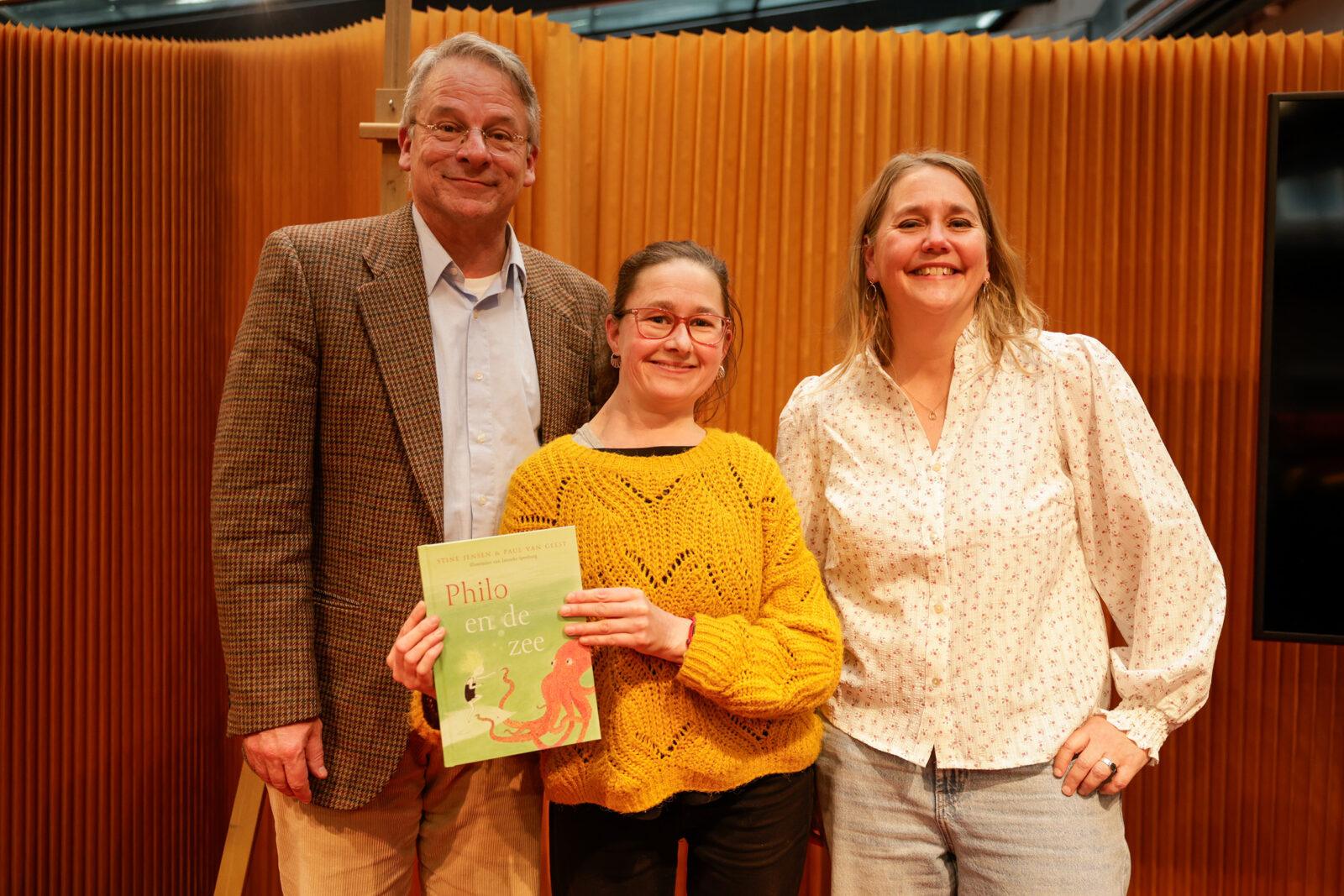
Image by: Daan Stam
The collaboration between Jensen and Van Geest came about after Jensen delivered her inaugural lecture in 2024. “I had decided in advance that I wanted to end my inaugural lecture in a fun way”, she says. She did so by handing out the Kleurboek voor Filosofen (Colouring Book for Philosophers) to those present, one of the titles under her name.
“Paul received a copy as well and found it very amusing”, she continues. “He sent me an email asking if we could talk further at some point.” Jensen agreed, and a few days later they met in Van Geest’s library, where he suggested the idea of writing a children’s book together.
In that library, he told her about the stories he used to invent for his children. During that conversation, his ideas really came to life, according to Jensen. “I thought: we could give that a try.”
Philo and the Sea
And from that attempt emerged Philo en de Zee – a philosophical children’s book written by Jensen and Van Geest, and illustrated by Janneke Ipenburg. The illustrations have a pastel-coloured palette that, according to Jensen, really allows the reader to disappear into the sea.
The main character, a girl named Philo, enjoys going to the seaside. When she meets a dolphin who invites her on a journey, Philo discovers that the sea is full of life. “It is an incredible world”, Jensen says. “By discovering this world, she can ask all the questions she has about life.”
The children’s book is based on stories that Van Geest told his daughters years ago. At the time, he was already a professor and did not always have enough energy to read from a book in the evenings. So he made up stories himself.
“My daughters shared one room and one bed at the time”, Van Geest continues. “I would lie down between them, and then tell them a story I came up with on the spot. And if I liked that story, I would write it down on a notepad, which I kept in a book.”
Compromise
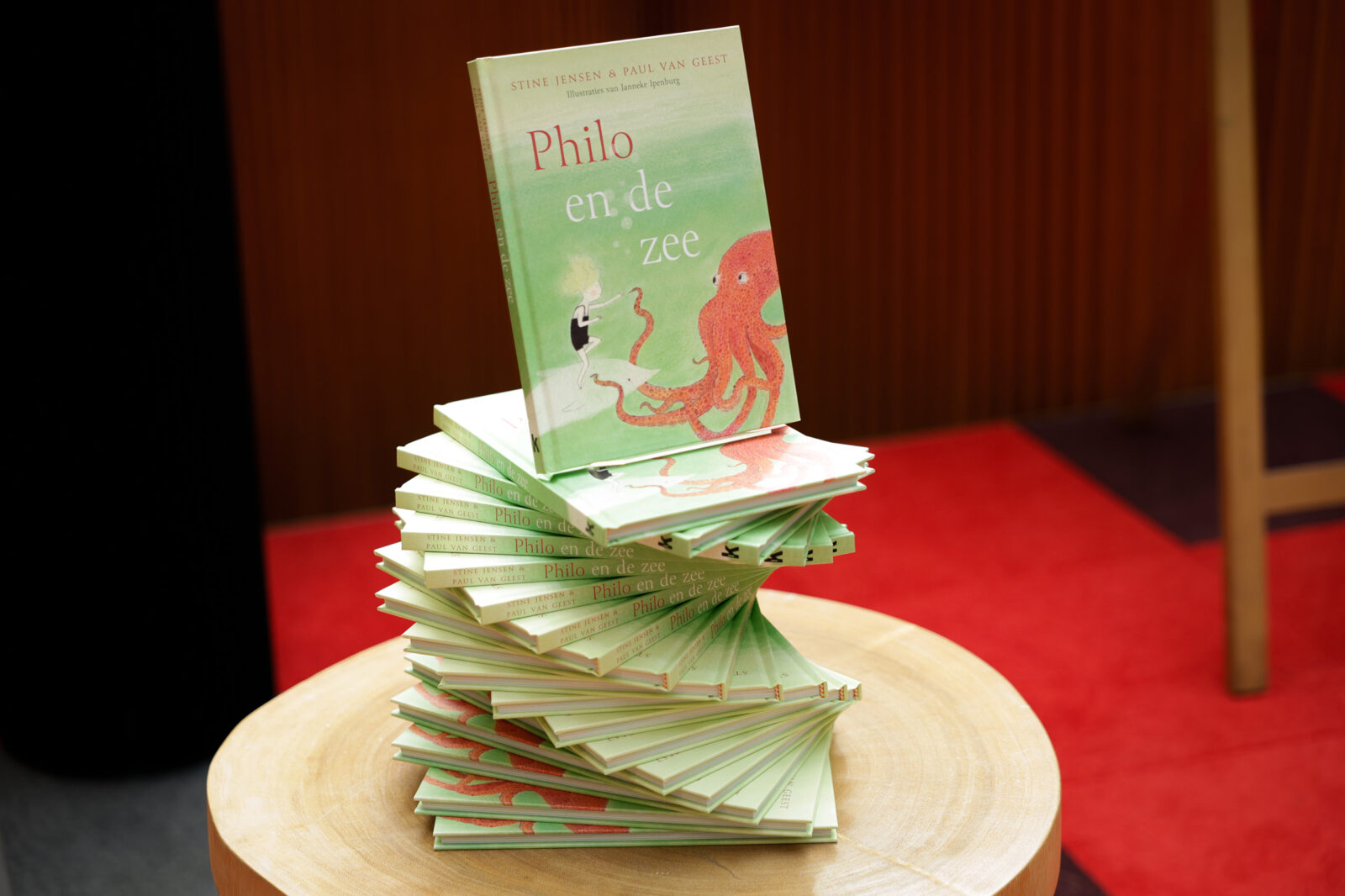
Image by: Daan Stam
Although these stories formed an inspiration for the book, there was not yet an overarching storyline that tied them together. “The idea of a girl swimming through the sea and being prompted to think by a different animal each time comes from Stine”, says Van Geest.
Jensen also came up with the idea that Philo works better as a name, as it brings her closer to philosophy. The editor supported this idea as well. But for Van Geest, the girl had been called Philomeen for years. “I struggled with that at first”, he says. Fortunately, a compromise was quickly reached: the story makes it clear that her real name is Philomeen.
Philosophy
Not only Philo’s name is connected to philosophy, but so is the rest of the book. “The book should prompt children to ask philosophical questions”, says Jensen, “but also inspire wonder. They should feel motivated to go outside and to think about the world around them.”
In addition to the questions Philo asks, philosophy is also reflected in the theological elements of the book. For example, there is a sea turtle named Petra, named after Peter.
“Philo asks Petra why she swims against the current”, Van Geest explains. “Petra does this to build up her strength, to become resilient – like a rock on which you build a church, as Peter does in the Bible.”
Connection with the sea
The fact that Philo en de Zee takes place in the water reflects the connection Jensen and Van Geest have with the sea. As a child, Jensen went on sailing trips with her father. “He had his own boat”, she says, “so I spent a lot of time on the water.” Even now, she still enjoys going to the beach.
‘The sea has something beautiful, something unfathomable, and sometimes something cruel’
Van Geest used to walk along the sea with his grandfather, on the pier at the Kurhaus in Scheveningen. “During those walks, he would tell me to be careful, but also that the sea was so beautiful. And that influenced my thoughts: the sea has something beautiful, something unfathomable, and sometimes something cruel.”
He now walks along the sea with love. Because: “Then there is nothing else but the sea. You are fully in the here and now, and that is important.”
Here and now
The importance of the here and now is something the authors wanted to make clear. In their children’s books, they talk about ‘sea time’, based on the natural phenomenon of ebb and flow.
According to Jensen, humans follow the clock, while life for animals flows more naturally. “For example, Philo goes to school at a set time,” she explains. “She has lunch at twelve o’clock, and her parents work every day. Animals don’t have such obligations.”
The idea that humans might have something to learn from animals is an important lesson for Philo. “And it is also an important lesson we want to pass on to children and even adults,” says Van Geest. “Live more in sea time, think about the here and now, and immerse yourself in life as Philo immerses in the sea.”
Read more
-
Ellen van Schoten brings cityscapes, half-timbered houses and cathedrals to life
Gepubliceerd op:-
Staff
-
De redactie

Comments
Read more in Staff
-
ESSB amends job posting after controversy over ‘scholars of colour’
Gepubliceerd op:-
Diversity
-
Staff
-
-
Anti-Israeli Pettit not allowed to work at Brussels university
Gepubliceerd op:-
Staff
-
-

Pay rise for interns, clinical rotations and staff at UMCs
Gepubliceerd op:-
Staff
-

Leave a comment