University Council and Erasmus Magazine must keep each other on their toes

You can see the university as a body, in which the organs keep things under control and guide them in the right direction, so the body does not grind to a halt. Editor-in-chief Wieneke Gunneweg reflects on the role of two of those organs – the University Council and Erasmus Magazine – and how they must keep each other on their toes. Organa sana in corpore sano.

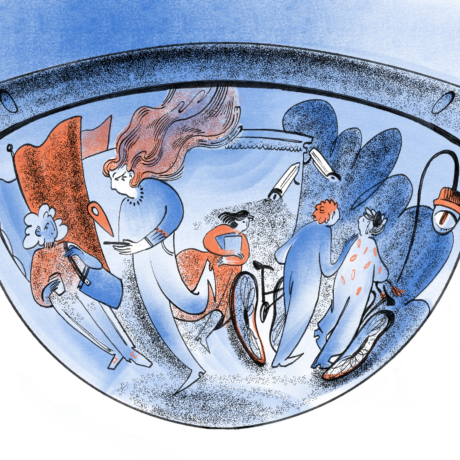
Image by: Geisje van der Linden
In the highly readable article by colleague Elmer Smaling about camera surveillance on campus, he notes several striking things. That as a member of staff or a student you cannot walk around campus unseen – there is always a camera that can follow you. That the cameras sometimes help catch criminals but often do not.
But the most important discovery, in my view, is that the University Council, as the body that monitors the policies and decisions of the Executive Board on behalf of students and staff, had been sidelined for years when it comes to the use of cameras on campus. The council has the right of consent regarding the placing or relocation of cameras on campus, but in recent years nothing was submitted to it, even though new cameras did in fact appear on campus, if only because new buildings were opened.
And that is a bad thing, because the University Council – like Erasmus Magazine – is part of the democratic body of the university.
For those who want to know more about the role of Erasmus Magazine, check the fantastic three-part video series made by colleague Nora van der Schoor about the origins, usefulness and necessity of independent journalism within the university.
I therefore agree with the remarks made by one of the speakers in the story, Jiska Engelbert, about how the University Council functions. She says that the council does not only have an advisory role, but also (or mainly) a monitoring role that should be able to approve or reject the choices made by the Executive Board.
In recent years, Erasmus Magazine has too often seen participation bodies being stripped of their critical role – or allowing it to be taken away – by already thinking along in all sorts of preliminary processes about the best policy. It sounds constructive, you might think, but how can you still be critical of a policy you helped shape yourself? At that point you are essentially marking your own homework.
'In recent years, Erasmus Magazine has too often seen participation bodies being stripped of their critical role'
Too often we see that major discussions about matters of principle are no longer held in the public meetings but have already been settled beforehand. With the placement of cameras on campus – typically a subject that affects all campus users and therefore deserves democratic oversight – the council was not even properly informed.
Fortunately, there is Erasmus Magazine, which takes up the monitoring role from a journalistic perspective, taking the time to investigate matters properly, ask questions and make information public.
I think it is good that policymakers have promised improvement, and that the University Council has now also refocused on the issue as part of its responsibility as a participation body. In this way the monitoring organs keep each other sharp, and the body of the university can stay healthy. And that is what matters.
Een lijst met artikelen
-
Walking from A to B without being filmed is no longer possible on campus Woudestein
Gepubliceerd op:-
Security
-
-

University Council sidelined for years on surveillance and now refuses relocation of two cameras
Gepubliceerd op:-
Security
-
De redactie
-
 Wieneke Gunneweg
Editor-in-chief
Comments
Read more in Editorial
-
Why facts are orange and opinions purple on EM’s new website
Gepubliceerd op:-
Editorial
-
-

At the end of the year, Erasmus Magazine wishes everyone an empty head, warm hands and a full heart
Gepubliceerd op:-
Editorial
-
-

Why EM is focusing on these six themes this year
Gepubliceerd op:-
Editorial
-

Leave a comment