Ad

Walking from A to B without being filmed is no longer possible on campus Woudestein


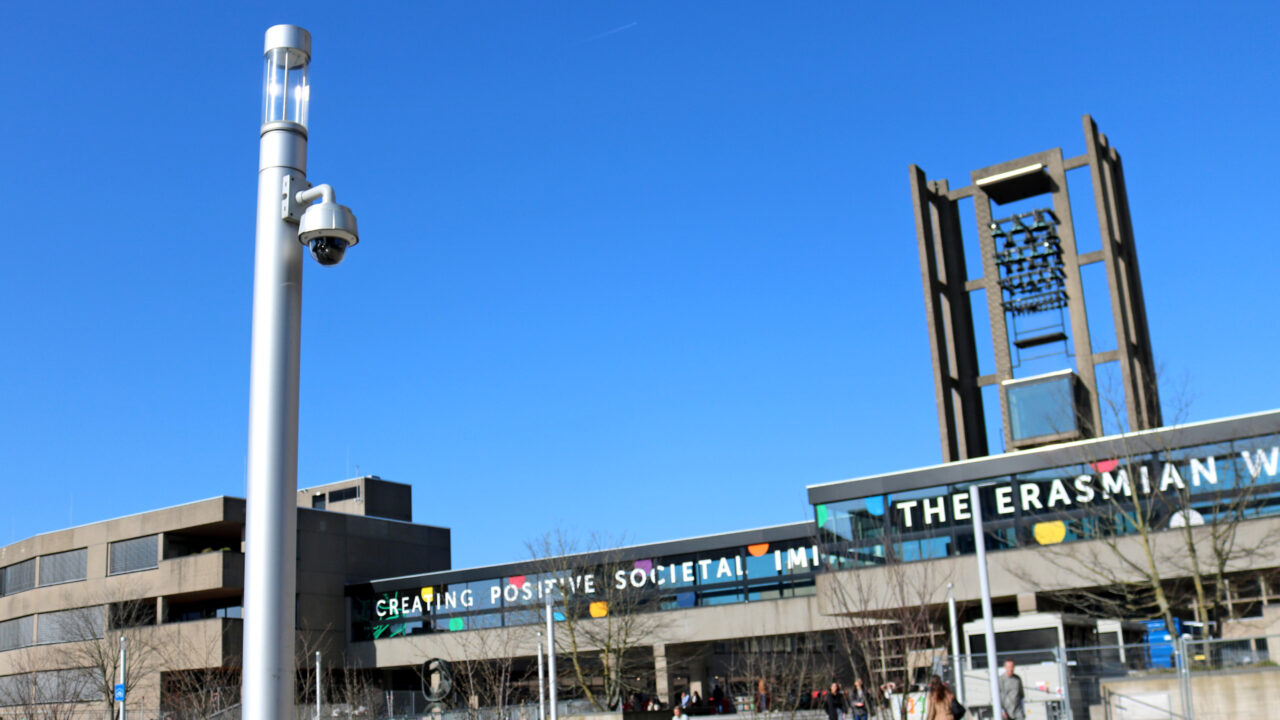
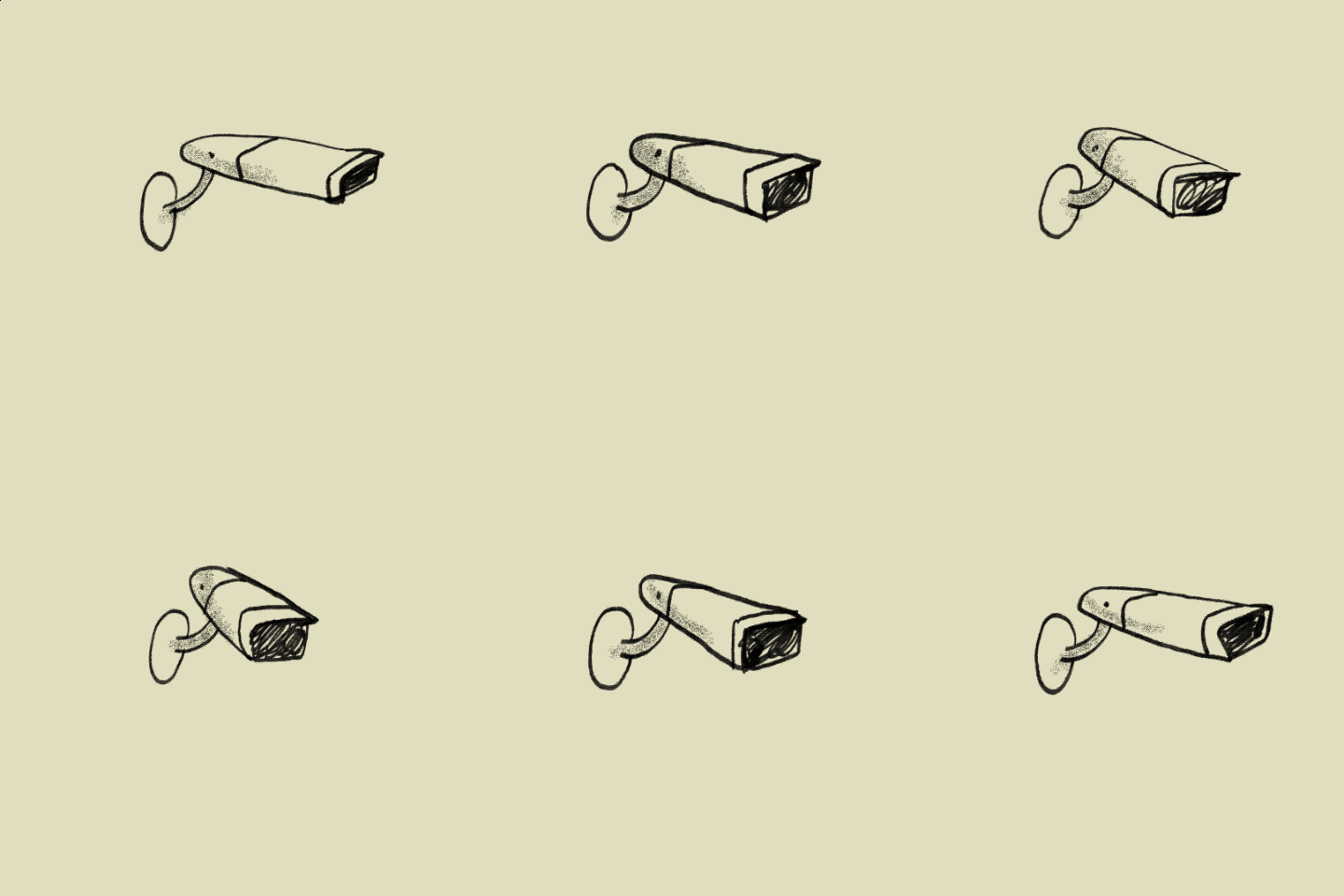
On campus you are watched 24 hours a day by dozens of cameras. Although the University Council is supposed to give permission for the installation of each camera, that didn’t happen for years. The exact location of cameras is officially undisclosed. That’s why EM mapped the cameras on campus and discovered that you can no longer walk from A to B without being filmed.
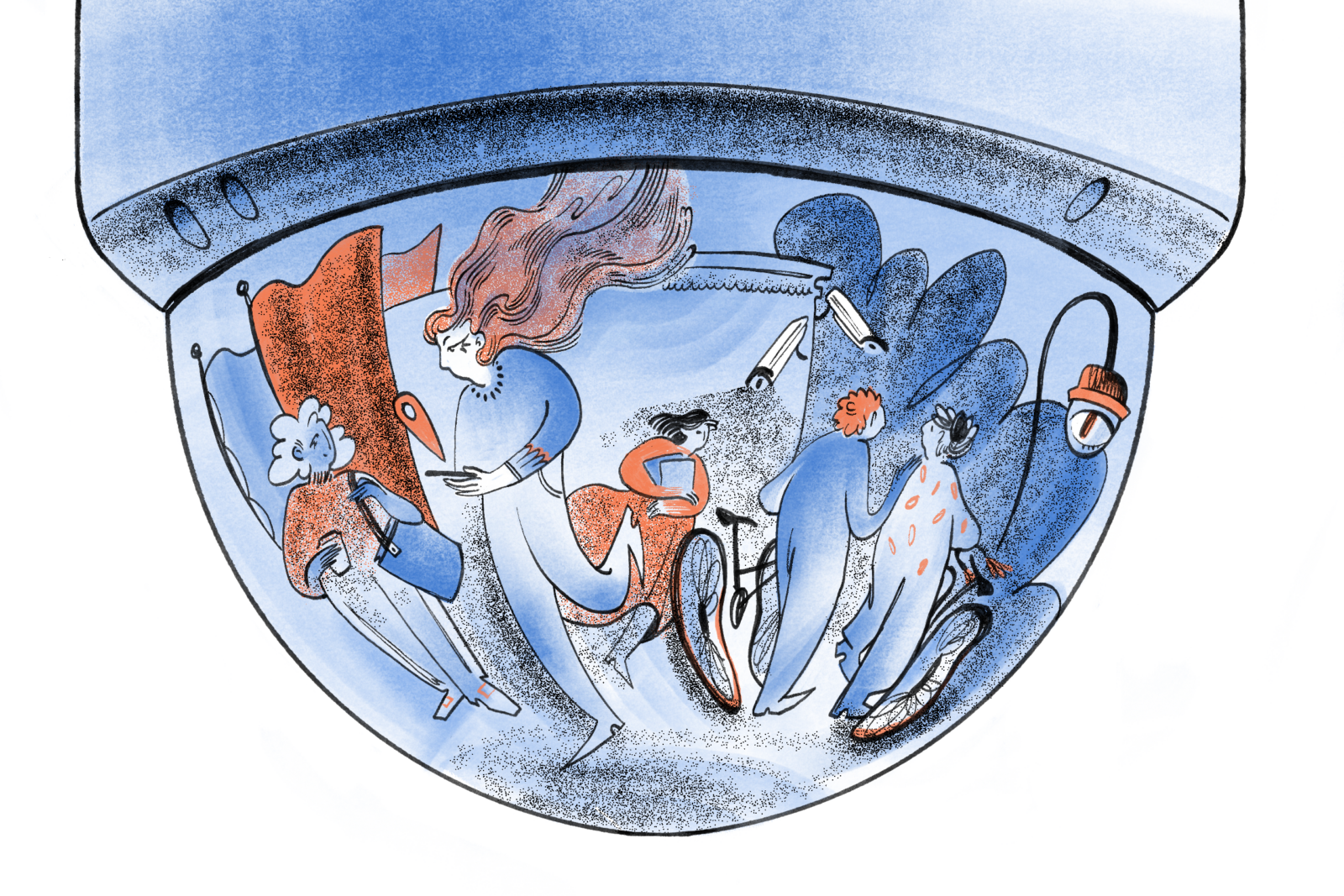
Image by: Ami Rinn
In this story:
- On campus there are regular incidents, from burglaries to nuisance caused by loitering youths.
- During a recent police chase the cameras were helpful, but they achieved little in burglaries.
- The university will not show where cameras are located for safety reasons.
- Endowed professor Jiska Engelbert of BOLD Cities would like a more fundamental discussion about the usefulness of cameras and believes the community should therefore be informed as well as possible.
- EM therefore mapped the outdoor cameras in collaboration with BOLD Cities.
- The university is investing almost 2 million euros in a new security system.
- The University Council is supposed to have the right to approve the placement of cameras, but was left out for years.
It is the night of 23 January 2026 and in the city, policemen are chasing a car with Belgian number plates. The driver of the Belgian car tries to shake off the officers and takes a short cut across campus Woudestein. The car comes to a stop in front of the sports building and the two occupants run off. One of them is arrested immediately, the other cannot be found.
On another side of campus, in a control room, an operator watches a wall of screens 24 hours a day. Even now, in the middle of the night. On one of the roughly forty outdoor cameras he sees a suspicious person. He doesn’t hesitate and calls the police. Thanks to the cameras, the officers are able to arrest the second suspect after all.
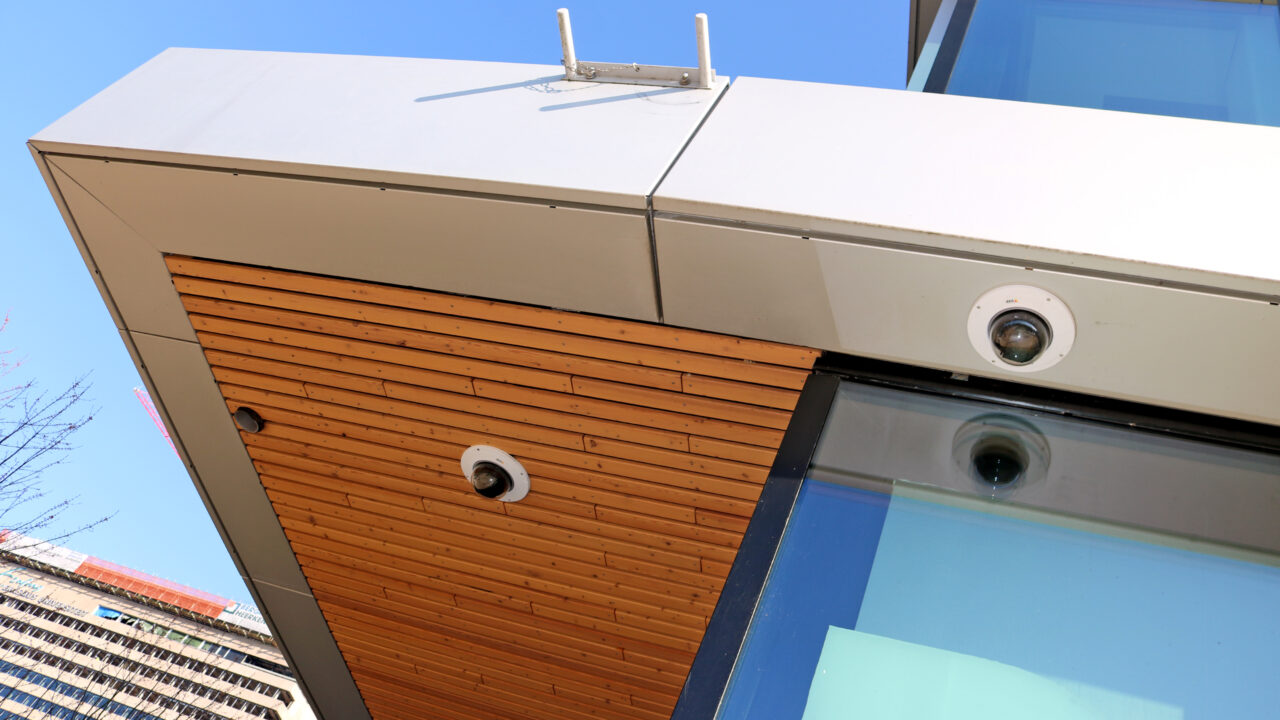
Camera footage follows the pair as they enter the Erasmus Pavilion, load a roll container with expensive electronics and walk away.
Another example. Tuesday 12 March 2024, around 17.30. Two men walk onto campus. Camera footage follows the pair as they enter the Erasmus Pavilion, load a roll container with expensive electronics and walk away. The loot: 16,000 euros. They are not caught.
One example where the cameras were useful, one where they helped very little. What kind of security system does the university actually have? And what does the academic community gain from such a system? For Jos Bal, head of the department of Integral Safety, who advises the Executive Board directly on these matters, the usefulness and secrecy surrounding the system are self-evident. Endowed professor Jiska Engelbert, academic director of the Leiden-Delft-Erasmus Centre for BOLD Cities, which itself researches cameras in the city, believes that many steps are often skipped in the security discussion while the cameras are already in place.
Confidentiality
Visitors to campus Woudestein are informed immediately at some entrances. “ID required. 24/7 camera surveillance”, reads blue and white signs. At other entrances, no warning is to be seen. Where those cameras are exactly mounted and how many there are is secret. A request from EM for an overview was refused by the department of Integral Safety. “That would immediately make clear where there are no cameras”, Bal says. And that would help malicious actors, which is not exactly the intention.
The amount of cameras isn’t public either. The most recent figure dates from 2019: at that time there were, according to former security adviser Jelle Jager, 124 cameras on campus, counting indoor and outdoor cameras together.
To nevertheless get an idea of where students and staff are being filmed, EM made a tour around campus, accompanied by two staff members of BOLD Cities. BOLD researchers do this kind of thing regularly in the rest of the city. “We are working on a project called Start Making Sense. With it we try to map cameras and sensors in the city. We do that with the help of an app”, Engelbert explains. The mapping includes not only municipal cameras but also those of companies and, for example, doorbell cameras.

Not for burglars
The maps the BOLD researchers make are of course not intended to help burglars, but instead to enable an informed public discussion. “Democratic opposition or input is very important”, Engelbert believes. “And we want to contribute by asking the full repertoire of questions you could ask about this. Cameras may well help to investigate crimes. But what is often missing is reflection. Institutions or municipalities first put up cameras as a matter of course and only afterwards think about what that means for the community. We see this primarily as a political issue. The question of what you should or should not do is hardly ever asked.”
During the walk across campus Woudestein EM and BOLD found 36 cameras. Most are mounted on building facades, others stand on poles. Here and there a camera is placed on top of a building. Five cameras were attached to a building of the Hogeschool Rotterdam, and for some others it is unclear whether they still work. The construction site of the Tinbergen building is also secured by several temporary cameras.
To meet the security concerns of Integral Safety, cameras inside buildings were not mapped. And a warning to would-be criminals: the map is based on own observations and is therefore almost certainly not complete. It shows that it’s virtually impossible to walk from A to B without being seen by one of the outdoor cameras. And they can see a lot: most of the cameras are so-called dome cameras made by Axis, which can be turned in any direction from the control room and, depending on the model used, have thirty to forty times optical zoom. They don’t record sound.
Camera locations on campus Woudestein
Cameras with a light-green label were installed after 2019 and therefore were not submitted to the University Council. Brown cameras are installed before 2019 and the installation date of the blue cameras is unknown. The yellow cameras are temporary and part of the construction site of the Tinbergen building.
'We are a university, not Fort Knox'
24-hour control room
At least one operator at a time watches the camera images 24 hours a day, seven days a week. That person does so on campus in a secure control room, the location of which Bal wants to keep secret for safety reasons. With a joystick the operator can move any camera in all directions and zoom in.
The operator can’t just zoom in on anybody for no reason: there must be a reason to follow a visitor. Reasons to start following someone by camera include first-aid incidents, cases of intimidation or burglary reports. Sometimes the cameras help to grant access to visitors with a disability, Bal says. That can involve activating a lift or opening a gate, for example.
Watching live
If an incident happens, the operator reports it to the operational manager. A security guard may then be sent to the situation. If criminal behaviour is reported, the police can be called in. Images are only shared with the police after a request or order. In such a situation the university can, at the press of a button, let the police watch live.
At the same time Bal wants to emphasise that the university doesn’t want to pull out all the stops when it comes to camera security. “We are a university, not Fort Knox. We want to provide security with proportionate means. The cameras are supportive, not intended to spy on people or follow them continuously”, he says.
Cameras at the encampment
In some incidents the cameras turn out to be of no use. On the weekend of 21 and 22 February 2026 burglars smashed the windows of the F building. Taps and boilers were stolen, leaving the building flooded. This side of the campus has plenty cameras, but the burglars were not visible on them: they covered a camera, another one turned out to be defective.
Cameras are intended for everyone’s safety, but not everyone always experiences it that way. In May 2024 the campus protests against the genocide of Palestinians were at a peak. On the Erasmus Plaza, demonstrators set up an encampment and stayed there for several days. Shortly after it began, large mobile camera units appeared on the square. The president of the Executive Board at that point, Ed Brinksma, said it wanted to monitor whether vandalism occurred and also keep the demonstrators safe, especially when they slept in tents at night and the campus was empty. The demonstrators mainly felt uncomfortable about them.
'The burden of proof is placed on the person being filmed. They’re the ones that have to prove they are not a threat'
Examples like these prompt Engelbert to question whether the invasion of privacy always balances out the crime-fighting purpose of the cameras. “As an academic community we simply assume we are completely homogeneous, that we all agree cameras lead to more safety. It was of course no coincidence that mobile camera units were placed exactly when there was an encampment on campus. That mainly signals to the demonstrators: we are watching you, you are potentially a problem or a danger. The burden of proof is placed on the person being filmed. They’re the ones that have to prove they are not a threat.”

Ban in showers and toilets
Who actually decides where a camera may be placed and what may be done with the images? First there is a camera surveillance regulation from 2013, which is currently being revised but is still valid. It sets out basic rules, such as a ban on cameras in toilets, showers and changing rooms. Hidden cameras are also not permitted, except in exceptional circumstances. Cameras are allowed at access roads, entrances, storage areas, places where incidents occur more often and exam halls. Images must be deleted within four weeks or, if the images are relevant to an incident, as soon as a possible incident has been dealt with.
For every placement or relocation of a camera the University Council must give prior approval. It may decide whether that camera serves a useful purpose and does not unduly infringe privacy. The council should also receive an annual update on changes in camera surveillance.
University Council left out for years
That went completely wrong for years. According to the registry of the University Council, no camera was submitted to the council for at least three years, until in November 2025 two relocations of cameras were presented. Sebastiaan Kamp, the council’s most senior member (since 2019), can’t recall any proposal for a camera placement. And yet new cameras have been installed, for example at the Langeveld building and the Sports building, both of which opened in 2022.
Temporary cameras that were placed during the Palestine protests were also not reviewed by the council, according to a spokesperson for the Executive Board because the placement was an ‘ad hoc decision’. The council also hasn’t received the mandatory annual overview for years.
Millions investment
Meanwhile the university wants to purchase a new camera system, which will cost a one-off 1.7 million euros and 400,000 euros annually. Not all cameras will be replaced, but the underlying system will. That system is ‘end of life’, according to Bal. The images the cameras shoot are quite high-quality, but those are stored at a low resolution. Bal says there’s also a significant risk that the ageing system will one day fail. It’s not a given that the investment will lead to more cameras on campus. “We will discuss together where we want cameras. And that can therefore mean more cameras but also fewer cameras.”

This investment was approved by the Executive Board in July 2025. That surprised council member Borja Ranzinger, chair of the University Council’s security taskforce. “Normally investments of more than 1 million euros are presented to the University Council. But we found out about it via EM’s reporting.” According to council chair Luca Hellings, however, the council doesn’t have the right to approve investments of more than 1 million euros. That only applies to changes of more than 1 million euros in the university’s budget. The council was informed about the investment in November.
Left out
In at least two areas the University Council was unjustly kept out of the loop regarding camera security: placements and the annual report. Ranzinger wants to investigate whether it is possible to still gain input on cameras that have already been installed. Engelbert, a former council member herself, sees the council’s mandate shrinking. “That worries me greatly. It is very important that we as an academic community have a say, that we can take control when necessary. The council shouldn’t merely have an advisory role, as it increasingly seems to, but should be able to approve or reject choices.”
'It is very important that we as an academic community have a say, that we can take control when necessary'
University Council chair Luca Hellings regrets that the University Council wasn’t informed in the past about new cameras and didn’t receive annual reports. “I would like to emphasise that we are currently in good consultation with Integral Safety about a new policy.”
Improvement
In recent years responsibility for the cameras lay with the Real Estate & Facilities department. Since recently, the department of Integral Safety under Bal now oversees camera surveillance. Bal promises improvement on behalf of the university. “Since we became responsible, all placements have been submitted to the University Council. Those were those two cameras. We want to organise this structurally better and report annually.”
The council is also involved in developing new regulations. The current regulation from 2013 does not yet take the General Data Protection Regulation into account or developments in the field of AI. A ban will be included on AI techniques such as facial recognition or emotion recognition. The regulation is currently being discussed in the University Council. The new camera system is due to go live in 2027.
Een lijst met artikelen
-

University Council sidelined for years on surveillance and now refuses relocation of two cameras
Gepubliceerd op:-
Security
-
De redactie
-
 Elmer Smaling
Deputy editor-in-chief
-
 Ami Rinn
Illustrator
Comments
Comments are closed.
Ad
Read more in Security
-
U-council loses right to approve security cameras
Gepubliceerd op:-
Security
-
-
University Council sidelined for years on surveillance and now refuses relocation of two cameras
Gepubliceerd op:-
Security
-
-

Break-in at the F building, boilers and taps stolen
Gepubliceerd op:-
Security
-