Higher education media also want protection against AI


Higher education media fear losing readers to AI, just like other news websites. Strict legislation could be a solution, but media minister Gouke Moes is not yet committing to this.
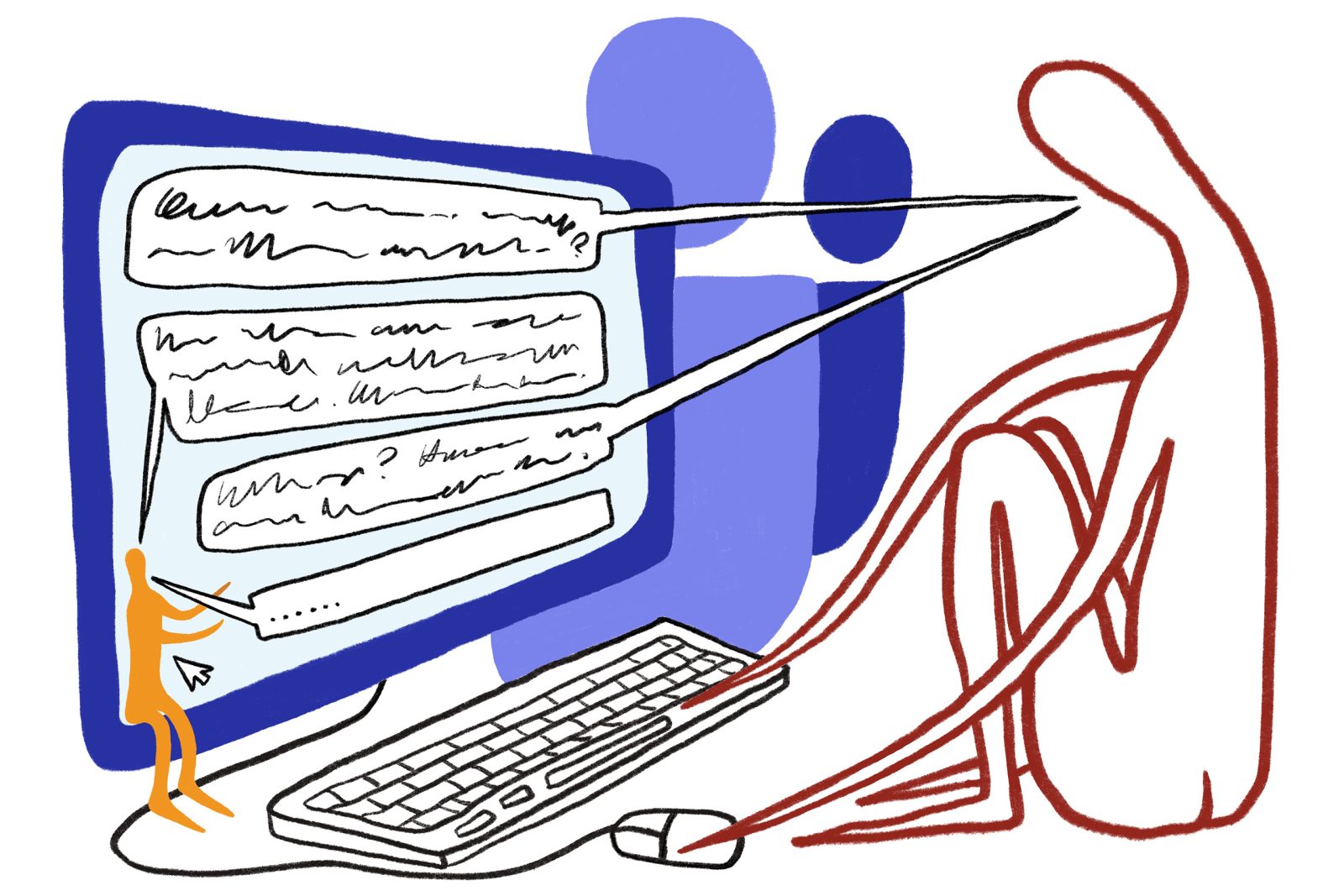
Image by: Sonja Schravesande
Google’s AI search assistant Gemini reported last week that up to ten billion euros are being cut from healthcare. Gemini based this claim in part on NOS, de Correspondent, RTL and de Telegraaf. But at that time nothing was yet known about such cuts.
Gemini relied on speculations by political reporter Joost Vullings of EenVandaag, who in the run-up to the presentation of the negotiating agreement of the new government explained how negotiations can unfold: suppose the coalition wants to cut five billion from healthcare, then you simply start with ten billion and after talks with the opposition you end up somewhere in the middle.
This blunder by Gemini illustrates the unreliability of AI. Yet readers rely on the quick summaries that have recently started appearing at the top of search results. They are clicking through to the original source less and less, according to research by cybersecurity company Cloudflare. Pew Research also observed that the number of people clicking through has been halved.
‘Major concerns’
In November, almost all Dutch media sent an urgent letter to the negotiating parties. In it, they expressed their concerns about the power and influence of AI companies. The media fear being swallowed up by Gemini and all those other artificial summarising tools. Media companies are asking the government for protection.
Higher education media were not involved in this urgent letter, but they have exactly the same concerns, says Willem Andrée, editor-in-chief of Resource at Wageningen University and chair of the Circle of Higher Education Media, which also includes Erasmus Magazine. He is missing website visitors and partly attributes this to Google’s AI answers. “I am very worried about that.”
Other higher education media also see readers disappearing. Editor-in-chief Marieke Verbiesen of Cursor at TU Eindhoven had the drop in visitor numbers investigated by her hosting company. It too considered it possible that AI summaries are preventing readers from still going to the source.
Erasmus Magazine has not yet seen a major drop in website visitor numbers since the rise of AI summaries in search engines, but fears this will certainly play a role in the future. “Erasmus Magazine currently reaches its target audience through the weekly newsletter that all students and staff receive and through social media. Organic traffic via search engines is less important for us, but it is worrying. Not only if you lose readers because of AI summaries, but above all that readers are being misinformed about issues that are happening at Erasmus University”, says editor-in-chief Wieneke Gunneweg of Erasmus Magazine.
Finding the truth
Media are not eager to make public just how dramatic the picture really is, but it is clear that they feel threatened. AI companies use the media as a source, but at the same time keep readers away from those same media. “Together this means that news organisations are missing out on reach and income on a large scale”, they write in the urgent letter.
As a university magazine, Willem Andrée does not rely so much on advertising, but he does want his journalistic productions to be read. “It is a crying shame that we are losing readers to AI. Moreover, you want people to get their information from the source, regardless of whether it generates money. AI is now undermining that principle.”
Paywall
Media companies are asking the Dutch government to translate European AI rules into strict legislation. This could curb ‘illegal scraping’. It appears that some AI companies even extract articles from behind paywalls, or content whose author has explicitly stated that it may not be included in AI databases.
The New York Times has also seen this and has filed a lawsuit against several major AI companies. Chatbots sometimes quote verbatim from Times articles that are only available online to subscribers, and as a result AI companies threaten to compete away a crucial pillar of democracy, the newspaper claims.
This fear is also present among Dutch media, according to the urgent letter. Because of the major tech companies, society is losing its grip on an ‘information supply aimed at finding the truth and characterised by diversity’. And: “The less space there is for journalistic reporting, the less we know about what is really happening in our country and in the world.”
No solution yet
The House of Representatives asked questions about this to caretaker minister Gouke Moes, who has media as well as education in his portfolio. In his response late January, Moes made it clear that he does not yet have a solution to this fundamental problem.
He places part of the responsibility with citizens, who must arm themselves with ‘media literacy’ against the effects of ‘disinformation’, according to Moes. He refers to a 2024 report by the Scientific Council for Government Policy, which examines the relationship between media and Big Tech.
But disinformation is not the problem that media are pointing to. And media literacy is certainly not the solution. The Scientific Council for Government Policy also says this in its report. Media literacy will offer ‘increasingly little relief’ due to the rise of generative AI, the council writes, because ‘real and fake are already hardly distinguishable’.
Protection
Media can defend themselves to some extent. Software exists that keeps AI robots (‘crawlers’) out. Cloudflare makes this available free of charge to journalistic media, and there appears to be interest in this in the Netherlands. But Cloudflare is ultimately a commercial company, and with tech companies the question is always how long free really remains free.
Another solution is to put up heavy paywalls or to stay away from Google altogether, Willem Andrée of Wageningen-based Resource considers. But will new readers still be able to find you then?
Andrée believes that rules will ultimately have to be introduced. “As far as I’m concerned, European legislation should be implemented here as soon as possible. Things are moving so fast. The time for standing by and watching is over.”
Read more
-

‘You’re basically stupid if you don’t use ChatGPT’
Gepubliceerd op:-
Artificial Intelligence
-
Comments
Comments are closed.
Read more in Artificial Intelligence
-
NWO bans secret AI prompts in grant applications
Gepubliceerd op:-
Artificial Intelligence
-
-
Highly educated workers in particular expect AI to partly take over their work
Gepubliceerd op:-
Artificial Intelligence
-
-
‘You’re basically stupid if you don’t use ChatGPT’
Gepubliceerd op:-
Artificial Intelligence
-