How Krish Raghav turned his frustrations with the housing market into a disorienting game

How surreal is the Dutch housing market to someone encountering it for the first time? Few things capture that feeling as clearly as the game Don’t get your hopes up, made by and based on the real-life experiences of EUR staff member Krish Raghav in Amsterdam.
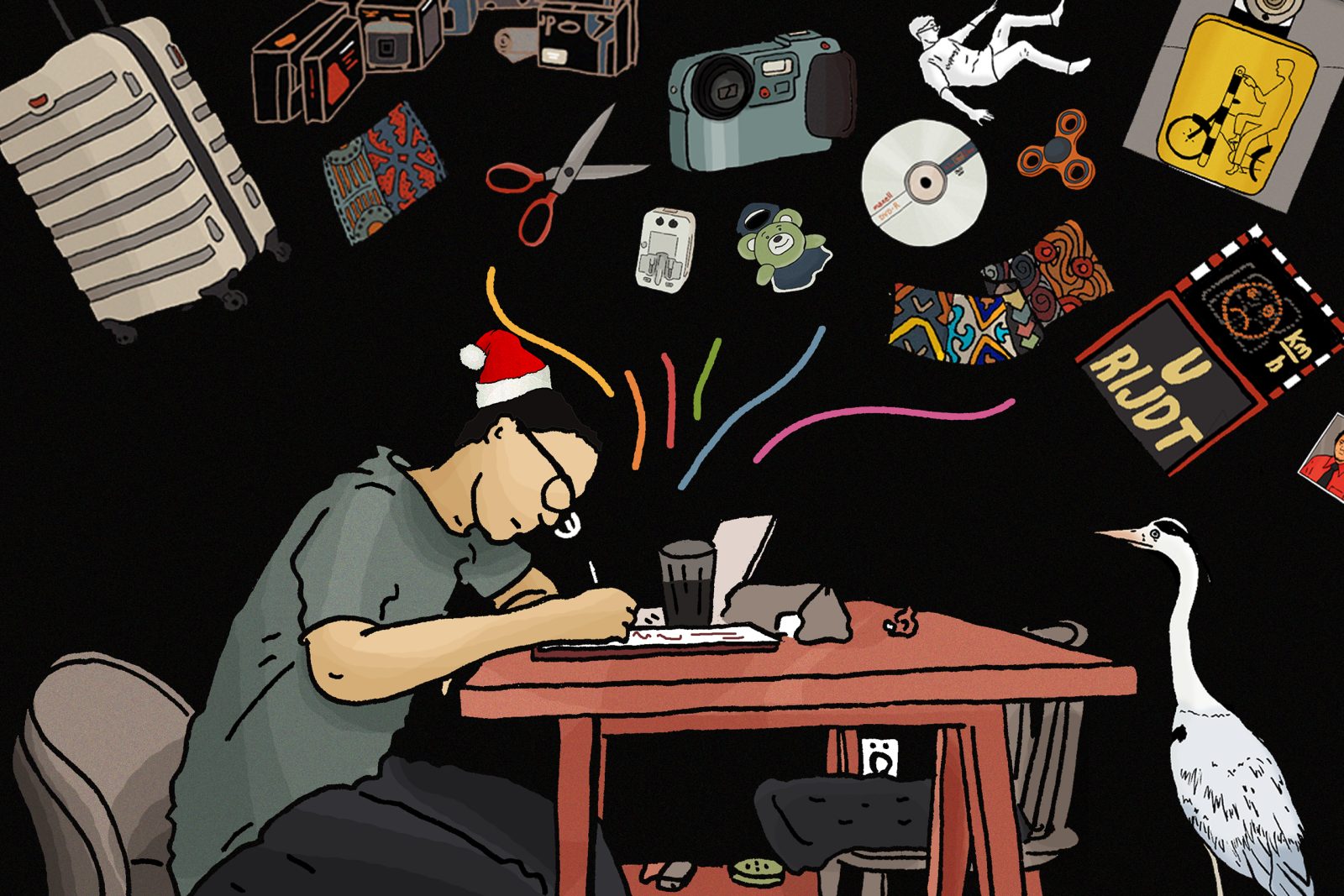
Image by: Krish Raghav
How surreal is the Dutch housing market to someone encountering it for the first time? Few things capture that feeling as clearly as the game Don’t get your hopes up, made by and based on the real-life experiences of EUR staff member Krish Raghav in Amsterdam.
With 6,422 staff and 31,473 students, it’s impossible to know everyone at the university. But what do these people do once they step off campus? In this end-of-year series, EM makes the connection with six remarkable stories about what students and staff do in their spare time.
Three years ago, Raghav – born in India, raised in Singapore – moved to the Netherlands from Beijing and eventually found a home in Amsterdam, together with his girlfriend Yan, a PhD candidate at ESSB. “We decided to build a new life in Amsterdam because we already knew a few people there.”
Horror-like
He channelled his creative take on this new world into a surrealist game of his own making. The game, titled Don’t get your hopes up, is a visual novel – a kind of interactive comic book – based on their search for a home and the frustration and disbelief they experienced along the way. “The title is a direct quote from a landlady during a viewing”, Krish chuckles. In the game, the Amsterdam housing market takes on an alienating, almost horror-like quality, which often comes across as absurdly funny. The game is freely available on Steam and has already been downloaded around thirty thousand times.
Krish has lived in quite a few places around the world – India, Singapore, China and the United States – but the Amsterdam housing market still came as a shock. “It was brutal”, he says about the search for a rental flat. “In Beijing, at least you got to see apartments. Shitty flats, but still. In Amsterdam, it was already a nightmare just to get a viewing. We sent out two hundred emails, maybe got fifteen or twenty responses, got to view ten places, and one of those might possibly result in an offer from the landlord.” In the game, players get to experience this frustrating process themselves by repeatedly clicking on real estate agent logos.
Cursed apartment
The game’s story unfolds over the course of a week, and each day players get to view one or two houses, inspired by the places Yan and Krish were actually allowed to visit. They are the most dreadful flats. “The places no one else wanted”, says Krish about both game and reality.
The game includes a flat that is almost entirely underground, apart from one room, descending dozens of floors below ground. “This is the most cursed apartment I’ve ever seen”, says Yan in the game. “She really did say that”, Krish explains. “Though the actual apartment didn’t have quite as many floors as in the game.”
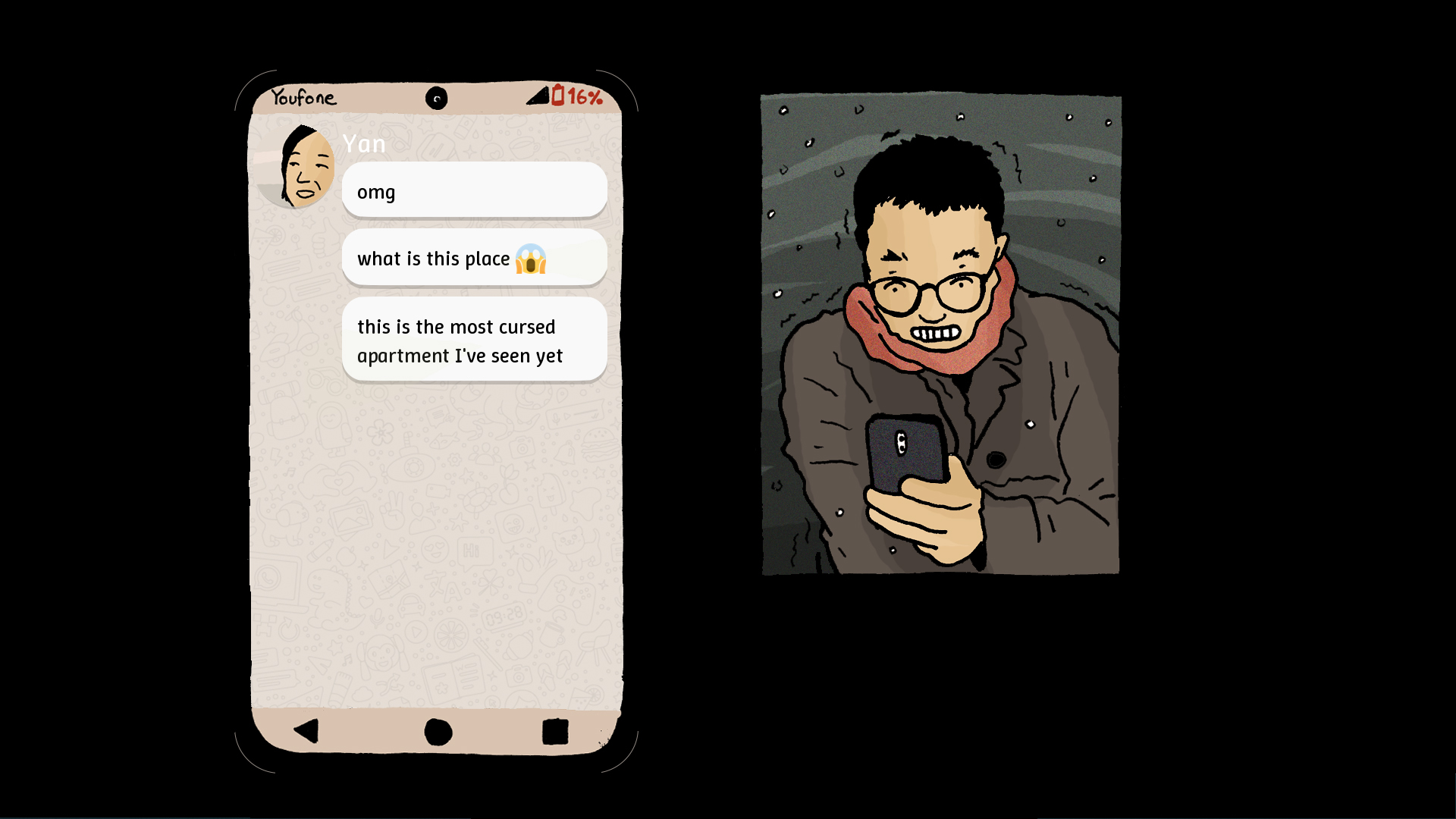
Image by: Krish Raghav
Mushroom
Sometimes reality was stranger than fiction. One of the flats they viewed had a hole in the roof patched up with duct tape, he recalls. And in a friend’s flat, a mushroom was growing out of a crack in the wall. “It looked like a brain”, says Krish. “No idea why I didn’t include that in the game.”
The whole estate agent circus never led to a home for Krish and Yan – they eventually found one through word of mouth. “A classmate from Dutch lessons said her husband had an apartment for rent. And she thought I was nice, so if we wanted it, it was ours. And of course we wanted it!”
Anime erotica
Don’t get your hopes up is mostly the result of Krish’s personal efforts. He had no previous experience in game design, other than making the satirical mini-game Sandwich or dumpling – where the player has to decide whether a photo shows a sandwich or a dumpling.
The new game is a lot more ambitious. “I started by making a storyboard”, he says about the development process. “Then I turned that into an interactive story structure using Ren’Py, a game engine usually used for erotic visual novels. That was quite funny – in almost all the templates, I had to change the default names because they referenced anime erotica (Japanese erotic cartoons, ed.). But my game looks completely different!”, he adds with a laugh.
The only part Krish didn’t produce himself was the game music. The synth pop by Simon Frank and the Rotterdam band Neighbours burning Neighbours amplifies the game’s uncanny yet satirical feel.
Comics
That Krish ended up making a game isn’t entirely out of the blue. He already had several comics to his name, some published in major international media. For The Washington Post, he illustrated and photographed the period when he and Yan were quarantined in a Chinese hotel during the pandemic – three rooms apart. On Al Jazeera’s website, he tells the story of his complex relationship with his now-deceased father in illustrated form. He also made comics about the music scene in Beijing, bullshit jobs in China, and the influence of Chinese culture on Jamaican reggae.
Making comics is hard work, says Krish. “I have no control over the creative process. One day you’re fully motivated, the next you’re not. Sometimes a game idea lives in my head for a year before anything ends up on paper.” What he finds easiest is the final writing and storyboarding. “From that point on it just flows”, he says.
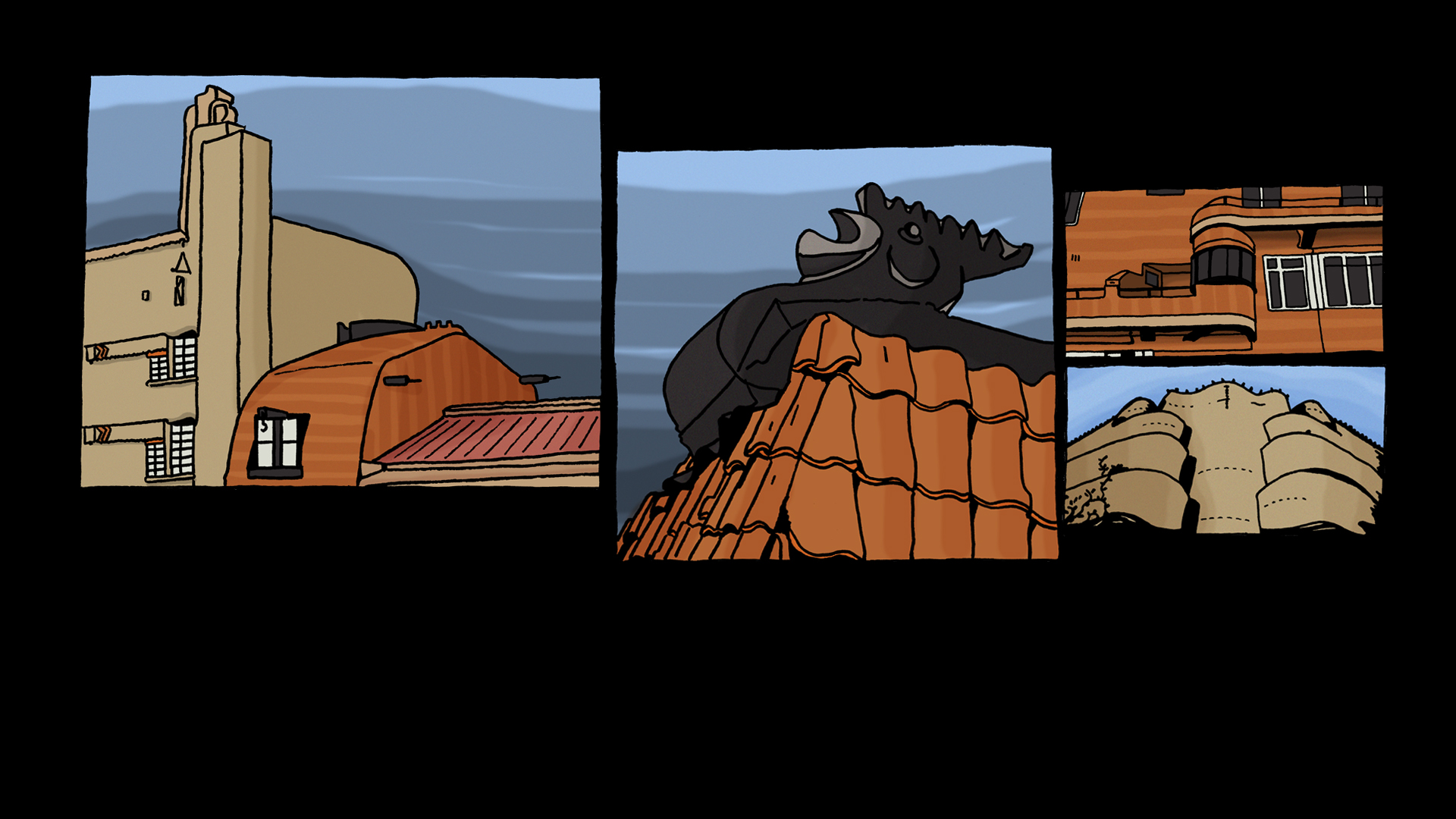
Image by: Krish Raghav
Hard work
He doesn’t really have a natural talent for drawing, he admits, but he actually finds that makes the process easier. “It’s not a creative process for me, so I don’t need to be inspired. I just have to work hard at it – and that can be planned.”
Anyone can learn to draw, Krish believes, if they put their mind to it. “Around 2010 I had a blog, and to make it stand out I added illustrations with stick figures. Later I moved to Facebook, and the comics became really popular there. That’s when I started teaching myself how to draw better – for instance by taking photos of myself in different poses and tracing them onto paper”, says Krish. “Then I’d edit them further in Photoshop. The more I did that, the better I got at anatomy. I still trace photos when I need to draw a tricky pose.”
Swamp creatures
‘Pigeons were useful to humans for centuries as a means of communication, so they still remember that people used to love them. But we’ve forgotten’
The game includes all kinds of observations Krish made since moving to the Netherlands. “I learned about the construction of Amsterdam – how the city rests on rotting wooden piles and is slowly sinking. People sometimes forget that it’s basically a swamp.”
This comes back in the game as ‘the swamp flat’, based on a real viewing of a home with one room that, for some reason, had very high humidity. In the virtual flat, a deep swamp is inhabited by endangered or extinct Dutch animals and plants, like the ruff, the narrow-headed marsh fly and the dark-blue bellflower.
His fascination with Dutch wildlife doesn’t end with extinct species. The Amsterdam city pigeon holds a special place in his heart. “There’s a group of volunteers called Pidgeon Rescue, who help the pigeons on Dam Square every week by removing waste like string or plastic wrapped around their feet. They call it stringfoot – it can be really dangerous for pigeons.” He actually wanted to make a comic about them. “Amsterdammers hate pigeons, they see them as flying rats, but I think it’s great that there’s a group that actually cares about them. You know, pigeons were useful to humans for centuries as a means of communication, so they still remember that people used to love them. But we’ve forgotten. And that’s actually quite sad.”
Read more
-
The gloomy Christmas of Erasmus
Gepubliceerd op:-
Column
-
De redactie
-
 Elmer Smaling
Deputy editor-in-chief
Latest news
-

Bottlenecks in higher education funding: will they change?
Gepubliceerd op:-
Education
-
-
Binding study advice mainly has disadvantages, according to new large-scale research
Gepubliceerd op:-
Education
-
Comments
Comments are closed.
Read more in Staff
-

ESSB amends job posting after controversy over ‘scholars of colour’
Gepubliceerd op:-
Diversity
-
Staff
-
-
Anti-Israeli Pettit not allowed to work at Brussels university
Gepubliceerd op:-
Staff
-