Ad

Lives are full of change, and that’s why Yara Toenders is researching the brain

Yara Toenders likes to look into other people’s lives. As a scientist and as a reader. With the book The eighth life (for Brilka) by Nino Haratischwili she could lose herself in six generations. A bull’s-eye.
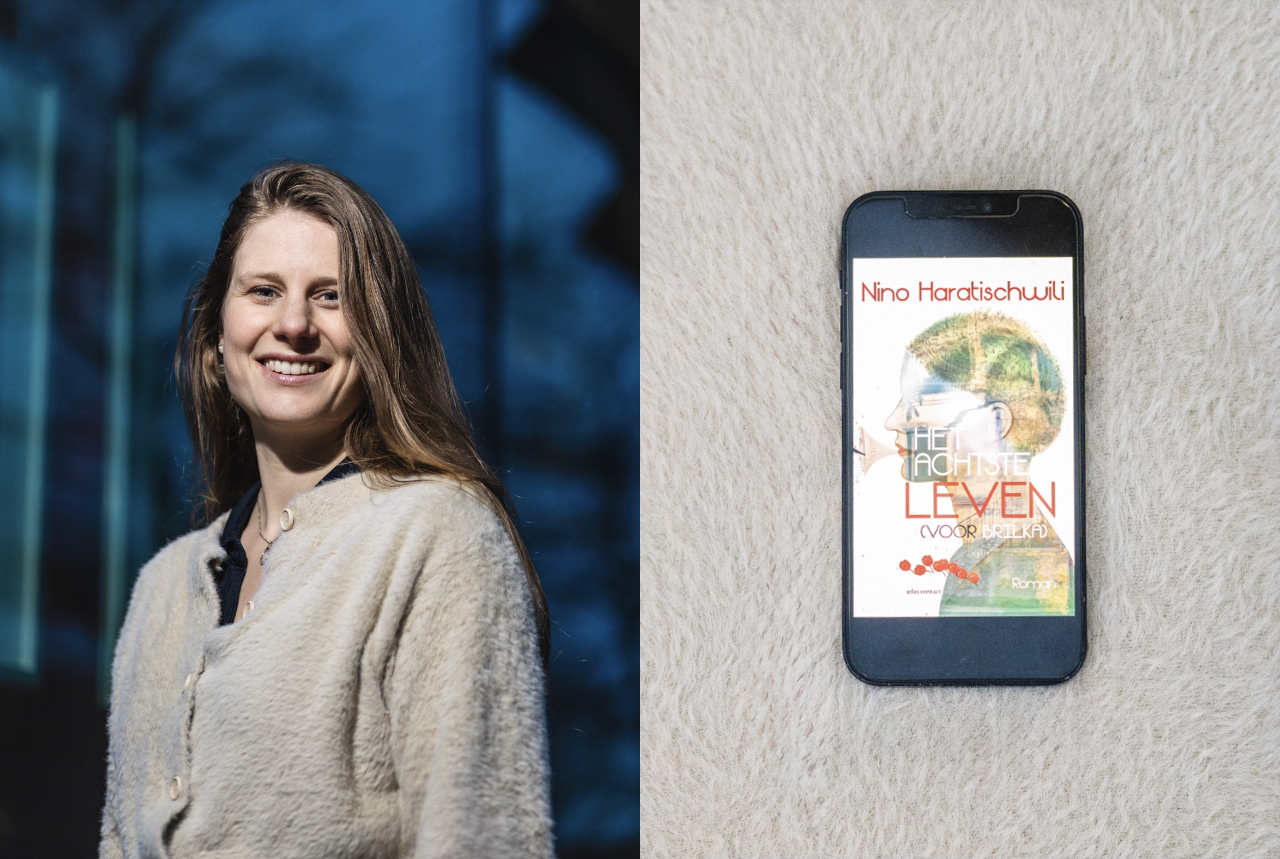
Image by: Leroy Verbeet
The book The eighth life (for Brilka) by Nino Haratischwili is ‘one of the favourite books’ of Yara Toenders. Her enthusiasm is shared by those around her. When she attended the theatre production of the same name, her uncle and aunt were sitting a row behind her and somewhere further along she spotted a friend. In the Netherlands nearly one hundred thousand copies of the book about six generations of a family in Georgia have been sold. What resonates?
Neurobiologist Yara Toenders earned her PhD at the University of Melbourne, where she researched the origins of depression in young people. She now works as a Healthy Start Fellow at Erasmus University. Her research focuses on the mental well-being of adolescents, from the biological to the social level. Biological factors she studies include brain development and sleep. Social factors include the smartphone ban and performance pressure. She recently received the Early Career Award from the KNAW.
Curious about the life of others
Toenders likes to take a brief look into the lives of others. The book offered her a glimpse into seven lives at once, lives that are connected but each developing in their own way. Every life goes through different stages; when Toenders thought about which stage she had read with the most interest, she arrived at adolescence. The period, roughly between 10 and 24 years of age, which she studies as a neurobiologist. “In that period people start discovering the world, they become more themselves and they develop opinions that differ from those of their parents. The characters in the book start exploring, just like the young adults I see in my research.”
Her scientific interest in adolescence began with the complex changes in the brain during this stage. Contrary to what people often think, the number of brain cells decreases during adolescence, Toenders explains. “At the same time, we call it a growth spurt, because the number of connections between the cells increases. In childhood, the brain is a densely overgrown forest with narrow paths; from puberty onwards some trees disappear, the paths widen and you can walk through the forest more easily and quickly, is the analogy.”
Mood swings are normal
While she focused on young people dealing with depression during her PhD research, she now turns to the mental well-being of adolescents in general. And what turns out? “Mood swings and gloomy thoughts are part of growing up. In the period between 10 and 24 many people experience mood swings, but that period passes. Later in life those mood swings, on average, decrease again.”
The developments and changes that people undergo throughout their lives are of interest to Toenders. That is why she is so enthusiastic about the book The eighth life (for Brilka) in which human lives unfold, and surprisingly enough it is also the reason she’s interested in brains.
Life-long brains
Brain scientists are sometimes accused of being deterministic, as if everything has already been decided, but Toenders emphasises the plasticity of the brain. “You can try to use the brain to explain or clarify something, but the brain itself also develops. The brain is never finished.”
For Toenders herself the exploratory phase that is so typical of adolescence began when, at eighteen, she left Wadenoijen, a small village near Tiel, and moved to Amsterdam. As a young mother she can now, through personal experience, relate to studies showing that the brain undergoes change during this stage.
Reading behaviour
Number of books per year: “My goal is two books a month, but for two years in a row I have read 23 books and therefore just missed my goal.”
Motivation: Losing myself
Last read book: The anxious generation by Jonathan Haidt. “Outside the university the book is popular, but in the scientific world it is received negatively. The author claims that social media are bad for mental health, while there is little scientific evidence for that. In the studies that do exist it’s always about correlations, not causations.”
Favourite genre: Novels. “I cannot cope with suspense, so no thrillers, then I can’t sleep anymore.”
Read more
-

Sam van Leeuwen teaches Dutch to newcomers integrating into society
Gepubliceerd op:-
Page-turners
-
De redactie
-
 Maartje Braam
Editor
Latest news
-

New code of conduct for science emphasises ‘distinctiveness and autonomy’
Gepubliceerd op:-
Science
-
-

Executive Board regularly uses AI for speeches and LinkedIn posts
Gepubliceerd op:-
Artificial Intelligence
-
Governance
-
-
TU Delft may not favour women in admissions to courses
Gepubliceerd op:-
Education
-
Comments
Comments are closed.
Ad
Read more in Page-turners
-
Kindred spirits are closer than you think, Lara Fizaine knows
Gepubliceerd op:-
Page-turners
-
-
Once you have found what suits you, things fall into place, says Lenya Slierendrecht
Gepubliceerd op:-
Page-turners
-
-
Feeling and thinking must go together, Paul van Geest knows
Gepubliceerd op:-
Page-turners
-