Students without municipal registration. ‘I work off the books in a restaurant’

Some students are unable to register with the municipality because they have no official address in Rotterdam. For Dutch students, that often means they can’t get the living-away-from-home grant. For international students, the consequences are even greater: they cannot take out health insurance or open a bank account, work legally or apply for student finance.
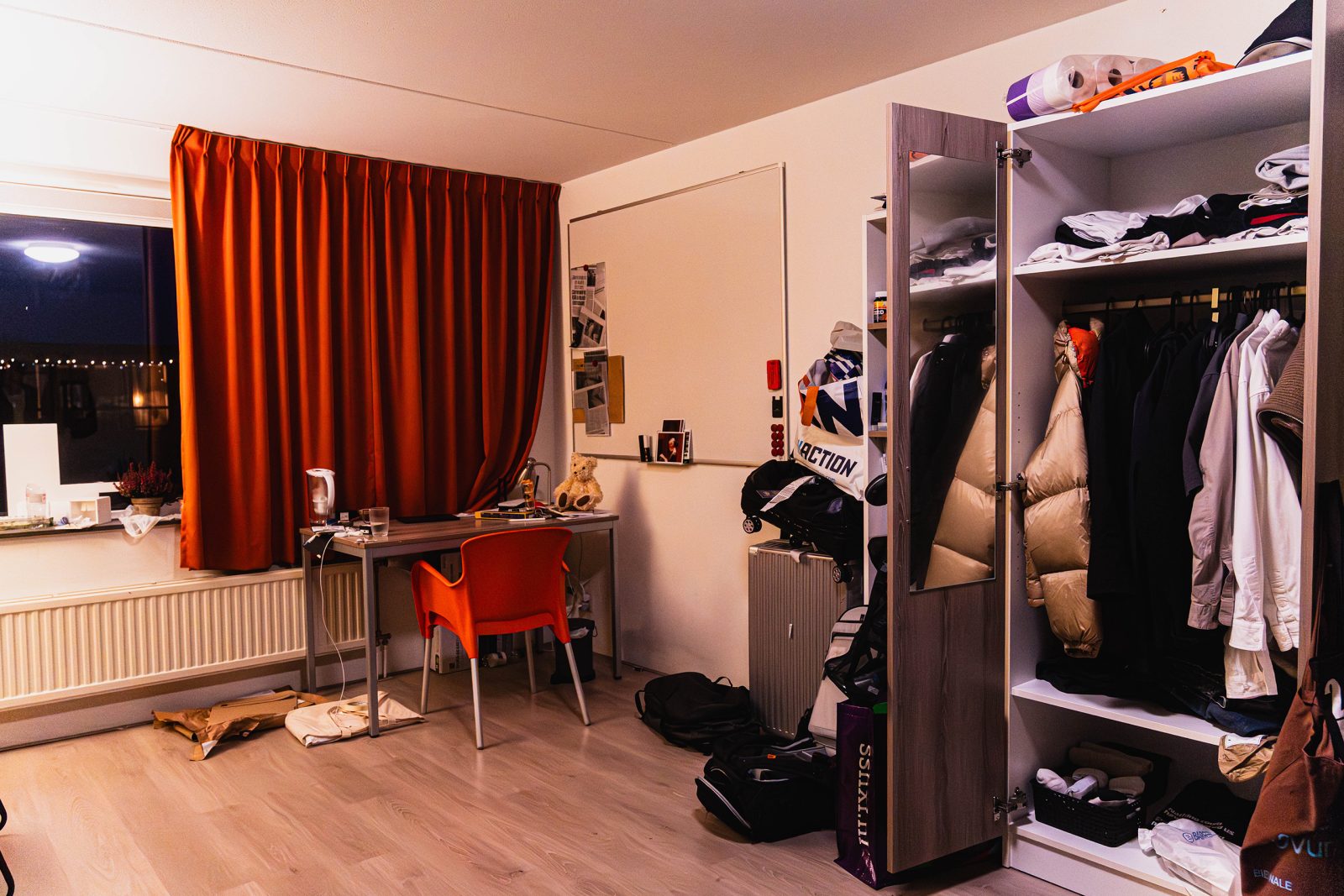
Image by: Nhat Minh Bui
When Ralph couldn’t find a room this summer, he was allowed to temporarily stay with friends of his parents in Delft. The French student slept in the couple’s study and commuted to Rotterdam every day. When he asked if he could use their address to register with the municipality, they refused. “Because then they would’ve had to pay more municipal taxes”, Ralph explains.
After six weeks, the first-year moved to a temporary room in Rotterdam. The actual tenant is abroad for seven months for work. Ralph can’t register with the municipality at this studio either, because the tenant is still registered at that address. “I don’t even have a contract. Every month, I transfer the rent to the tenant’s account.”
Known problem, unknown scale
Image by: Nhat Minh Bui
Ralph isn’t the only student living at an address where municipal registration is not possible. EM spoke to six international students who are in or have been in the same situation. Institutions and student organisations are also aware of the issue.
“I have no other choice”, says Emy, a German student. When she learns in April that she has been admitted to the Psychology programme, the first-year enthusiastically begins her search for a room. It soon turns out how difficult that is. She travels back and forth from Germany several times for viewings and introduction evenings, but without success. Eventually, she finds a room in Blijdorp from August: a sublet from another student who is on exchange until February, meaning she can’t register with the municipality.
‘It’s especially hard for international students, because they have no safety net here’
EM’s investigation shows that the problem is known to the university, the municipality and student organisations such as the National Student Union (LSVb) and the Dutch National Student Association (ISO). Yet no figures are available. “We have heard about the problem, but unfortunately we don’t keep track of it”, says ISO chair Sarah Evink. “I feel really sorry for students who have to deal with this. It’s especially hard for international students, because they have no safety net here. I can imagine that they can no longer fully enjoy their student life in the Netherlands.”
Legal advice bureau Rechtswinkel Rotterdam also doesn’t know how widespread the problem is. Staff members occasionally speak to students who find themselves in this situation, says legal adviser Nassim Ajdid. “For example, students who live in rooms that don’t meet legal standards, or in houses where more people live than allowed.”
Image by: Nhat Minh Bui
Financial losses
Both Dutch and international students miss out on financial support because they can’t register, says Ajdid. “Dutch students often remain registered at their parents’ address and therefore cannot apply for the living-away-from-home grant.”
The basic grant is currently 125.99 euros per month, while the living-away-from-home grant is 314 euros. Students who cannot be registered as living away from home thus miss out on 188 euros per month. “That may not sound dramatic”, says Ajdid, “but over three years of study that’s almost 7,000 euros – a substantial amount.”
For international students, the consequences are often even more serious. Without registration, they cannot get a citizen service number (bsn). Without that number, they can’t work, open a bank account or health insurance policy, or apply for allowances. “In short: without a bsn, you do not exist administratively in the Netherlands.”
No student finance
This is also the case for Ralph and Emy. They have no bsn, so as EU students they can’t apply for student finance. “That’s actually the biggest disappointment”, says Ralph. “My parents still help a bit, but I can barely get by without student finance.”
That’s why he took a job on the side. Off the books, because officially he’s not allowed to work. Through acquaintances, he gets a weekend job as a dishwasher at a restaurant in the city centre. “I get paid in cash at the end of my shift”, says the student, who is enrolled in an international bachelor’s programme at EUR. This is also why he doesn’t want his surname or degree programme mentioned in the article. “I’m afraid that not only I could get into trouble, but also the restaurant where I work.”
Image by: Nhat Minh Bui
Katharina from Slovakia, who recently graduated, continued to receive student finance even though she also lived at an address where she couldn’t register. “In my first year, I lived at Xior and could register with the municipality. When I went on exchange to Germany and gave up my room, I deliberately didn’t deregister”, she explains. When she returned, she rented a sublet room for a year without registration. “That was fine, because I had everything already arranged. My student finance was paid into my Dutch bank account, and I collected all my post from my old address.” She now lives somewhere else. “I’ve updated my address with the municipality now.”
‘Legally it is punishable, but in practice it is rarely enforced’
Legally punishable
Emy finds her situation stressful, she says. Not only because she has to find new accommodation within two months, “but also because I’m technically staying in Rotterdam illegally.” That’s why she also doesn’t want her surname mentioned in the article.
Her statement is correct, says a spokesperson of the municipality of Rotterdam. Every foreigner, including EU citizens, is required to register in the municipality’s Personal Records Database if they stay in the Netherlands for more than four months. Not registering, or registering incorrectly, is legally an offence and can lead to a fine.
“Legally it is punishable, but in practice it is rarely enforced”, says Ajdid from Rechtswinkel. “It’s not a criminal offence, so it doesn’t result in a criminal record.” In practice, these situations are usually tolerated or remain invisible to the municipality unless a report is made. “A student who goes to the municipality to register risks getting the main tenant into trouble and losing their room”, Ajdid explains. “That’s why many students choose not to register or report the situation, even though they know it’s required.”
Image by: Nhat Minh Bui
Correspondence address as a temporary solution
The municipality spokesperson points to a temporary solution: the correspondence address (briefadres). This is an official mailing address where you can receive government and tax correspondence. With a correspondence address, you can work, apply for student finance, take out health insurance and open a bank account. “But you can’t apply for rent allowance, because it’s not the home you actually live in”, says the spokesperson.
According to the university, the correspondence address helps to ease some of the problems, but doesn’t solve them entirely. “For prospective international students, having accommodation is an important condition for coming to Rotterdam. We emphasise this early in their orientation process”, says Karen de Man from the International Office. “We try to support students as best we can and guide them through the steps they can take to find accommodation.”
Ralph hadn’t heard about the correspondence address. “That’s good news”, he says. After a short pause, he sighs: “But I still have to keep looking for a room. Without a permanent place to live, I can’t relax. You can’t really settle when you’re stressed about housing.”
Where can i find information?
The municipality advises students to be well aware of their rights and responsibilities. At www.weetwatjehuurt.nl, you can find information about rent prices, registration and agency fees. You can check whether your rent is too high using the rent price calculator. The municipality also stresses the importance of reporting abuses directly via the Unwanted Rental Behaviour hotline. You can also visit the information centre at Markerstraat 7.
On the EUR website, students can find tips on starting their housing search early, information about reserved rooms and advice on reliable platforms.
Read more
-
Mass exodus of student houses from the housing market
Gepubliceerd op:-
Housing
-
De redactie
-
 Feba Sukmana
Editor
Latest news
-

Away with the ‘profkip’, says The Young Academy
Gepubliceerd op:-
Science
-
-

House of Representatives wants basic grant for university master after HBO
Gepubliceerd op:-
Money
-
Politics
-
-

Company takes a huge chunk of the student finance of at least 350 internationals
Gepubliceerd op:-
Internationalisation
-


Comments
Comments are closed.
Read more in Housing
-

Loan system kept students living at home with parents
Gepubliceerd op:-
Housing
-
-

Student housing Toepad not scrapped after all, completion expected in 2027
Gepubliceerd op:-
Housing
-
-
Mass exodus of student houses from the housing market
Gepubliceerd op:-
Housing
-