Showing their colours: how did the parties vote on higher education?
Election manifestos are full of wonderful words, but what did political parties actually do when push came to shove? How did they vote on issues like English-taught education, discrimination and internship pay?
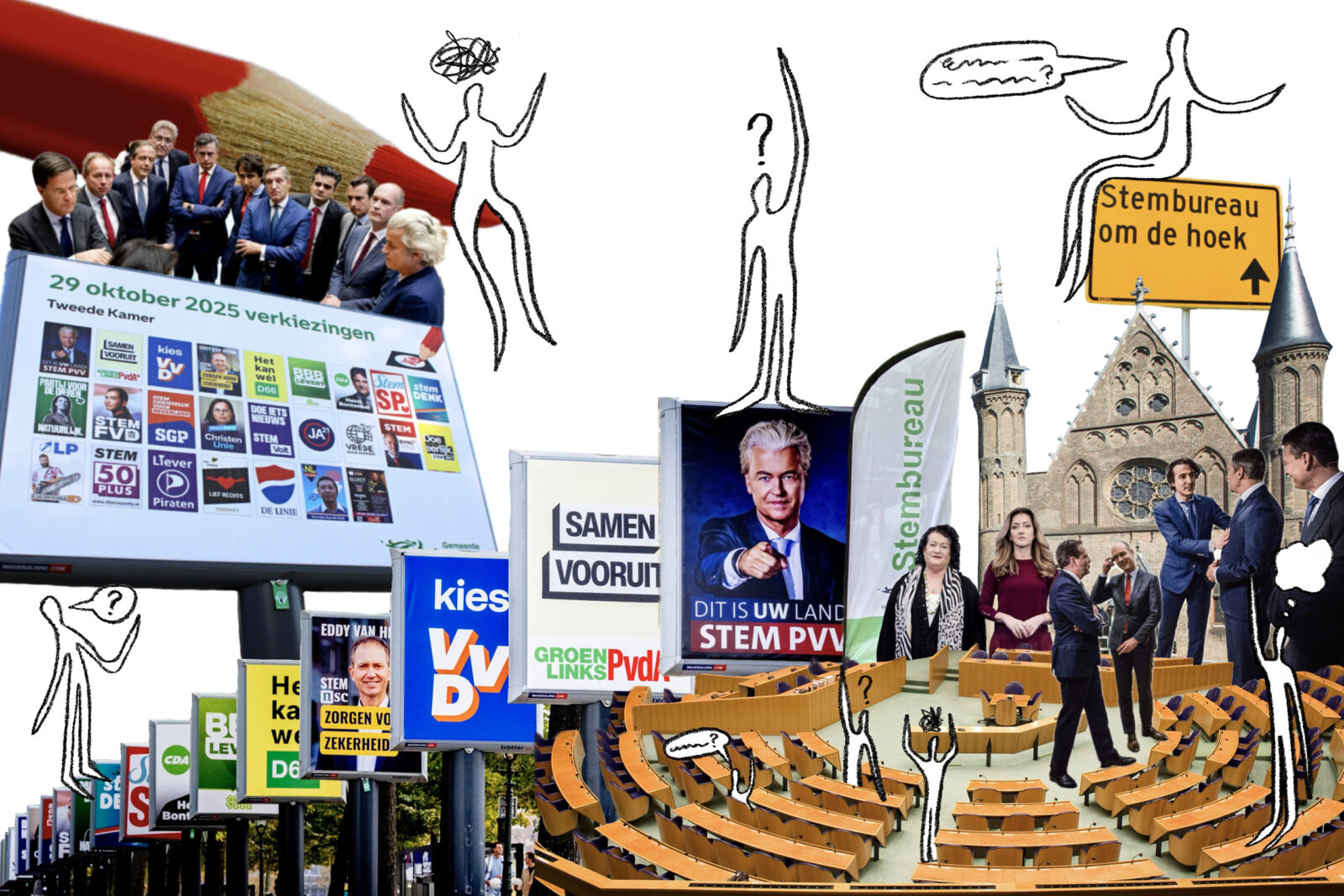
Image by: Sonja Schravesande
At almost every debate, MPs submit motions to force other parties to take a stand. If a motion is adopted, the government must act on it.
So how did things go recently in higher education? Which motions passed and which ones failed?
No ‘bullet-point terrorism’
Note: sometimes parties submit nonsensical motions, mainly to put others in a bad light and share screenshots online. That’s what Arjen Lubach refers to as bullet-point terrorism. We’ve tried to leave out those types of motions.
We’ve also left out motions on budget cuts. The governing parties signed a coalition agreement they couldn’t easily deviate from. On top of that, compromises were made with opposition parties on the education budget. So votes on budget-cutting motions say little about where individual parties really stand.
Foreign students
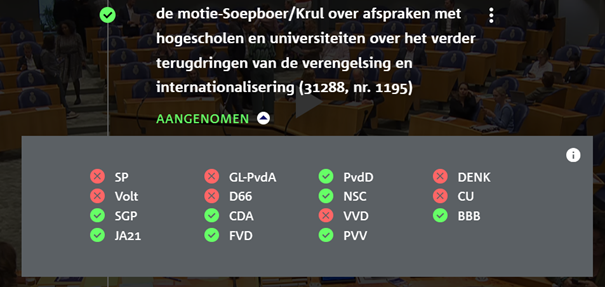
A few years ago, a large political majority wanted fewer foreign students to come to the Netherlands. The easiest way? Make bachelor’s programmes Dutch-taught again. That way, international students wouldn’t be able to attend the classes.
All English-taught bachelor’s programmes were to be assessed with a language test: wouldn’t it be better to teach them in Dutch? This created major uncertainty in higher education, and even the business sector raised concerns.
Gradually, nuance started to creep in. Even some government parties recognised that in certain fields – and certain regions – the Netherlands can really use international talent. What’s more, universities decided to take the initiative: let us decide for ourselves which programmes should become bilingual or switch entirely to Dutch, they said. That initiative was welcomed by the political world.
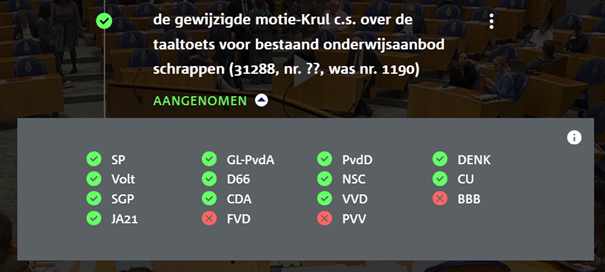
So this spring, two motions were adopted. One stated that a set of criteria by the ministry (the ‘language test’) to decide whether existing programmes are allowed to continue, should be scrapped. The other called for agreements with universities to reduce English-taught education. Both passed with varying majorities.
Discrimination: do we want to know?
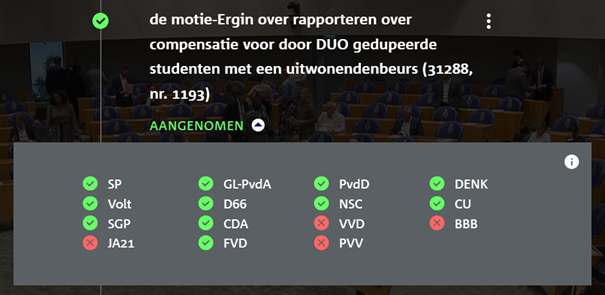
Fraud investigations by student funding agency DUO went wrong: almost all of those targeted were students with a migrant background, often without any actual leads that they might be fraudulent. The previous cabinet apologised, and the current one decided to reverse all fines and repayments. But paying the money back takes time.
The Denk party wanted an update. The psychological and financial damage to (former) students is considerable, after all. How many students have already been compensated? Are there bottlenecks? Is the allocated budget sufficient? The then-minister (from NSC) was fine with the request, but some parties would rather not receive this information.
Student financing
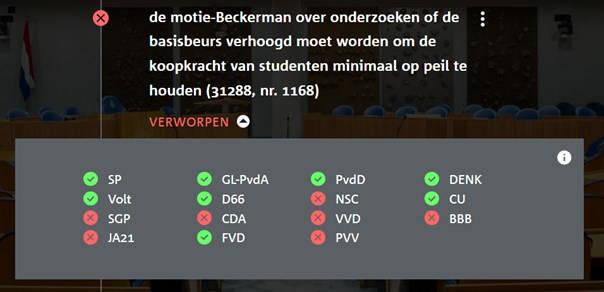
How are students doing financially? Should the basic grant perhaps be increased? Let’s investigate that, said a motion. Again, some parties didn’t want to know, while others saw no harm in it.
Internship discrimination
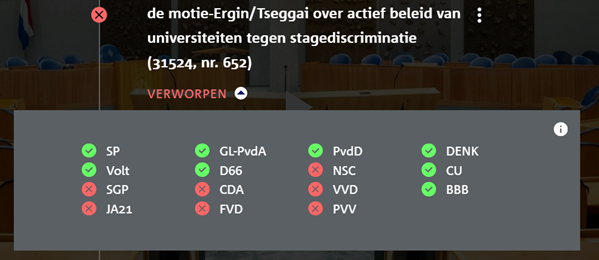
Jochem and Julia easily find an internship, Achmed and Fatima don’t. That’s called internship discrimination. Sometimes lecturers and staff at education institutions don’t know what to do when their students face this. So hold universities accountable and ask them to adopt ‘proactive policies’, the motion said.
The then minister of Education thought the issue was important, but called the motion unnecessary: according to him, universities are already doing plenty. That might explain why the CDA voted against it – the party dislikes superfluous motions.
Internship pay
Sometimes interns are paid, sometimes not. Only 42 percent of MBO students receive internship pay. For HBO students it’s 75 percent. Among university students, 65 percent of compulsory internships and 91 percent of voluntary internships are paid.
Don’t let interns work unpaid, say some parties. The minister has indeed held the threat of a legal requirement over the sector. But others disagree, saying: if small businesses can’t afford the costs, they’ll stop offering internships and we’ll all be worse off.
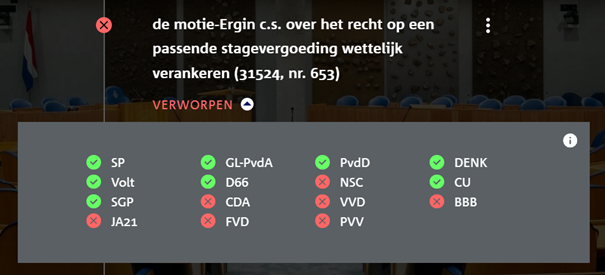
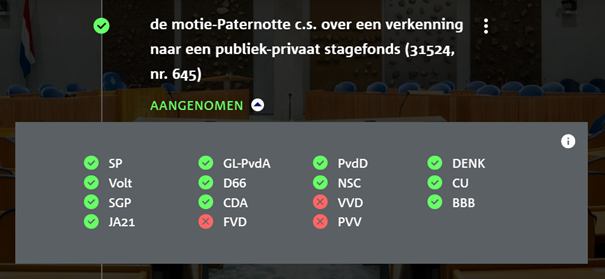
Can’t we find a solution for small employers? Let’s set up a public-private internship fund, said another motion. That way, interns could receive pay even at small businesses. The responsible minister called it a sympathetic plan and was open to exploring it – but not all parties felt the same.
Protests
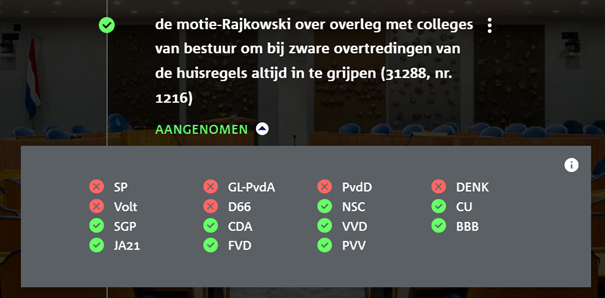
University administrators sometimes have to take a practical approach to protests on campus. Occasionally, a few troublemakers are among well-meaning demonstrators – and then what? Ban demonstrations? Evict buildings? Or still opt for dialogue?
Some parties believe these decisions should be left to university administrators and express understanding for the protesters’ concerns (for example, over ties with Israel or the fossil fuel industry).
But others argue the government should expect something from administrators in return. We cannot accept vandalism, intimidation or the threat of violence – academic freedom is at stake. The minister could make it clear to Executive Boards that they must act in cases of serious breaches of house rules.
Private sector
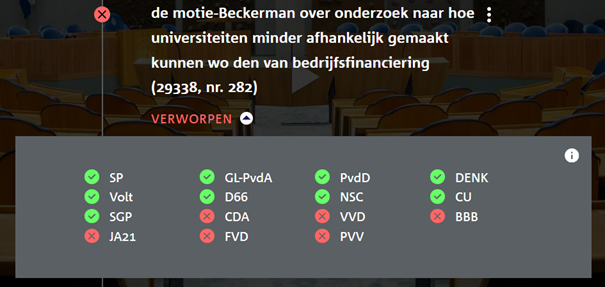
Companies sometimes fund a chair (i.e. the salary of a professor focusing on a specific subject). They also occasionally commission research at universities. This ‘third stream’ of funding accounts for around 18 percent of all income.
Some parties are wary. Collaborating with business can be valuable, but science must remain independent. Others see no issue.
United States
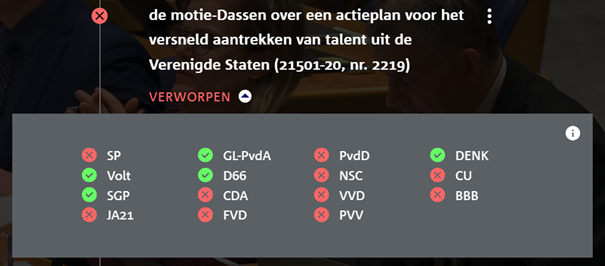
Donald Trump’s attacks on higher education and research in the US may open a door: could we attract researchers and students from the United States to the Netherlands?
The real question wasn’t whether such a fund was a good idea – 40 million euros has since been allocated – but whether it should specifically target the United States. That might rub our ally the wrong way.
Housing shortage
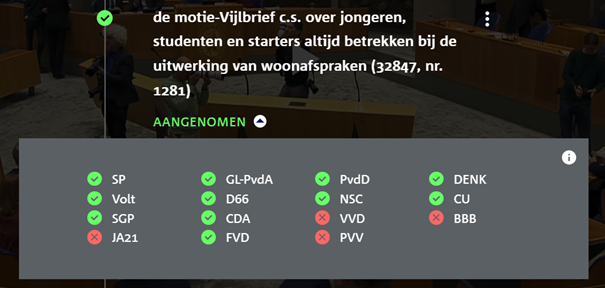
Young people are feeling the effects of the housing crisis, yet they weren’t represented at a key meeting between the government, housing associations and private investors. That needs to change in future, said a majority. But a few parties saw little merit in the idea.
The general election takes place this Wednesday, 29 October.
Lees meer
-

Poll: Neck-and-neck race between D66 and GroenLinks-PvdA at Erasmus University
Gepubliceerd op:-
Politics
-
De redactie
Latest news
-

Away with the ‘profkip’, says The Young Academy
Gepubliceerd op:-
Science
-
-

House of Representatives wants basic grant for university master after HBO
Gepubliceerd op:-
Money
-
Politics
-
-

Company takes a huge chunk of the student finance of at least 350 internationals
Gepubliceerd op:-
Internationalisation
-


Comments
Comments are closed.
Read more in Politics
-
House of Representatives wants basic grant for university master after HBO
Gepubliceerd op:-
Money
-
Politics
-
-

Returns on knowledge can indeed be predicted, economists argue
Gepubliceerd op:-
Politics
-