Ad

Poll: Neck-and-neck race between D66 and GroenLinks-PvdA at Erasmus University

GroenLinks-PvdA and D66 are virtually tied in a poll among students and staff at Erasmus University. Housing, climate, and asylum and migration are the three most important election issues on campus.

Image by: Esther Dijkstra
If it were up to students and staff, GroenLinks-PvdA and D66 would be the largest parties. Both can count on at least 21 seats and are most often mentioned by voters still hesitating between two or more parties. The difference in the EM poll, conducted among more than six hundred students and staff, is so small that it is impossible to say which of the two is ahead. The CDA, JA21 and the Partij voor de Dieren also enjoy significant support on campus.
Lees meer
-
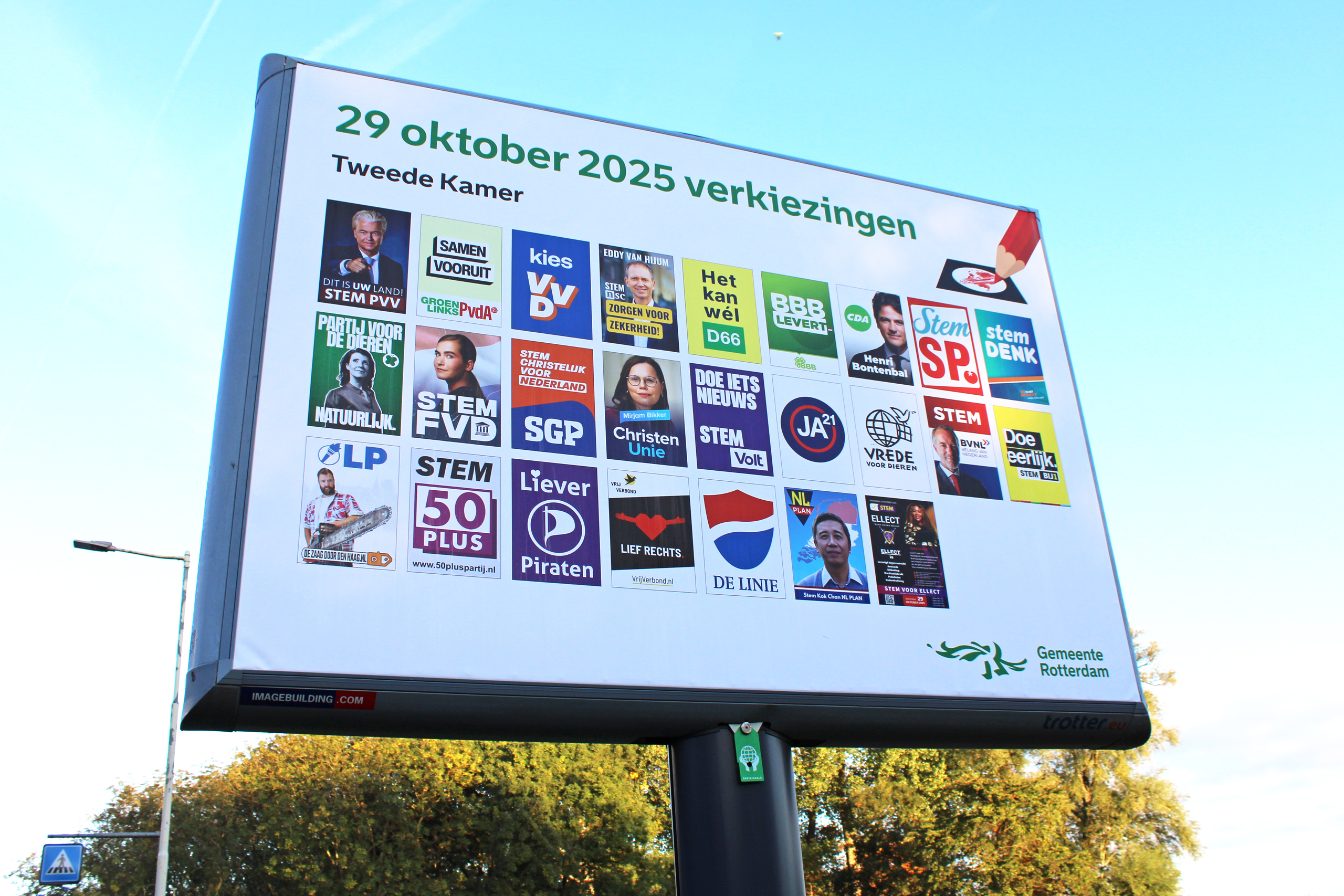
This is what the parties want for higher education and research after the elections
Gepubliceerd op:-
Politics
-
Among students, D66 is slightly more popular than GroenLinks-PvdA. Among academics, however, the latter party is by far the largest: almost 30 percent already know they will vote for the party led by Frans Timmermans on 29 October, and another 14 percent are wavering between GroenLinks-PvdA and one or more other parties. EUR academics in general appear to vote somewhat more left-wing than support staff and students. In addition to GroenLinks-PvdA and D66, the Party for the Animals and Volt are also doing well among academics, while there is little to no support for parties to the right of the CDA. GroenLinks-PvdA also receives the most votes among support staff, with at least 20 percent voting for the party.
JA21 popular among students, men and RSM
Another striking difference between students and staff is the enthusiasm for JA21. 8 percent of students plan to vote for the party, and another 7 percent mention Joost Eerdmans’ party as one of the options they are considering. Only one staff member intends to vote for JA21 on 29 October.
The party is also significantly more popular among men. In this poll, JA21 ranks in the top three among men, after D66 and on par with GroenLinks-PvdA, while fewer than 2 percent of women are considering voting for it. Eerdmans performs particularly well among RSM students – for a third of respondents from that faculty, JA21 is an option.
Coalition loses ground
Alongside JA21, the CDA and the Partij voor de Dieren are performing much better than in the poll EM conducted ahead of the 2023 elections. Volt, on the other hand, has become slightly less popular, but with six seats and many undecided voters, it remains the sixth largest party on campus.
As in the national polls, the (former) coalition parties VVD, BBB and NSC are losing considerable ground. The PVV, however, enjoys slightly more support among EUR students than two years ago, although no staff members in the poll intend to vote for the party.
Lees meer
-

Poll: GroenLinks-PvdA victory at Erasmus University
Gepubliceerd op:-
Politics
-
Housing the most important issue
Housing is by far the most important topic in these general elections. More than half of respondents say the issue will influence their vote. Academics, however, more often cite climate and higher education as the most important topics.
“I think the housing crisis is currently the most important issue for my future and that of my peers”, writes an ESSB student. “I’d like to own my own house in the future”, says a first-year RSM student. “Society, including the housing market, shouldn’t become a monopoly for the wealthiest people”, adds another first-year ESSB student. An ESE master’s student sums it up: “The Netherlands needs to build more houses.”
Climate is also an important issue for many staff and students – particularly academics, and students from ESSB, ESPhil and Erasmus MC. Asylum and migration also appears to be significant topic, especially among RSM and ESL students.
Higher education back on the agenda
Issues such as healthcare and taxation have faded somewhat into the background compared with two years ago. Likewise, social security – the key election issue of 2023 – seems less relevant to EUR students and staff this time.
Higher education, on the other hand, is back on the agenda. Nearly a quarter of respondents cite it as an important issue. In the 2023 elections, only 13 percent considered it relevant. This likely relates to the budget cuts: “Stop cutting funding for higher education”, one staff member commented in the poll.
Economy matters to economists and business students
For RSM students, the economy is the most important election issue. More than six in ten say it influences their vote. For ESE students, too, the economy ranks high – after housing, it is their second priority. The economy is also a more important topic for men than for women.
With climate, it is the other way round: more than half of women name it as an important election issue, compared with just one in three men.
Genocide
The war in Gaza also appears to be an important election issue for many students and staff. It was not included as a separate topic in the poll but frequently appears in open responses. “The oppression of Palestinians by descendants of Western World War II refugees affects me deeply”, writes an ESL student. “I want to vote for a party that recognises the genocide in Palestine, wants to impose sanctions on Israel such as an arms embargo and cut economic ties”, says an ESSB student who plans to vote for the Partij voor de Dieren.
Populism, polarisation and good governance also feature prominently in open responses. One student advocates ‘a sober reassessment of the current political system: less populism, more reason’. “Politics has become rather harsh in recent years”, a staff member notes. “It could be a bit kinder to everyone.” “A stable government”, is what a philosophy student wants. “No more caretaker cabinets – just calm, clarity and consistency.”
From 7 to 20 October, 629 students and staff took part in EM’s poll. Of them, 489 were students, 67 support staff and 66 academic staff. They answered questions about which party they plan to vote for, which parties they are hesitating between, and which issues determine their choice at the ballot box.
Almost 60 percent of respondents identify as male. Men are therefore overrepresented. It is likely that this poll therefore skews slightly to the right compared with a representative sample of all students and staff, as men tend to vote more right-wing than women.
We chose not to include Israel–Palestine as a separate topic so that the poll could be compared with that of two years ago. Nonetheless, the open responses show it is an important election issue for many students and staff.
Parties that, according to this poll, could count on fewer than half a seat have been excluded, as the number of respondents voting for those parties is too small to draw meaningful conclusions.
With the cooperation of Elmer Smaling.
De redactie
-
 Tim Ficheroux
Desk editor
Latest news
-

New code of conduct for science emphasises ‘distinctiveness and autonomy’
Gepubliceerd op:-
Science
-
-

Executive Board regularly uses AI for speeches and LinkedIn posts
Gepubliceerd op:-
Artificial Intelligence
-
Governance
-
-

TU Delft may not favour women in admissions to courses
Gepubliceerd op:-
Education
-


Comments
Comments are closed.
Ad
Read more in Politics
-

Translator: Suspended Palestinian student did not say ‘this is me’
Gepubliceerd op:-
Politics
-
-

Knowledge institutions warn against the Netherlands’ frugal approach in Europe
Gepubliceerd op:-
Internationalisation
-
Politics
-
-

Minister sees ‘major problem’ looming: will there be too few international students soon?
Gepubliceerd op:-
Internationalisation
-
Politics
-