U-council criticises justification for Planetary Health Diet, but substantiates it in a letter with errors


The University Council has raised concerns in a letter to the Executive Board regarding the scientific justification of the Planetary Health Diet that the board intends to implement. However, the council substantiates its criticism in the letter with a table full of errors and a flawed assumption.
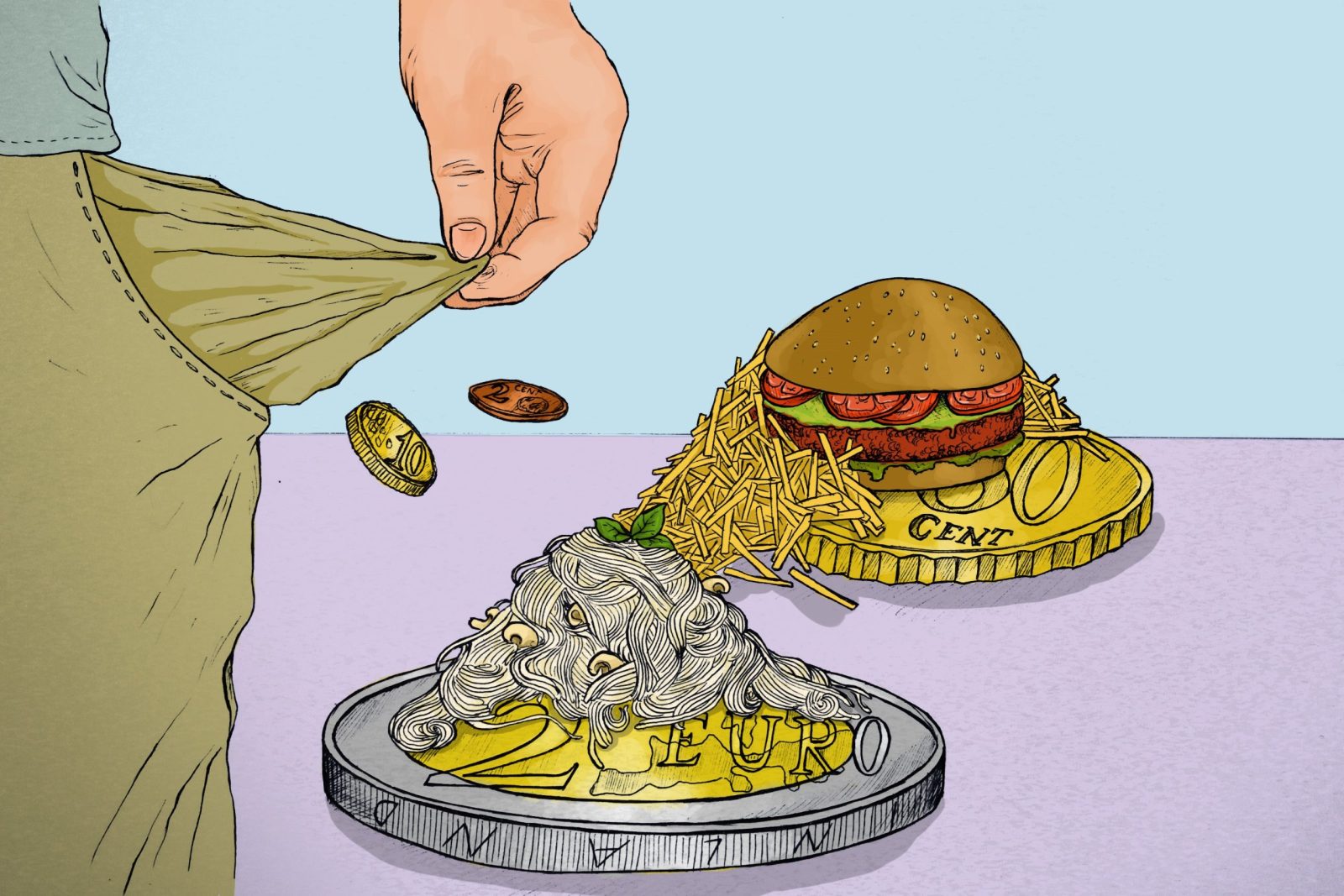
Two council members mentioned possible factual inaccuracies Tuesday 17 June – even before the vote on the letter – but the council decided to adopt and send the letter anyway. EM’s investigation revealed that there were not one, but many factual inaccuracies in the letter, possibly because a table with chatgpt was generated.
Last Tuesday, it was decided that Luca Hellings, chair of the University Council, would inform the board informally about the errors made.
Hellings regrets this, but according to him, the council’s criticism stands. “The gist of the letter remains the same, but it is important that we provide reliable and sound advice to the board.”
Higher prices
In 2022, the Executive Board expressed the ambition that the campus would become completely vegan by 2030. Following the declaration of a climate emergency, the university board aimed to accelerate their efforts. The university has now reconsidered this and is opting for the more flexible option of the Planetary Health Diet, which still includes limited animal products.
In the letter, the University Council expresses its critical stance towards this initiative. According to the council, the implementation would lead to higher prices, and the savings on the university’s carbon footprint would be minimal.
Furthermore, the University Council claims that the university deviates on crucial points from the scientifically substantiated diet. The council attempted to demonstrate this in the letter with a table comparing the proportions of different food groups in the Planetary Health Diet with the proposal from EUR. In this, the council identified various discrepancies. “This raises questions about the consistency and scientific foundation of EUR’s policy”, the letter states.
Table incorrect
It has now become apparent that the authors of the letter made errors in converting percentages from the EUR proposal into grams. Although EM has not had this confirmed, it strongly appears that the table was created using ChatGPT. The familiar ‘copy icon’ and the classic emoji bullet point were still visible in the letter. The formatting is also identical to tables generated by ChatGPT.
Based on this table, the council claimed that the university did not scientifically substantiate the dietary proposal well. However, 21 out of the 28 figures in their own table are incorrect. Some figures deviate slightly, while others differ significantly.
'Dutch context' is (not) missing
In the letter, the council also claims that the university deviates by 31 percent from the Planetary Health Diet. It is true that the university does not adopt the standard diet one-to-one: it chooses to include approximately 42 percent less dairy, fish, red meat, poultry, eggs, and saturated fats. It has now become clear that the authors of the letter did not take into account that the scientists behind the healthy and sustainable diet work with a range that the diet must meet, rather than exact percentages.
Moreover, the critical council members state that no Dutch person participated in the development of the Planetary Health Diet, suggesting a lack of a ‘Dutch context’ for the diet. However, further research has shown that there is indeed a Dutch scientist from Wageningen among the contributors. Hellings will also correct this aspect with the board before the council’s plenary meeting with the board next week.
'Shame'
It is noteworthy that during the discussion of the letter, last Tuesday, two council members already raised objections regarding the factual inaccuracies. Nevertheless, the letter was subsequently accepted by 13 out of the 17 present council members without addressing this point.
“It is a shame that we are sending out letters full of factual inaccuracies. Although I pointed out during the meeting that there were errors, unfortunately, I was not listened to. I already suspected AI usage at that time, but that was denied”, says Jasper Klasen, one of the dissenting votes.
De redactie
-
 Elmer Smaling
Deputy editor-in-chief
-
 Wieneke Gunneweg
Editor-in-chief
Latest news
-

Letschert gives nothing away in first parliamentary debate
Gepubliceerd op:-
Education
-
Politics
-
-
Away with the ‘profkip’, says The Young Academy
Gepubliceerd op:-
Science
-
-

House of Representatives wants basic grant for university master after HBO
Gepubliceerd op:-
Money
-
Politics
-


Comments
1 reactie
Comments are closed.
Read more in Governance
-

Executive Board supports institutes ISS and IHS’s wish to merge
Gepubliceerd op:-
Governance
-
-

Broad Rotterdam Student Council has first months behind it: ‘We are now really taking part at city level’
Gepubliceerd op:-
Governance
-
-

Thousands of students and lecturers take to the streets for higher education
Gepubliceerd op:-
Governance
-


A. op 27 June 2025 om 11:29
Ridiculous. Just stop with this mandatory vegan nonsense. Let everyone just eat whatever they want.