Ad

CvB: University to face financial ‘perfect storm’

The financial situation of Erasmus University is very concerning, said Executive Board president Annelien Bredenoord on Tuesday during the first ‘townhall’, an information meeting for staff. She described it as a ‘perfect storm’ of various developments. More than 18 million euros in annual cuts will be necessary.
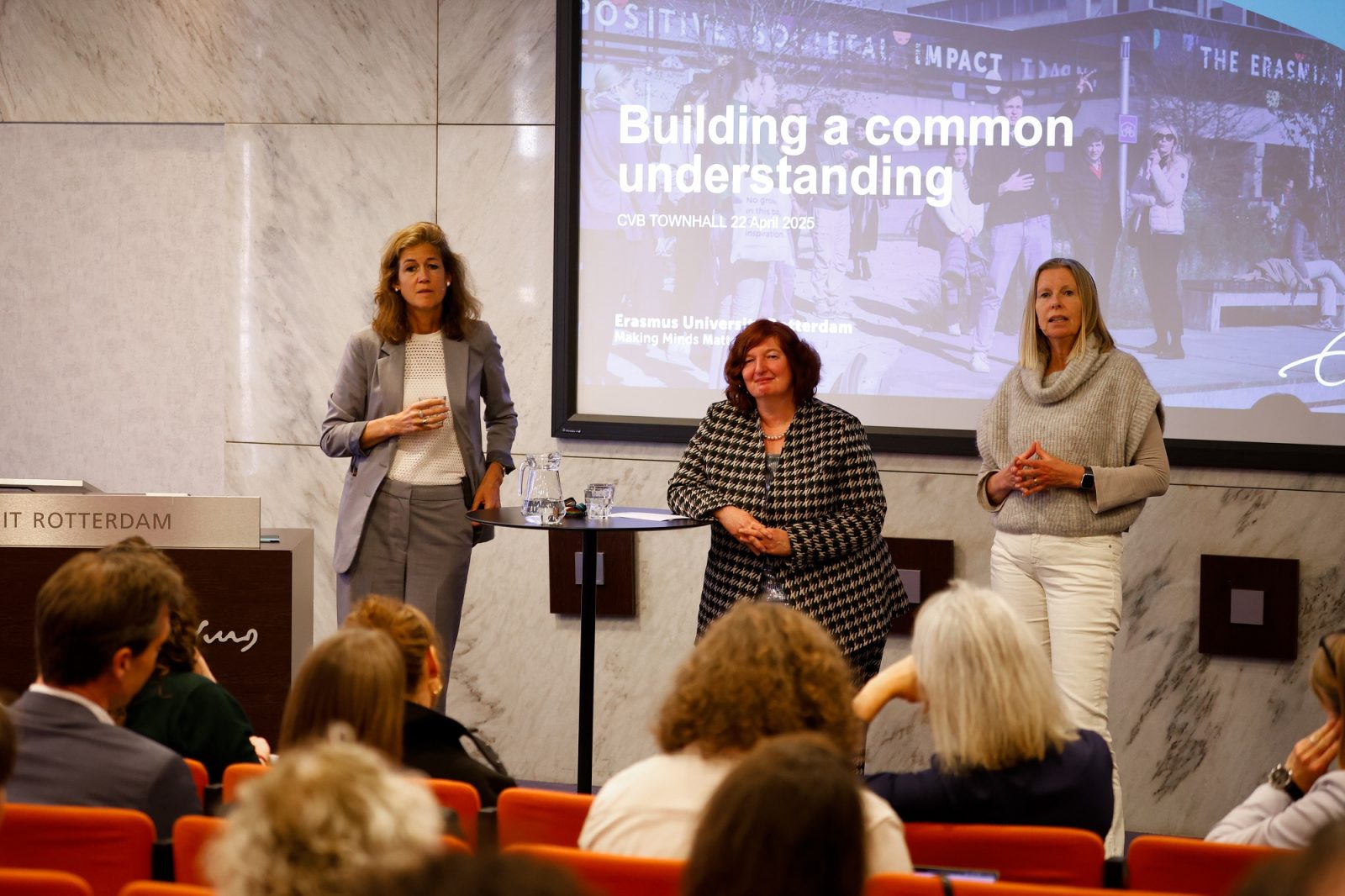
The Executive Board spoke to staff members in the Senate room.
Image by: Daan Stam
In the Senate room of the Erasmus Building, Executive Board president Annelien Bredenoord, vice-president Ellen van Schoten and rector Jantine Schuit spoke with interested staff members. Deans and a few faculty board members were also present. In total, over one hundred staff attended in person, while around 150 colleagues joined online.

About a hundred staff members attended the meeting in person.
Image by: Daan Stam
Financial storm
Read more
-

Spring memorandum includes new cuts to higher education
Gepubliceerd op:-
Politics
-
Bredenoord opened the meeting with an overview of the university’s financial concerns. There are three causes: major budget cuts by the government, a decrease in international students due to political decisions, and a decline in the number of Dutch students as a result of demographic trends. In addition, universities are facing more competition, for example for research grants. “Our university’s earning capacity is under pressure. That makes it difficult to decide for ourselves how we spend our money”, said Bredenoord.
At the same time, salaries have increased and the university has more permanent staff. “That’s exactly what we want: permanent jobs and decent wages. But at the moment, this contributes to a perfect storm”, she said.
Vice-president Ellen van Schoten then outlined the financial figures: the university ended 2024 with a deficit of 3.5 million euros. For 2025 and 2026, annual cuts of 15 million euros are expected, with a further total of 18 million euros between 2026 and 2030 due to the declining number of Dutch students. “So we need to become more strategic, more agile and more entrepreneurial”, she stressed.
Read more
-
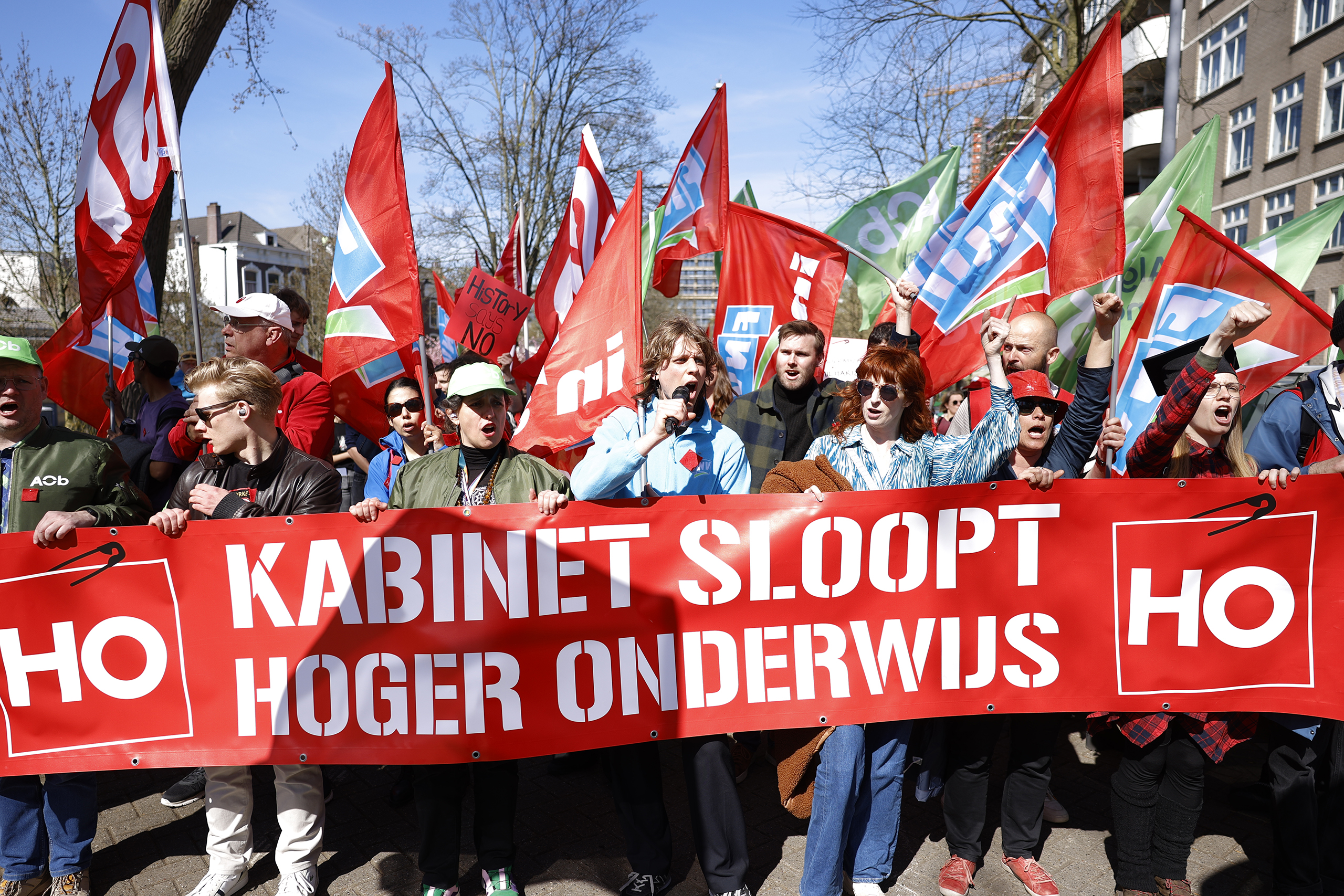
EUR staff went on strike in the city against the ‘Eppocalypse’
Gepubliceerd op:-
Protest
-
Language policy
A second key issue is the Internationalisation in Balance Act, which requires universities to offer fewer programmes in English. Bredenoord explained that she and other university boards had submitted a proposal to the minister: the bachelor’s programme in Psychology will now be offered in Dutch, and student numbers at IBEB and IBA will be reduced. In return, the universities want minister Bruins to leave all other programmes untouched and stop imposing further checks.
Read more
-

English-taught Psychology to disappear and IBEB and IBA to shrink, if language test is scrapped
Gepubliceerd op:-
Internationalisation
-
This deal caused unrest among some staff in the room. “When you made that deal at the expense of our colleagues in Psychology, are you sure this is the end of it? Or will we have to give up more if political winds shift again? That’s been keeping me up at night”, one employee asked.
“I understand you, because we previously had an agreement that wasn’t honoured either”, Bredenoord responded, referring to the 2022 administrative agreement on internationalisation, which was unilaterally cancelled by the current government. “But I believe that making agreements is the right approach. If we don’t make a proposal and the Act is passed – which is likely given the support in both Houses – then all bachelor’s programmes will be assessed against the language requirement. That would mean losing eight or nine programmes. By taking control ourselves, we retain more influence.”
External collaborations
The Executive Board also reflected on the university’s social role. New committees are advising the board on sensitive collaborations, such as ties with the fossil fuel industry and institutions in Israeli territories. “Our social legitimacy can no longer be taken for granted”, said Bredenoord. “We must continue to be accountable to taxpayers and to society.”
Read more
-

Criticism on Israel advice: ‘Stop collaboration now and reverse the burden of proof’
Gepubliceerd op:-
Safety
-
The university is also exploring new strategic partnerships, for example with TU Delft and Leiden University within the Leiden-Delft-Erasmus consortium. An online question was raised: “Do you foresee a merger with Delft, for example?”
Bredenoord: “I don’t see a merger happening in the short term, but we are seriously looking at how we can integrate more, at least in the support services. The content of our programmes differs, but the way we work is very similar. So we believe we can integrate our operations.”
The Executive Board plans to inform staff more regularly through the townhall format. The next one is going to take place on June 22.
De redactie
-
 Feba Sukmana
Editor
Latest news
-

Minister scraps ‘interest cap’ for students: plan much more expensive than expected
Gepubliceerd op:-
Money
-
-
Clubs closing, expensive drinks and dancing with a matcha. How Rotterdam’s nightlife is changing
Gepubliceerd op:-
Culture
-
-

Powerhouses are like shoulder pads
Gepubliceerd op:-
Column
-

Comments
Comments are closed.
Ad
Read more in Money
-
Minister scraps ‘interest cap’ for students: plan much more expensive than expected
Gepubliceerd op:-
Money
-
-

Repay your student debt in 15 years? Then interest rises to 3.28 per cent
Gepubliceerd op:-
Money
-
-
For the first time, student debt in the Netherlands falls
Gepubliceerd op:-
Money
-