Who cleanses your social media feed? Students learn about digital exploitation in a lecture on artificial intelligence

Through the AI and societal impact lecture series, students explore the impact of artificial intelligence (AI) on various aspects of life. This time, they learned about exploitation on the digital labour market.

Image by: Pauline Wiersema
Most of the students already sit in the lecture hall in the Van der Goot building when guest lecturer Claartje ter Hoeven comes in. She is going to tell students all about ghost workers today. These are workers who organise and interpret big data online.
Lecture: AI and societal impact (Wednesday at 11.00 a.m., Van der Goot Building, M1-17)
Lecturer: This lecture series is coordinated by Michele Murgia. The students have a guest lecturer almost every week. This week’s guest lecturer was Claartje ter Hoeven.
Subject: Ghost workers
Audience: Sixteen students from various disciplines (ranging from Economics to Business Administration and Communication), all interested in the subject.
Reason to attend: A lively debate ensued among the students. The lecturer had originally intended to show a documentary, but the spirited and lengthy discussions left her short of time.
Big data
“You can’t interpret big data – a huge data set – without labels”, Ter Hoeven told the students. “In order to train AI systems, you need labelled data. That means people have to train a system to recognise an image as being of an apple, say, or of a banana”, the lecturer went on, pointing to the overripe banana and weirdly shaped apples in her PowerPoint presentation. “At a certain point, artificial intelligence is capable of recognising apples and bananas by itself, but if these fruits deviate from the ‘norm’ in terms of shape or colour, AI will no longer see them for what they are. This is where the ghost workers come in, to help the system out.”

Image by: Pauline Wiersema
Among other things, ghost workers label data for traffic situations (labelling traffic signs), medical procedures (labelling trembling hands) and interactions that are of a violent or sexual nature. Images in the last category are labelled as inappropriate content, so that they do not end up in our feeds.
Exploitation

Image by: Pauline Wiersema
Ghost workers look for assignments on online platforms. “Let’s say you’re a business owner who needs labelled data to train your AI system. You can post the assignment on one of those online platforms”, Ter Hoeven explained. Examples of such digital labour platforms are Amazon Mechanical Turk, Clickworker and Microworkers.
The problem, Ter Hoeven continued, is that this platform work is currently still unregulated. This puts ghost workers in a similar position as on-call workers, who likewise lack employment contracts and workers’ rights. “Worldwide, there are millions of people who do this type of work, and 10 per cent of them depend on it for their livelihood. They work full-time and on average earn between 3,000 and 5,000 euros a year,” she said.
A student raised his hand. “That might seem a pittance by European standards, but this work can be done from anywhere in the world. For people in places like – I don’t know – India, this should be enough money to cover their basic needs, right?”

Image by: Pauline Wiersema
Ter Hoeven: “An investigation by Fairwork, affiliated with the University of Oxford, has shown that most ghost workers worldwide are paid less than the living wage and don’t have decent terms and conditions of employment. The question is: do we as a society want this situation to continue?” The lecturer compared the digital labour platforms with the textile industry. “We’ve witnessed a number of changes. Some workers in the textile industry are obviously still being exploited, but consumers have become more aware of their working conditions. As a result, they’ve started seeking out sustainable and fair products. It’s quite conceivable this is going to happen in the digital labour market as well.”
“I believe the situations are somewhat different”, a student intervened. “While the textile industry is characterised by fierce competition, this is a new industry with as yet little competition. So my question would be: how can we change this situation?”

Image by: Pauline Wiersema
Another student replied: “I think the European Union should regulate platform work more. For instance, the EU could say: we only want to use your services if you offer your ghost workers a decent employment contract. Look, other countries are keen to work with the EU, so it’s not as if the EU doesn’t wield any influence.”
“I’m not so sure about that.” His fellow student was less optimistic. “I wonder how much of a say the EU really has. The world is changing, with the emergence of new economies like China. If the EU adopts a firm position on this, commissioning clients will go to China instead.”
Figures
Economy student Ignas found the subject interesting. “The debate is engaging, but still a bit abstract to me. I’d like to know the figures: how many ghost workers are there in total? How much do they earn, exactly? What are their working hours? What kinds of employment contracts are they on? I have many more questions, so I’m going to delve into this.”

Image by: Pauline Wiersema
Public Administration students Samuel and Sjoerd also followed the debate with interest. “AI will change jobs, so it’s important that we think matters through before that change actually happens”, Samuel said. “As future public administrators, we must be able to understand and explain how AI is influencing our policies, to name but one example. That’s why I’m so glad that these lectures are providing me with so much background information.”
Being a ‘digital optimist’, Sjoerd is convinced that AI offers many possibilities. “We still need to find out how to cope with the rapidly expanding use of artificial intelligence, but I hope that in the future AI will take care of unpleasant tasks, allowing us to work less and spend more time on the fun and creative things in life, such as art.”
Read more
-
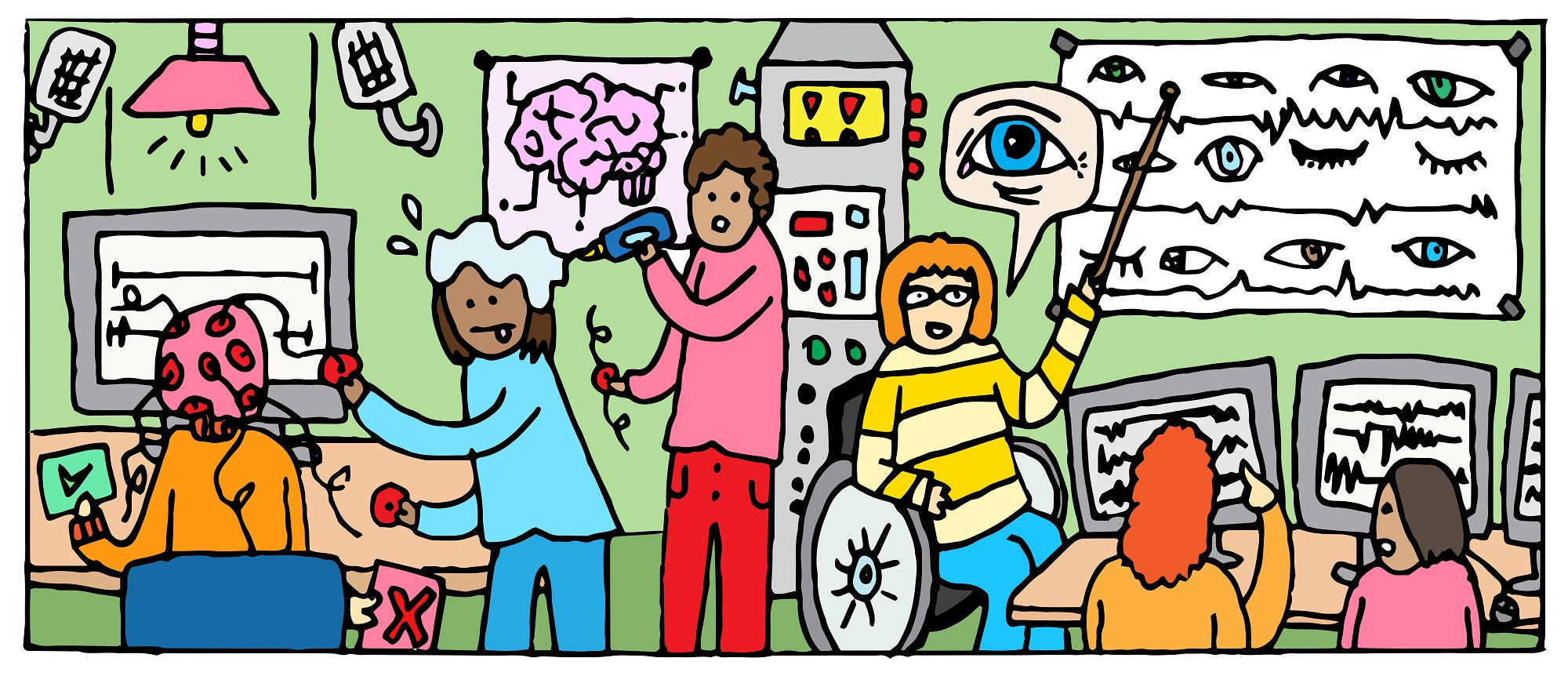
Students play around with gel and stick electrodes on each other during Electrophysiology practical
Gepubliceerd op:-
In the lecture hall
-
Editor Feba Sukmana and illustrator Pauline Wiersema follow a college every month. Together, they describe and depict how teaching is done, what happens in the lecture hall and what students think of the lecture.
EM is looking for the best, funniest or most interesting lectures at EUR. Should we pay your lecturer a visit? Tip us off at [email protected]
De redactie
-
 Feba Sukmana
Editor
-
 Pauline Wiersema
Illustrator
Latest news
-

Away with the ‘profkip’, says The Young Academy
Gepubliceerd op:-
Science
-
-

House of Representatives wants basic grant for university master after HBO
Gepubliceerd op:-
Money
-
Politics
-
-
Company takes a huge chunk of the student finance of at least 350 internationals
Gepubliceerd op:-
Internationalisation
-

Comments
Comments are closed.
Read more in In the lecture hall
-
Students chase away climate anxiety with dance moves
Gepubliceerd op:-
In the lecture hall
-
-
Can you make contraception mandatory for psychiatric patients? Students learn about the health rights of people with disabilities
Gepubliceerd op:-
In the lecture hall
-
-
Why are concert tickets getting pricier? Students delve into the concept of cost disease in the art world.
Gepubliceerd op:-
In the lecture hall
-