Students living away from home get 439 euros, those living at home 110 euros


Starting in September 2023, students living away from home will receive 439 euro of basic grant per month. This includes a temporary inflation compensation of 164 euro per month, which will only be paid in the academic year 2023-2024. Students living at home will have to make do with almost four times less: 110 euros.
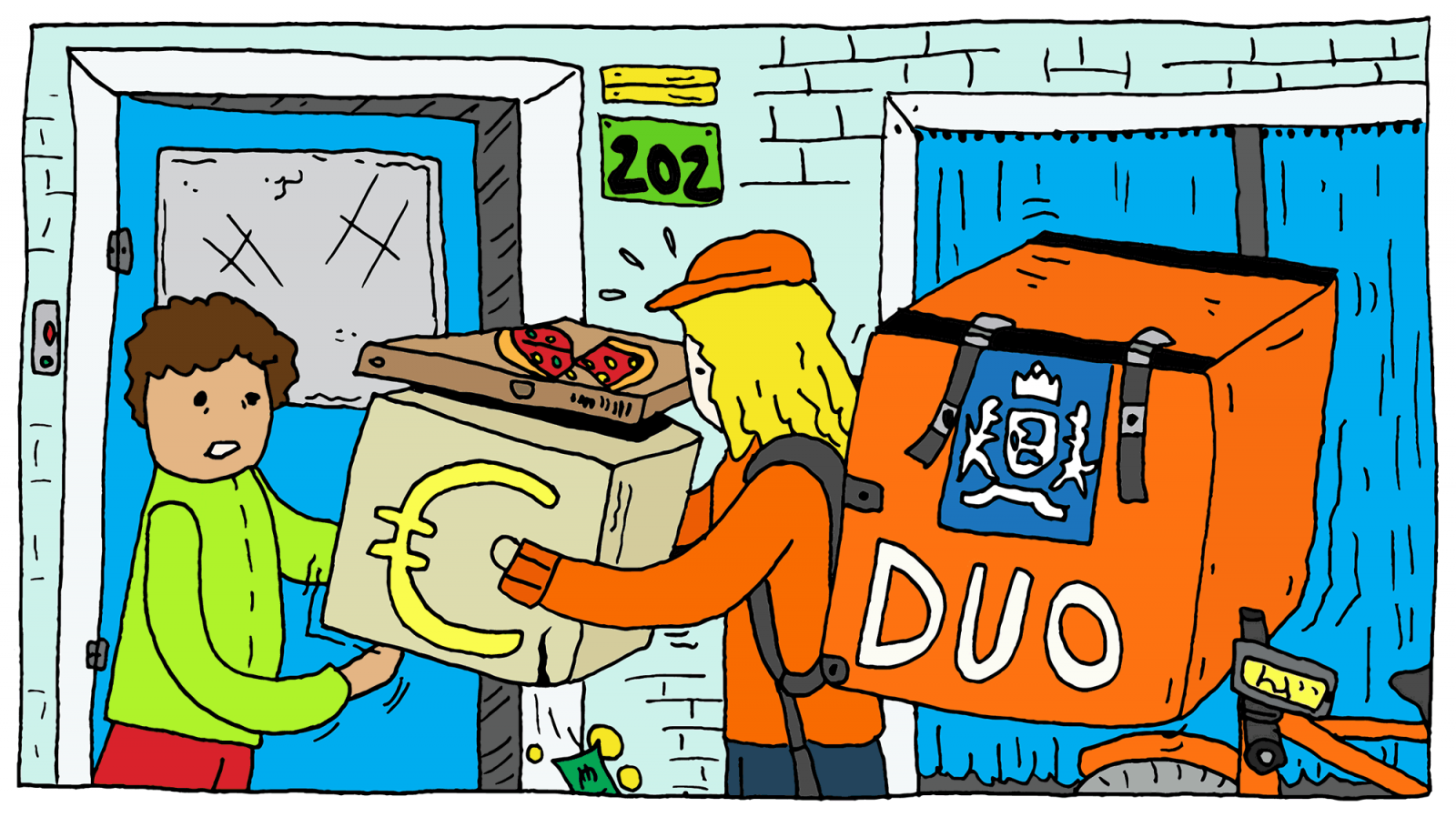
Image by: Pauline Wiersema
This is written in the bill minister Robbert Dijkgraaf of Education, Culture and Science sent to the House of Representatives.
Students living at home are to get 110,30 euros per month. Students living away from home will receive 274,90 euros. The supplementary grant will be a maximum of 416 euros and is subject in part to the parental income.
For the 2023-2024 academic year, there will be an additional 164.30 euros per month for students living away from home. With this, the government wants to compensate students partially for the rapidly rising rate of inflation.
The amounts differ somewhat from previous summaries, but the differences are slight. Only the maximum supplementary grant is particularly striking: the increase is 15 euros per month, in other words 180 euros per year.
It should be noted these amounts are not necessarily a gift. Students get the basic student grant and supplementary grant as a loan, in the same way as the students’ public transport card. They have to graduate within ten years, otherwise they have to pay everything back.
Ray of hope
The bill also deals with interest rates on study debts and the repayment period. Students will indeed pay interest on their student debt, but Dijkgraaf sees a ray of hope: inflation is higher than interest rates, so student debt will be reduced ‘in real terms’.
There will be no cap on the interest rate for now. “Changes in interest rates are unpredictable”, the minister argues. So over a period of 35 years the interest rate can be higher or lower than expected.“On the other hand, in the course of 35 years a debt becomes smaller in real terms if inflation is higher than the interest rate on student debt”, he explains. “That was certainly the case in recent decades.”
'Too low'
The bill was also uploaded online so that people could add comments. The vast majority of respondents considered the amounts too low, Minister Dijkgraaf mentions in his explanatory notes. Respondents refer to inflation and the high housing costs.
But the Minister sees no reason for objection. The basic student grant will “never cover a student’s total costs during the study period”, Dijkgraaf writes. Students, parents and the government always share the costs of education, and the balance is now shifting a little more back towards the government. So students will benefit.
Criticism
In their criticism of the new basic student grant, the student organisations are all somewhat conflicted: on the one hand, it is good that students benefit, but on the other hand they feel the amounts are too low.
For example, the Dutch National Students’ Association (ISO) criticises the 164 euros per month that students living away from home will get for one year to compensate for inflation. Many senior students will not get the money because they are not entitled to the basic student grant or because they are living with their parents, chair Terri van der Velden suggests.
Read more
-

‘Unlucky students’ get up to 3272 euros compensation
Gepubliceerd op:-
Money
-
De redactie
-
 Elmer Smaling
Deputy editor-in-chief
Latest news
-

Letschert gives nothing away in first parliamentary debate
Gepubliceerd op:-
Education
-
Politics
-
-

Away with the ‘profkip’, says The Young Academy
Gepubliceerd op:-
Science
-
-

House of Representatives wants basic grant for university master after HBO
Gepubliceerd op:-
Money
-
Politics
-


Comments
Comments are closed.
Read more in Money
-
House of Representatives wants basic grant for university master after HBO
Gepubliceerd op:-
Money
-
Politics
-
-
New coalition wants basic grant for university master’s after hbo
Gepubliceerd op:-
Money
-