This researcher is developing a nasal spray that offers temporary protection against corona

Being able to attend a crowded concert without worrying about being infected with the coronavirus or take a long-haul flight in a packed plane. This could soon all be possible following research by the Erasmus Medical Centre in collaboration with Columbia University. Rory de Vries and his research team are testing a nasal spray that offers 24-hour protection against infection.

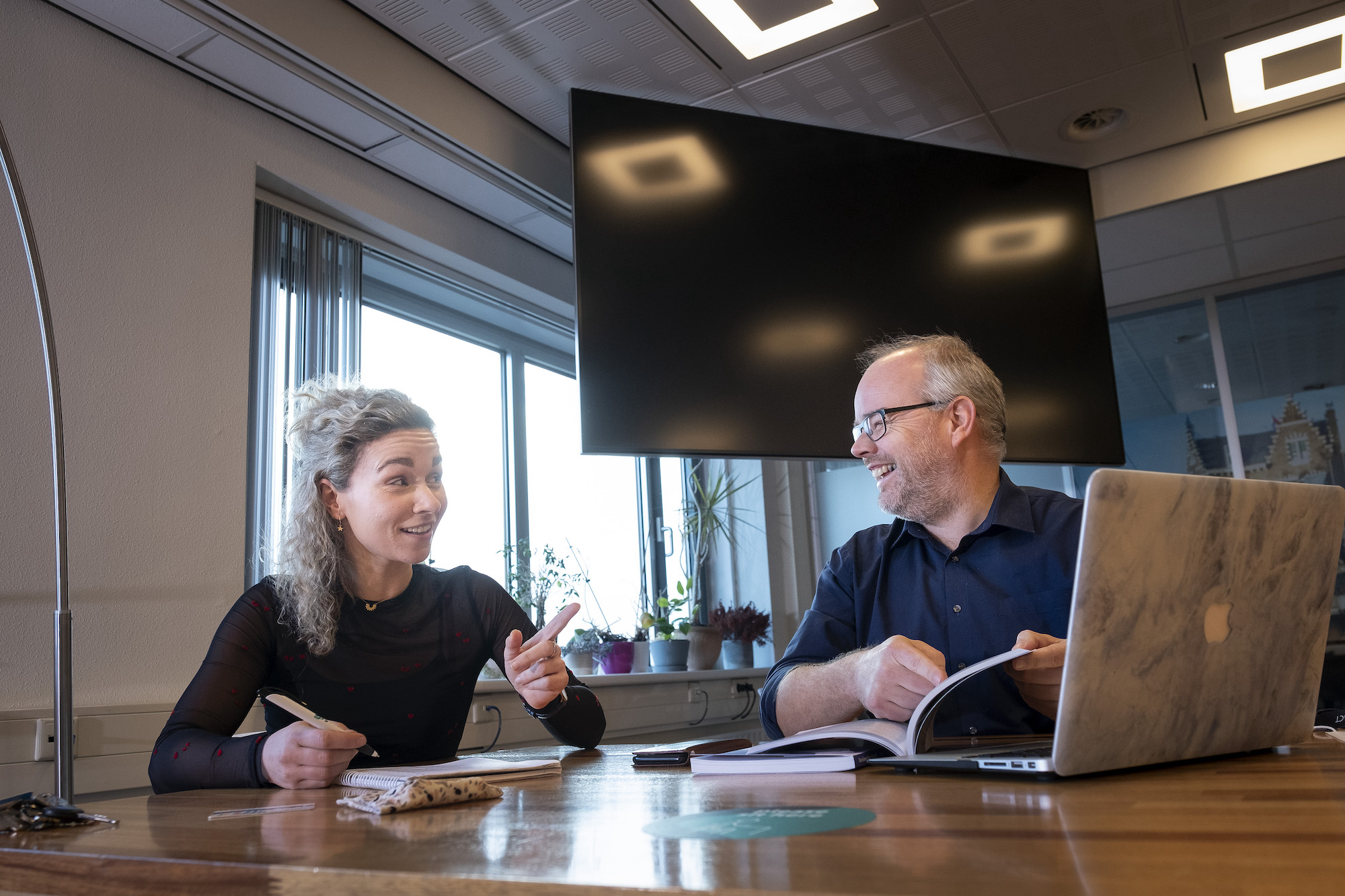
A simple spray that protects you from the virus that has turned the world upside down for over a year now. Sounds almost too good to be true. Rory de Vries, a virologist involved in research into this agent, is seated at his desk in the Erasmus MC research tower. Wearing a sport coat and his baseball cap back to front, he told his story enthusiastically: “At the start of the pandemic, almost all research was suspended in our department, and the only possible exception was for coronavirus research. I’m mainly involved in immunology of viruses transmitted via respiratory aerosols such as measles, but last year that changed when we were approached by a research group from New York. These researchers were working on entry inhibitors, agents that ensure that virus particles cannot enter human cells. Our experience in the field meant we were the right partner to test the agent in laboratory animals.”
24-hour protection
The research is almost at the point that the first studies can be conducted in humans. In animals it has been demonstrated that a SARS-CoV-2 infection is blocked for at least 24 hours. “To infect a human cell, the coronavirus needs to fuse with that cell. The virus surface contains a fusion protein for this; the so-called spike protein. When this is attached to the surface of a cell, under normal circumstances the spike protein will fold down, bringing the virus and cell closer together so that these can fuse. That’s when the pathogenic particles of the virus end up in the cell and you become ill,” explained de Vries.
“You could think of it like doing up a zip. When the spike protein folds, the agent ends up in the folds. “The agent remains between the teeth of the zip as it were, so that the zip can no longer close. The virus particles can then no longer enter the cell and you can’t be infected,” stated De Vries describing the action of the nasal spray.
Read more
-
Corona science: ‘Deciding who is given a bed in the IC ward is a horrible dilemma’
Gepubliceerd op:-
Science
-
Not a silver bullet
In practice this means that you could use the nasal spray on occasions when it’s not possible to keep a distance. For example, if you’re attending a concert or football match or you’re on a long-haul flight. Is De Vries holding a silver bullet? “No. The pitfall is of course that the effect is short-term. Vaccines give real long-term protection, and that’s why vaccination is the best way to stop the pandemic. It is possible that we will need a combination of these types of agents, vaccines and social restrictions to get everything properly under control, but I don’t think you could call it a silver bullet,” he answered while a colleague who is also in the room laughs in protest.
A relationship with the virus
Read more
-

This professor of economics is already trying to draw up the balance sheet of the pandemic
Gepubliceerd op:-
Science
-
The research by De Vries has taken him back to the origins of his interest in virology. As double degree student of Biomedical Sciences and Medicine, it quickly became clear to him that he wanted to be a researcher, so he didn’t bother to finish studying medicine. “My first internship was here at Erasmus MC, and I returned here not long after to start work. What I mainly found interesting was that such simple organisms can have such huge consequences. As virologist, you see the outbreak from the inside, and you have a kind of relationship with the virus. You can test the effect of new measures if you have a better understanding of how the virus works and how it is transmitted,” explained De Vries.
Team effort
De Vries thinks it’s particularly interesting that his and his colleague-virologists’ expertise is now not only being used for fundamental research. The huge patient population at Erasmus MC meant that they were quickly able to do relevant clinical research during the pandemic. “We’re currently conducting several vaccination studies in which we’re testing vaccines among risk groups. Of course, that’s incredibly interesting, because your research is translated directly to people, for example when looking at the impact of the vaccine on vulnerable patients.”
De Vries thinks that the social responsibility of conducting such research during the pandemic has resulted in tighter collaboration within the department. “From the first lockdown, specialists from different areas of expertise came together to focus on a common problem. That resulted in our work being much more of a team effort.”
De redactie
Latest news
-
Pro-Israel demonstration on campus: ‘The text ‘I am a Muslim who supports Israel’ is rather provocative’
Gepubliceerd op:-
Campus
-
Protest
-
-

TU Delft passed columnist’s name to police
Gepubliceerd op:-
Protest
-
-

NOS: Crisis of trust and culture of fear in Erasmus MC intensive care unit
Gepubliceerd op:-
Safety
-

Comments
Comments are closed.
Read more in Science
-
Away with the ‘profkip’, says The Young Academy
Gepubliceerd op:-
Science
-
-

Two Vici grants for researchers ESE and ESPhil
Gepubliceerd op:-
Science
-
-

Participants in dialogue on academic freedom want actions to match words
Gepubliceerd op:-
Science
-