Ad

In de Smitse gets visit from its founder: ‘We had a pub built in secret’

In celebration of Rotterdam School of Management’s fiftieth anniversary, last Friday, In de Smitse was visited by Jaap de Smit, the gentleman to whom the campus bar owes its name – and indeed its very existence.
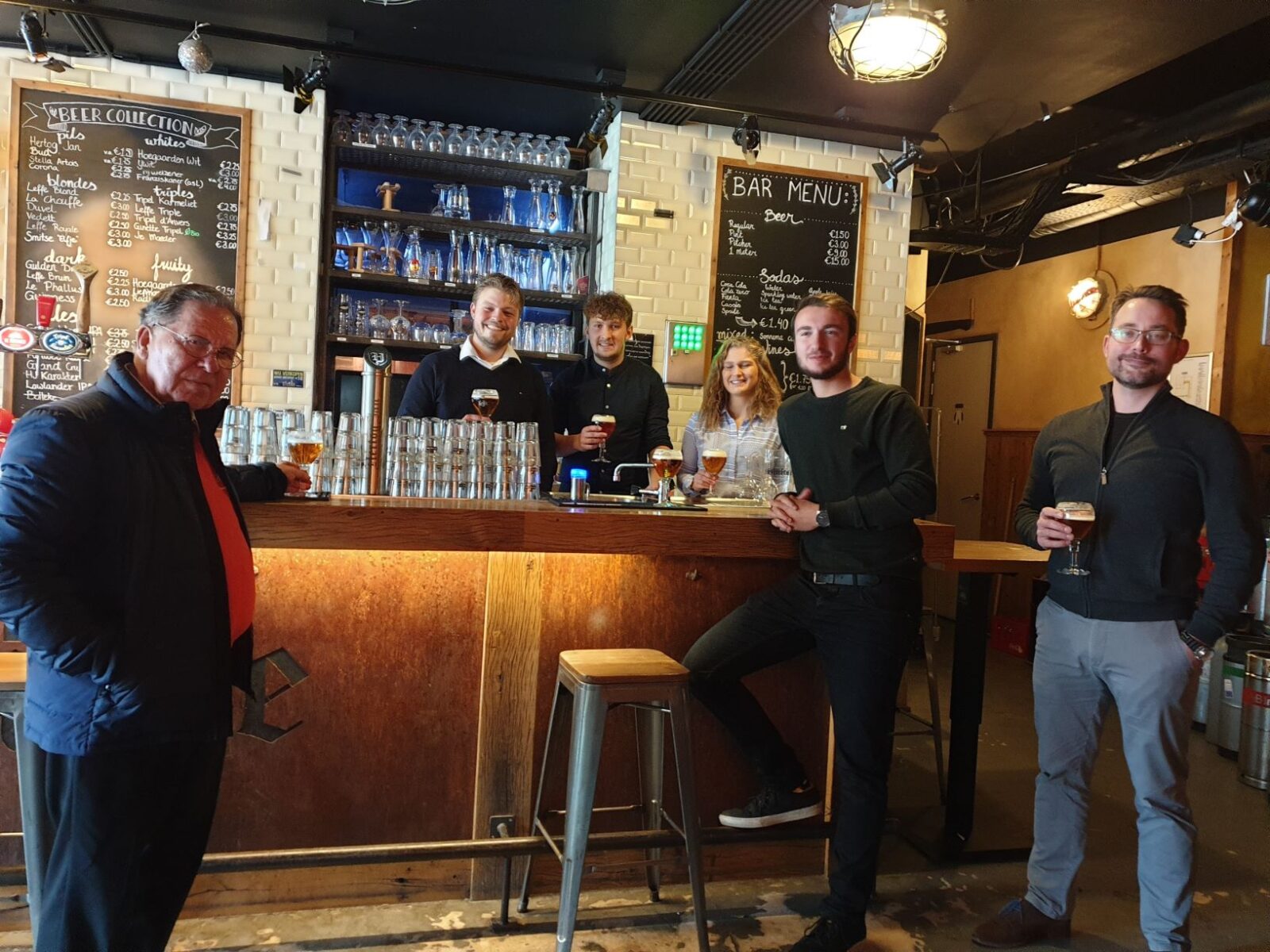
Image by: Feba Sukmana
In de Smitse dates back to the early 1970s. What started as an RSM establishment developed over the years into today’s iconic campus café. “Every campus community in the Netherlands, from Rotterdam to Tilburg, knows In de Smitse,” says the board chair of the bar, Sem Sint Nicolaas, with some pride. In de Smitse is the largest buyer of Hertog Jan beer in the world: in a good year good for some 1,050 hectolitres in sales. In addition, the bar team supply alcoholic beverages to a host of other student events – both on and off campus. “Eurekaweek, music festivals: you name it. Wherever there’s beer, you can expect to find us too.” The bar is currently run by five board members and a team of 25 bartenders.
Iron emblem
Four of the board members welcome Jaap de Smit to In de Smitse at 3 p.m. De Smit is wearing his red RSM jumper under his dark blue jacket and is flanked by his wife Loes and RSM alumnus and corporate historian Ronald van der Heijden, who organised this reception. In honour of the occasion, the board has set up In de Smitse’s iron emblem – its first sign – between two barstools.
“It belongs on that wall over there,” says Sint Nicolaas, pointing to the yellow wall in the back of the bar. Old black and white photos and memorabilia hang on it. “We always keep a sharp eye on this iron emblem. Because of course, it’s precisely the sort of thing that students like to nick,” he says half-jokingly. The sign was made by ‘non-technical students’ in Delft during the subject workshop technology, explains De Smit, ‘at some point in the 70s’. “The emblem actually has a mistake.” He crouches and puts his finger on the letter ‘t’. “You see? If you look hard, you can see there used to be a ‘d’ here instead of a ‘t’.”

Image by: Feba Sukmana
On the sly
Seventy-seven-year-old De Smit is an enthusiastic guide to the café’s history. “When we started on our programme in Kralingen, we could go to Café Stobbe on the corner. But after moving to Delft University of Technology (TU Delft), we didn’t have anything like that.” De Smit worked as director of Stichting Bedrijfskunde, as RSM was known at the time. At their new location in Delft, the students and staff missed a common area where they could get together in an informal atmosphere. So they set up a bar, in an old building. “It was dreadful: the air-conditioning created acoustic bridges between the different rooms, and we had to make a hole in the wall for each of the cooling units.”
Around 1975, De Smit ordered the construction of a new lecture hall – purportedly for conducting experiments. He asked the contractor to put in brown walls. Other items on his wish list included a water supply, drain and electricity, but his application was turned down by TU Delft’s facilities department. “So we decided to have it installed on the sly,” De Smit remembers with a grin. The room’s official name, Lecture Hall 9, was used as a code word among RSM students. It didn’t take long before the bar had attracted an outside sponsor and was rechristened in De Smit’s honour. And when the programme returned to Rotterdam, the café came along too. What is De Smit’s take on the fact that ‘his’ bar can now be found in the Hatta building, right under the student housing units? “Do students live on campus nowadays? Wow, it’s almost as if we’re in America.”
‘Do students live on campus nowadays? Wow, it’s almost as if we’re in America.’
RSM’s fiftieth anniversary
De Smit’s informal visit was arranged in honour of RSM’s anniversary. Corporate historian Ronald van der Heijden is the man responsible for organising today’s visit and the anniversary project as a whole. RSM’s fiftieth anniversary inspired Van der Heijden to delve into the rich past of his own faculty. His findings were the starting point for various interesting initiatives, including videos and a collection of personal reminiscences shared via RSM’s anniversary website. “I’ve been in close touch with Jaap since the start of this project. When I told him I had rounded off my work, this met with a very enthusiastic response. He told me he looked forward to seeing the results,” says Van der Heijden. “So I thought to myself: let’s make it something special!”
The party walks over from In de Smitse to the Mandeville Building, to admire the fruits of Van der Heijden’s labours. As part of the project, the team has put up a timeline for the faculty’s history on the third floor of the building. This shows a selection of highlights from RSM’s 50-year existence. A nine metres long LED panel displays an array of digitised photos and newspaper articles, from 1970 to the present day.
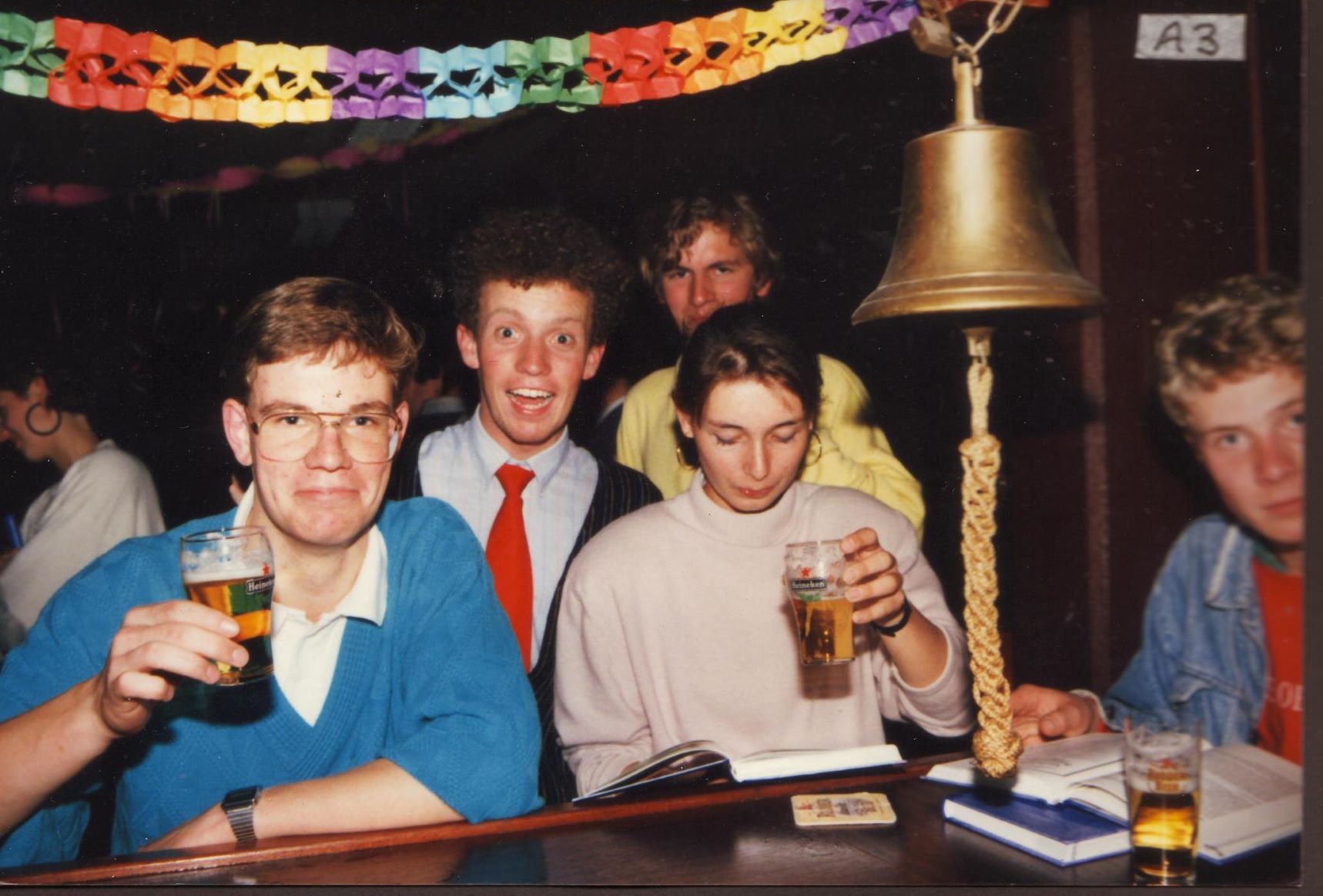
“Hey, you can see my office on this one,” says De Smit, pointing to a picture of RSM’s first premises in Kralingen. “I had the best room in the building, with this hefty two-by-one metre desk. One of my colleagues was looking forward to taking over my room before we left for Delft, but no one could shift my desk. So I sat there nice and tight until the move,” remembers De Smit, with a twinkle in his eye.
Advocate of internationalisation
De Smit is particularly drawn to the mementos of the 1970s. “I remember this nursery school.” He’s pointing to a panorama picture of a lecture. In its second year, the programme was faced with a space shortage, so it regularly used a small primary school on Oude Dijk as a makeshift lecture hall.
De Smit has been a strong advocate of internationalisation from the very start of his career. He laid the groundwork for the faculty’s exchange programmes and believed that RSM should offer its lectures in English. “At one point, I had 47 nationalities in a group of 40 students,” he says with some pride. While diversity and inclusion are fine in themselves, he was driven by more pragmatic considerations: international experiences and familiarity with other cultures will stand you in good stead in the business world. “Say you’re doing business with a German. Who do you think will get the better deal: someone who speaks fluent German, or someone who doesn’t know the first thing about German culture?”
‘You shouldn’t have more than 80 students attending a lecture at a time. Larger numbers affect the group dynamics.’
While De Smit is chuffed that ‘his little school’ has developed into ‘a major international player’, he does feel the programme has become too large. “When we moved from Delft to Rotterdam, we had 500 students. At the time, I already felt the student body had become too large,” he remembers. “Mass-scale education is detrimental to quality. You shouldn’t have more than 80 students attending a lecture at a time. Larger numbers affect the group dynamics.”
After going over the timeline, the group return to In de Smitse to cap off the afternoon. De Smit asks the bartender whether he could have a Leffe Blond, his favourite (“Naturally”). He seems to be getting a bit tired – but with a cool glass of beer in his hand, he doesn’t mind taking one last trip down memory lane. His soft voice and leisurely narration take the audience back to the days when a glass of beer still cost 30 cents.
De redactie
-
 Feba Sukmana
Editor
Latest news
-

New code of conduct for science emphasises ‘distinctiveness and autonomy’
Gepubliceerd op:-
Science
-
-
Executive Board regularly uses AI for speeches and LinkedIn posts
Gepubliceerd op:-
Artificial Intelligence
-
Governance
-
-
TU Delft may not favour women in admissions to courses
Gepubliceerd op:-
Education
-

Comments
Comments are closed.
Ad
Read more in Student life
-

RSC/RVSV accused of poo stunt targeting student houses in Utrecht
Gepubliceerd op:-
Student life
-
-
Carolina could wake up ten minutes before her lectures
Gepubliceerd op:-
Housing
-
-
No joint introduction week for vocational, applied sciences and university students for now
Gepubliceerd op:-
Eurekaweek
-