EUR scholars published in predatory journals

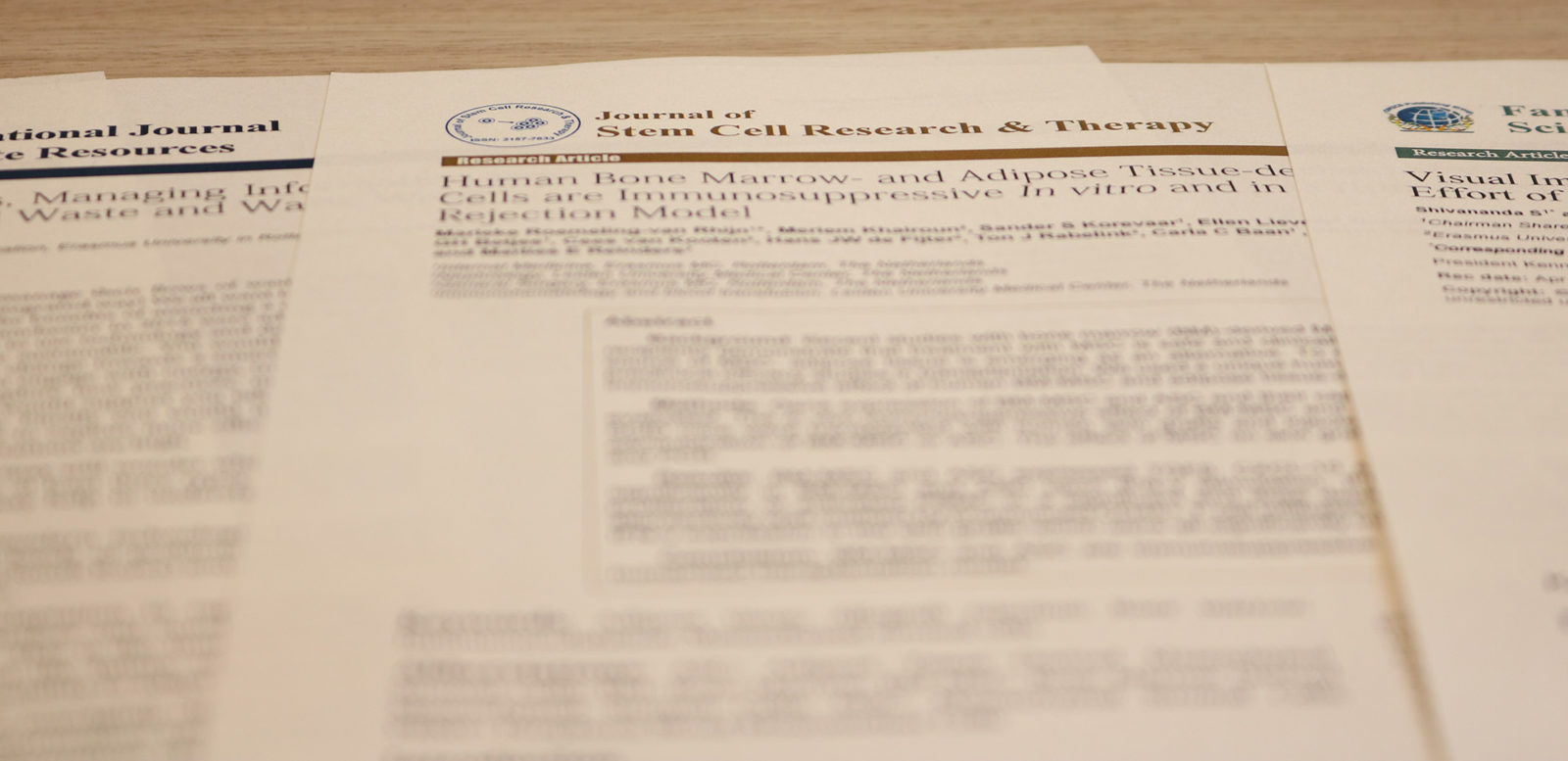
Dutch newspaper De Volkskrant reported on Wednesday that Dutch academics have published hundreds of articles in known predatory academic journals in recent years. Erasmus MC-affiliated scholars such as virologist Ab Osterhaus and psychiatrist Witte Hoogendijk are among those who have published in the journals.
More about scientific publishing
- Erasmus University Rotterdam pays 3 million euros for academic journals
- Elsevier and universities reach agreement over Open Access and subscription
- Europe’s top universities demand open access
The academics can be found in a database drawn up by the International Consortium of Investigative Journalists (ICIJ) , which previously published the infamous Panama Papers. De Volkskrant was the only Dutch medium to be granted permission to inspect the database.
ICIJ’s study focused on two well-known predatory publishers, India’s OMICS, which is alleged to publish over 700 journals, and Turkey’s WASET, which mainly organises conferences and publishes the proceedings. Both companies are currently being investigated by the American justice authorities on charges of fraud and deceit. The Internet is full of warnings posted by concerned or defrauded scholars.
Alternative medicine practitioners
Generally, articles published by such journals were written by PhD students or junior academics and rejected by well-known journals. In many cases, professors will be listed as co-contributors, but their names will be listed last. Upon payment of several hundreds of dollars, predatory journals will publish scholarly articles very promptly, without asking complicated questions or subjecting the articles to a proper peer review. As a result, leading scientists will find themselves published by journals that also publish contributions by companies such as Danone or alternative medicine practitioners. It should be noted that OMICS and WASET contend that their peer review procedures are fine and that they are being falsely accused by the major publishers.
Witte Hoogendijk told De Volkskrant that he does not remember publishing the article released by OMICS. “It looks like the principal author at my previous employer arranged it that way, and I don’t really go in for that kind of publishing business.”
‘Problem on a limited scale’
Matthijs van Otegem, the Director of EUR’s University Library, admits that the EUR-affiliated articles in the fake journals ‘do constitute a problem, but only on a limited scale’. “If people are found out, as they are now, their research will no longer be taken seriously. That is a very bad thing, because once you have published an article, you can’t re-publish it in a proper journal.”
Van Otegem stated that the problem hardly ever occurs at EUR. “Academics are constantly spammed with e-mails by these types of publishers, and the best thing to do is simply to ignore them. Most academics opt for journals with which they are familiar, with high impact factors.” In addition, the library offers a web page featuring tips on how to recognise predatory journals.
Van Otegem did point out that he was not sure whether any EUR academics had voluntarily had any dealings with the journals in which they were published. “There is a possibility that these journals steal articles from proper journals, meaning that academics are published in such journals without actually being aware of it.”
De redactie
-
 Elmer Smaling
Deputy editor-in-chief
Latest news
-

Letschert gives nothing away in first parliamentary debate
Gepubliceerd op:-
Education
-
Politics
-
-
Away with the ‘profkip’, says The Young Academy
Gepubliceerd op:-
Science
-
-

House of Representatives wants basic grant for university master after HBO
Gepubliceerd op:-
Money
-
Politics
-


Comments
Comments are closed.
Read more in Research
-

How investment treaties undermine the voices of local communities
Gepubliceerd op:-
The PhD Defence
-
-

Why it is hard to find a connection between the psychiatric illness and the brain
Gepubliceerd op:-
The PhD Defence
-
-
Investigation into DUO fraud hunt nominated for ‘Loep’
Gepubliceerd op:-
Research
-